
Online Database of Chemicals from Around the World
| Changzhou Ditong Chemical Co., Ltd. | China | |||
|---|---|---|---|---|
 | www.edengenechem.com | |||
 | +86 (519) 8829-8848 +86 18118010980 | |||
 | info@edengenechem.com sale@edengenechem.com | |||
 | QQ Chat | |||
 | WeChat: 18118010980 | |||
| Chemical manufacturer since 2006 | ||||
| chemBlink Premium supplier since 2026 | ||||
| Classification | Organic raw materials >> Carboxylic compounds and derivatives |
|---|---|
| Name | (+)-alpha-Cyclopentylmandelic acid |
| Synonyms | (2R)-2-cyclopentyl-2-hydroxy-2-phenylacetic acid |
| Molecular Structure | 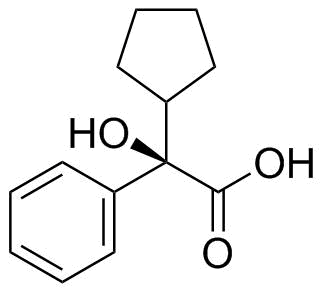 |
| Molecular Formula | C13H16O3 |
| Molecular Weight | 220.26 |
| CAS Registry Number | 64471-45-0 |
| SMILES | C1CCC(C1)[C@@](C2=CC=CC=C2)(C(=O)O)O |
| Density | 1.2±0.1 g/cm3 Calc.* |
|---|---|
| Boiling point | 395.6±22.0 °C 760 mmHg (Calc.)* |
| Flash point | 207.2±18.8 °C (Calc.)* |
| Index of refraction | 1.59 (Calc.)* |
| * | Calculated using Advanced Chemistry Development (ACD/Labs) Software. |
 chemBlink Chemical Story
|
(+)-α-Cyclopentylmandelic acid is a chiral α-hydroxy carboxylic acid belonging to the mandelic acid family. It is structurally derived from mandelic acid by replacing the phenyl group with a cyclopentyl group while retaining the characteristic α-hydroxy acid framework. The compound contains a single stereogenic center and exists as optically active enantiomers, with the (+) designation indicating the dextrorotatory form. The (+) notation specifies the direction of optical rotation but does not, by itself, establish the absolute configuration. Structurally, the molecule consists of a carboxylic acid group and a hydroxyl group attached to the same carbon atom (the α-carbon). This α-carbon is also bonded to a cyclopentyl ring and a hydrogen atom, making it the sole stereogenic center in the molecule. The combination of the hydroxyl and carboxyl groups classifies the compound as an α-hydroxy acid. The carboxylic acid group (–COOH) is the most acidic functional group in the molecule. It contains a carbonyl oxygen and a hydroxyl oxygen that are conjugated through resonance, allowing the corresponding carboxylate anion formed upon deprotonation to be stabilized by delocalization of the negative charge over both oxygen atoms. Under physiological or moderately basic conditions, the compound predominantly exists in its carboxylate form. The hydroxyl group attached to the α-carbon contributes additional polarity and serves as both a hydrogen bond donor and a hydrogen bond acceptor. Because the hydroxyl and carboxyl groups are located on adjacent atoms, they can participate in intramolecular and intermolecular hydrogen-bonding interactions, influencing molecular conformation and crystal packing. The cyclopentyl substituent is a saturated five-membered carbocyclic ring composed entirely of sp3-hybridized carbon atoms. Unlike aromatic substituents, the cyclopentyl ring is nonplanar and adopts dynamic envelope and half-chair conformations to minimize torsional strain. This flexible hydrophobic ring contributes lipophilic character while introducing considerably less rigidity than a phenyl group. The α-carbon adopts tetrahedral geometry and defines the stereochemistry of the molecule. Because it is bonded to four different substituents—the carboxyl group, hydroxyl group, cyclopentyl group, and hydrogen—it gives rise to two enantiomeric forms. Enantiomers possess identical physical properties in achiral environments but differ in their interactions with other chiral molecules and in their optical rotation. From an electronic perspective, the molecule contains localized functional groups rather than an extended conjugated system. The electron-withdrawing effect of the carboxyl group slightly decreases the electron density at the adjacent α-carbon, while the hydroxyl group provides localized polarity through its oxygen atom. Physicochemically, (+)-α-cyclopentylmandelic acid is amphiphilic. The carboxylic acid and hydroxyl groups provide substantial polarity and hydrogen-bonding capability, whereas the cyclopentyl ring contributes hydrophobic character. The balance of these features results in greater solubility in polar organic solvents than in nonpolar solvents, while ionization of the carboxyl group significantly increases aqueous solubility. Chemically, the carboxylic acid group readily undergoes reactions typical of carboxylic acids, including salt formation with bases, esterification with alcohols, and conversion to activated carboxylic acid derivatives. The secondary alcohol can undergo oxidation under appropriate conditions or participate in esterification and etherification reactions while retaining the stereogenic center unless racemization occurs. Overall, (+)-α-cyclopentylmandelic acid is a chiral α-hydroxy carboxylic acid composed of a stereogenic α-carbon bearing hydroxyl, carboxyl, and cyclopentyl substituents. Its combination of a resonance-stabilized carboxylic acid, a hydrogen-bonding hydroxyl group, and a conformationally flexible cyclopentyl ring defines its structural, stereochemical, and physicochemical properties. References 2025. Sofpironium bromide. Pharmaceutical Substances. URL: https://pharmaceutical-substances.thieme.com/lexicon/KD-19-0148 |
| Market Analysis Reports |