
Online Database of Chemicals from Around the World
| Tianjin Zhongxin Chem-tech Co., Ltd. | China | |||
|---|---|---|---|---|
 | www.tjzxchem.com | |||
 | +86 (22) 6688-0623 | |||
 | +86 (22) 8988-0739 ex 8030 | |||
 | sales@tjzxchem.com | |||
| Chemical manufacturer since 2007 | ||||
| chemBlink Standard supplier since 2009 | ||||
| Classification | Organic raw materials >> Organometallic compound >> Organotin |
|---|---|
| Name | Di-n-butyltin di(monobutyl maleate) |
| Synonyms | 4-O-[[(Z)-4-butoxy-4-oxobut-2-enoyl]oxy-dibutylstannyl] 1-O-butyl (Z)-but-2-enedioate |
| Molecular Structure | 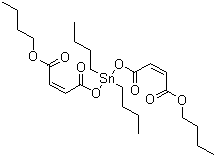 |
| Molecular Formula | C24H40O8Sn |
| Molecular Weight | 575.28 |
| CAS Registry Number | 66010-36-4 |
| EC Number | 239-596-4 |
| SMILES | CCCCOC(=O)/C=CC(=O)O[Sn](OC(=O)/C=CC(=O)OCCCC)(CCCC)CCCC |
| Boiling Point | 535.1±60.0 °C (760 mmHg), Calc.* |
|---|---|
| Flash Point | 277.4±32.9 °C, Calc.* |
| * | Calculated using Advanced Chemistry Development (ACD/Labs) Software. |
| Hazard Symbols |     GHS05;GHS07;GHS08;GHS09 Danger Details GHS05;GHS07;GHS08;GHS09 Danger Details |
|---|---|
| Risk Statements | H302-H314-H373-H400-H410-H411 Details |
| Safety Statements | P260-P264-P270-P273-P280-P301+P317-P301+P330+P331-P302+P361+P354-P304+P340-P305+P354+P338-P316-P319-P321-P330-P363-P391-P405-P501 Details |
 chemBlink Chemical Story
|
Di-n-butyltin di(monobutyl maleate) is a specialized organotin compound that has garnered significant attention due to its unique chemical properties and various industrial applications. This compound is characterized by its dual functionality, combining the characteristics of both organotin and maleate, making it a valuable additive in several formulations. The discovery of di-n-butyltin di(monobutyl maleate) can be attributed to ongoing research in organotin chemistry during the late 20th century. Organotin compounds have been extensively studied for their diverse applications in plastics, agriculture, and coatings. Researchers aimed to develop new derivatives that could enhance the performance of existing materials. Di-n-butyltin di(monobutyl maleate) emerged as a noteworthy candidate due to its excellent stability and effectiveness as a heat stabilizer and modifier for various polymer systems. In terms of its chemical structure, di-n-butyltin di(monobutyl maleate) comprises a tin atom coordinated with two n-butyl groups and two monobutyl maleate ligands. This unique arrangement imparts distinct properties, including thermal stability and resistance to degradation under heat and UV exposure. These characteristics make it particularly suitable for use in polyvinyl chloride (PVC) formulations, where heat stability is crucial during processing. One of the primary applications of di-n-butyltin di(monobutyl maleate) is as a heat stabilizer in the production of PVC and other polymeric materials. Its ability to inhibit the degradation of these polymers during processing at elevated temperatures enhances their longevity and performance. This stabilizing effect is particularly important in applications such as construction materials, automotive parts, and consumer goods, where durability and resistance to environmental stressors are paramount. In addition to its role as a heat stabilizer, di-n-butyltin di(monobutyl maleate) is also utilized as a modifier in various coatings and sealants. It contributes to improved adhesion, flexibility, and weather resistance in these formulations. The compound's incorporation into coatings enhances the performance of paints and varnishes, making them suitable for exterior applications where exposure to harsh environmental conditions is a concern. Moreover, di-n-butyltin di(monobutyl maleate) has gained attention for its potential applications in the agricultural sector. It is being explored as a biocide and fungicide in crop protection formulations. Its effectiveness against various pests and pathogens, combined with its relatively low toxicity to beneficial organisms, makes it an attractive option for sustainable agricultural practices. While di-n-butyltin di(monobutyl maleate) offers several advantages, it is essential to address potential environmental and health concerns associated with organotin compounds. Regulatory agencies worldwide have implemented strict guidelines for the use of organotin-based additives to mitigate their impact on ecosystems. Manufacturers and researchers are continuously working towards developing safer alternatives and minimizing the ecological footprint of such compounds. In conclusion, di-n-butyltin di(monobutyl maleate) represents a significant advancement in organotin chemistry, offering valuable properties for use in various industrial applications. Its discovery reflects the ongoing innovation in material science aimed at enhancing the performance and durability of polymers and coatings while also addressing environmental sustainability concerns. |
| Market Analysis Reports |