Online Database of Chemicals from Around the World

Dibutyltin dichloride
[CAS# 683-18-1]

List of Suppliers
Nantong Advance Chemicals Co., Ltd. China Inquire
www.adv-chem.cn
+86 (513) 8388-7999
8308-4410
+86 (513) 8388-6550
lixiangyang@21cn.com
Chemical manufacturer
chemBlink Standard supplier since 2007
SINOJIE (HK) Limited China Inquire
www.sinojie.com
+86 (21) 5230-3877
+86 (21) 5230-3799
sissizhou@sinojie.com
Chemical manufacturer
chemBlink Standard supplier since 2007
Simagchem Corporation China Inquire
www.simagchem.com
+86 13806087780
+86 (592) 268-0237
sale@simagchem.com
Chemical manufacturer since 2002
chemBlink Standard supplier since 2008
Tianjin Zhongxin Chem-tech Co., Ltd. China Inquire
www.tjzxchem.com
+86 (22) 6688-0623
+86 (22) 8988-0739 ex 8030
sales@tjzxchem.com
Chemical manufacturer since 2007
chemBlink Standard supplier since 2009
Hefei TNJ Chemical Industry Co., Ltd. China Inquire
www.tnjchem.com
+86 (551) 6541-8684
+86 (551) 6541-8697
sales@tnjchem.com
Chemical manufacturer since 2001
chemBlink Standard supplier since 2010
BOC Sciences USA Inquire
www.bocsci.com
+1 (631) 485-4226
+1 (631) 614-7828
info@bocsci.com
Chemical manufacturer
chemBlink Standard supplier since 2010
Intatrade Chemicals GmbH Germany Inquire
www.intatrade.de
+49 (3493) 605-465
+49 (3493) 605-470
sales@intatrade.de
Chemical distributor
chemBlink Standard supplier since 2011
Pure Chemistry Scientific Inc USA Inquire
www.purechems.com
+1 (888) 588-9418
+1 (617) 206-9595
sales@purechems.com
Chemical manufacturer since 2004
chemBlink Standard supplier since 2014
Hangzhou Leap Chem Co., Ltd. China Inquire
www.leapchem.com
+86 (571) 8771-1850
market19@leapchem.com
QQ Chat
Chemical manufacturer since 2006
chemBlink Standard supplier since 2015
ChemPur GmbH Germany Inquire
www.chempur.de
+49 (721) 933-840
+49 (721) 47-2001
info@chempur.de
Chemical manufacturer
Chiron AS Norway Inquire
www.chiron.no
+47 (73) 874-490
+47 (73) 874-499
chiron@chiron.no
Chemical manufacturer
Gelest, Inc. USA Inquire
www.gelest.com
+1 (215) 547-1015
+1 (215) 547-2484
info@gelest.com
Chemical manufacturer

Identification
ClassificationOrganic raw materials >> Organometallic compound >> Organotin
NameDibutyltin dichloride
SynonymsDi-n-Butyldichlorotin
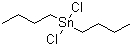
Molecular StructureCAS # 683-18-1, Dibutyltin dichloride
Molecular FormulaC8H18Cl2Sn
Molecular Weight303.83
CAS Registry Number683-18-1
EC Number211-670-0
SMILESCCCC[Sn](CCCC)(Cl)Cl
Properties
Density1.4
Melting point39-41 °C
Boiling point135 °C (10 mmHg)
Flash point112 °C
Water solubility320 mg/L, hydrolises in hot water
Safety Data
Hazard Symbolssymbol symbol symbol symbol symbol   GHS05;GHS06;GHS07;GHS08;GHS09 Danger  Details
Risk StatementsH301-H312-H314-H317-H318-H330-H341-H360-H360FD-H370-H372-H400-H410  Details
Safety StatementsP203-P260-P261-P264-P264+P265-P270-P271-P272-P273-P280-P284-P301+P316-P301+P330+P331-P302+P352-P302+P361+P354-P304+P340-P305+P354+P338-P308+P316-P316-P317-P318-P319-P320-P321-P330-P333+P317-P362+P364-P363-P391-P403+P233-P405-P501  Details
Hazard Classification
up    Details
HazardClassCategory CodeHazard Statement
Acute toxicityAcute Tox.4H312
Germ cell mutagenicityMuta.2H341
Chronic hazardous to the aquatic environmentAquatic Chronic1H410
Acute hazardous to the aquatic environmentAquatic Acute1H400
Skin corrosionSkin Corr.1BH314
Specific target organ toxicity - repeated exposureSTOT RE1H372
Acute toxicityAcute Tox.3H301
Reproductive toxicityRepr.1BH360
Acute toxicityAcute Tox.2H330
Serious eye damageEye Dam.1H318
Acute toxicityAcute Tox.1H330
Skin sensitizationSkin Sens.1H317
Specific target organ toxicity - single exposureSTOT SE1H370
Reproductive toxicityRepr.1BH360FD
Skin corrosionSkin Corr.1H314
Acute toxicityAcute Tox.2H300
Reproductive toxicityRepr.1BH360FD
SDSAvailable
up Discovery and Applications
Dibutyltin dichloride (DBTDC) is an organotin compound with the molecular formula C₈H₁₈Cl₂Sn. It was first synthesized in the early 20th century, with significant contributions from researchers exploring the properties of tin compounds. Notably, the structure and reactivity of dibutyltin dichloride were elucidated in studies during the 1940s and 1950s, leading to its increased prominence in both research and industrial applications.

DBTDC is primarily recognized for its function as a versatile reagent in organic synthesis and catalysis. It serves as a key intermediate in the preparation of various organotin compounds, which find applications across multiple fields, including pharmaceuticals, agriculture, and materials science. Its ability to form stable complexes with various ligands makes it an essential tool in synthetic chemistry.

In organic synthesis, dibutyltin dichloride is employed as a catalyst for a variety of reactions, such as the polymerization of isocyanates and the synthesis of polyurethanes. Its catalytic properties facilitate the formation of complex organic structures, making it valuable in developing new materials. Additionally, DBTDC is utilized in the preparation of organotin derivatives, which possess unique properties suitable for various applications, including biocides and stabilizers.

One of the notable applications of dibutyltin dichloride lies in the field of polymer chemistry. It is often used as a stabilizer in the production of polyvinyl chloride (PVC) and other polymeric materials. By incorporating DBTDC into the formulation, manufacturers can enhance the thermal stability and durability of the final products. This application is particularly important in creating materials for construction, automotive, and consumer goods industries.

In agriculture, dibutyltin dichloride is recognized for its antifungal properties. It is used as a biocide in agricultural formulations to protect crops from various fungal pathogens. Its effectiveness in preventing fungal growth makes it a valuable component in agricultural practices, contributing to improved crop yields and quality.

Despite its beneficial applications, dibutyltin dichloride raises environmental and health concerns. Organotin compounds, including DBTDC, are known to exhibit toxic effects on aquatic life and may pose risks to human health. Consequently, regulatory measures are in place in many regions to limit its use and ensure safe handling practices in industrial settings.

In summary, dibutyltin dichloride is an important organotin compound with diverse applications in organic synthesis, polymer chemistry, and agriculture. Its unique properties and versatility make it a valuable reagent and catalyst in various industrial processes. However, awareness of its environmental and health implications is crucial, prompting ongoing research into safer alternatives and improved regulatory practices.

References

1968. Cyclic glycol ethers derived from dialkylstannanediols. Chemistry of Heterocyclic Compounds.
DOI: 10.1007/bf00664831

2023. New organotin(IV) complexes derived from 1-adamantanethiol: synthesis, crystal structure, DFT calculation, and in vitro antifungal activity and cytotoxicity. Transition Metal Chemistry.
DOI: 10.1007/s11243-023-00528-9

2022. Hollow-Fiber Liquid-Phase Micro-Extraction Method for the Simultaneous Derivatization, Extraction, and Pre-concentration of Organotin Compounds from Packed Fruit Juices. Food Analytical Methods.
DOI: 10.1007/s12161-022-02393-1
Market Analysis Reports
List of Reports Available for Dibutyltin dichloride
Related Products
Dibutyl 2,2'-th...  Dibutyl 3,3'-Th...  3,4-Dibutylthio...  1,3-Dibutyl-2-t...  Dibutyltin bis(...  Dibutyl tin bis...  Dibutyltin bis(...  Dibutyltin Bis(...  Dibutyltin Bis(...  Dibutyltin diac...  Dibutyltin di(2...  Dibutyltin Diis...  Dibutyltin dila...  Di-n-butyltin d...  Dibutyl Tin Dio...  Dibutyl Tin Dis...  Di-n-Butyltin G...  Dibutyltin-3-hy...  Dibutyltin male...  Dibutyltin male...