
Online Database of Chemicals from Around the World
| Simagchem Corporation | China | |||
|---|---|---|---|---|
 | www.simagchem.com | |||
 | +86 13806087780 | |||
 | +86 (592) 268-0237 | |||
 | sale@simagchem.com | |||
| Chemical manufacturer since 2002 | ||||
| chemBlink Standard supplier since 2008 | ||||
| Beijing Eagle Sky Pharmatech Co., Ltd. | China | |||
|---|---|---|---|---|
| www.eagleskypharmatech.com | |||
| +86 (10) 5979-9429 8875-5821 | |||
| +86 (10) 5804-3698 | |||
| sophia_818@126.com contact@eagleskypharmatech.com | |||
 | QQ Chat | |||
| Chemical manufacturer since 2009 | ||||
| chemBlink Standard supplier since 2010 | ||||
| Beijing Lang Rebone Technology Co., Ltd. | China | |||
|---|---|---|---|---|
| www.langrb.com | |||
| +86 (10) 5260-9649 +86 18612220856 | |||
| +86 (10) 8895-6459 | |||
| sales@langrb.com marketing@langrb.com | |||
| QQ Chat | |||
| Chemical manufacturer since 2013 | ||||
| chemBlink Standard supplier since 2013 | ||||
| Accel Pharmtech, LLC | USA | |||
|---|---|---|---|---|
| www.accelpharmtech.com | |||
| +1 (732) 993-9004 | |||
| +1 (732) 289-6244 | |||
| info@accelpharmtech.com | |||
| Chemical manufacturer | ||||
| Carbone Scientific Co., Ltd. | UK | |||
|---|---|---|---|---|
| www.carbonesci.com | |||
| +44 (870) 486-8629 | |||
| +44 (870) 288-7399 | |||
| sales@carbonesci.com | |||
| Chemical distributor | ||||
| Texas Biochemicals Inc. | USA | |||
|---|---|---|---|---|
| www.texasbiochemicals.com | |||
| +1 (979) 696-7070 | |||
| +1 (979) 696-7171 | |||
| info@texasbiochemicals.com | |||
| Chemical manufacturer | ||||
| Classification | API >> Circulatory system medication >> Antiarrhythmic drug |
|---|---|
| Name | Arotinolol hydrochloride |
| Synonyms | 5-(2-(3-(tert-butylamino)-2-hydroxypropylthio)thiazol-4-yl)thiophene-2-carboxamide hydrochloride |
| Molecular Structure | 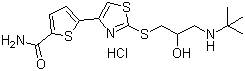 |
| Molecular Formula | C15H21N3O2S3.HCl |
| Molecular Weight | 408.00 |
| CAS Registry Number | 68377-91-3 |
| EC Number | 818-190-6 |
| SMILES | CC(C)(C)NCC(CSC1=NC(=CS1)C2=CC=C(S2)C(=O)N)O.Cl |
| Hazard Symbols |  GHS06 Danger Details GHS06 Danger Details | ||||||||
|---|---|---|---|---|---|---|---|---|---|
| Risk Statements | H301 Details | ||||||||
| Safety Statements | P264-P270-P301+P316-P321-P330-P405-P501 Details | ||||||||
| Hazard Classification | |||||||||
| |||||||||
| SDS | Available | ||||||||
 chemBlink Chemical Story
|
Arotinolol hydrochloride is a synthetic beta-blocker with both alpha- and beta-adrenergic blocking properties. It is primarily used as a pharmaceutical agent to manage conditions related to hypertension and cardiovascular diseases. Arotinolol hydrochloride belongs to a class of compounds known for their ability to reduce heart rate and lower blood pressure by inhibiting the effects of catecholamines on the heart and blood vessels. It was first developed in the 1980s as part of a search for more effective antihypertensive medications with fewer side effects compared to older beta-blockers. The compound is synthesized through a process involving the combination of specific chemical reagents designed to introduce both the alpha- and beta-adrenergic blocking groups into the molecular structure. Arotinolol hydrochloride consists of a phenyl ring attached to an ethanolamine side chain, which is central to its mechanism of action. The hydroxyl group in the side chain is important for its interaction with beta-receptors, while the aromatic ring contributes to its ability to block alpha-receptors. This dual action allows the compound to effectively manage both high blood pressure and conditions like angina, arrhythmias, and heart failure. Arotinolol hydrochloride is mainly used in the treatment of hypertension and as an adjunct in managing other cardiovascular diseases. Its dual action—blocking both alpha and beta receptors—helps reduce peripheral vascular resistance, thereby lowering blood pressure. By reducing heart rate and improving blood flow, it is effective in preventing angina and reducing the risk of myocardial infarction in patients with a history of heart disease. Additionally, it is used in the treatment of heart failure as it can help improve cardiac output while limiting the excessive activation of the sympathetic nervous system that can worsen heart function. In addition to its cardiovascular applications, arotinolol hydrochloride has been studied for its potential use in the treatment of anxiety and panic disorders due to its calming effects on the cardiovascular system. However, its use in this area is less common, and other medications are typically preferred for anxiety management. The side effect profile of arotinolol hydrochloride, including symptoms like dizziness, fatigue, and bradycardia, requires careful monitoring during treatment. In conclusion, arotinolol hydrochloride is a valuable medication in the management of hypertension and various cardiovascular conditions. Its ability to simultaneously block alpha and beta receptors offers a dual therapeutic effect that makes it particularly useful in treating heart-related diseases. Ongoing research into its long-term benefits and potential uses in other medical fields could further enhance its clinical application. References 1979. [Pharmacological properties of dl-2-(3'-t-butylamino-2'-hydroxypropylthio)-4-(5'-carbamoyl-2'-thienyl) thiazole hydrochloride (S-596), a new beta-adrenergic blocking agent (author's transl)]. Nihon yakurigaku zasshi. Folia pharmacologica Japonica. DOI: 10.1254/fpj.75.707 2017. High‐throughput LC-MS/MS method with 96‐well plate precipitation for the determination of arotinolol and amlodipine in a small volume of rat plasma: Application to a pharmacokinetic interaction study. Journal of Separation Science. DOI: 10.1002/jssc.201700784 |
| Market Analysis Reports |