
Online Database of Chemicals from Around the World
| Zhiyi Specialty Chemicals Co., Ltd. | China | |||
|---|---|---|---|---|
 | www.zhiyi-chem.com | |||
 | +86 (20) 3938-8972 3938-8973 | |||
 | +86 (20) 3938-8971 | |||
 | zhiyi@zhiyi-chem.com gary@zhiyi-chem.com | |||
| Chemical manufacturer since 2001 | ||||
| chemBlink Standard supplier since 2007 | ||||
| Nanjing Capatue Chemical Co., Ltd. | China | |||
|---|---|---|---|---|
| www.capatue.com | |||
| +86 (25) 8637-1192 +86 13851602286 | |||
| +86 (25) 8637-1191 ex 0 | |||
| info@capatue.com stephenchow@capatue.com | |||
 | QQ Chat | |||
| Chemical manufacturer | ||||
| chemBlink Standard supplier since 2008 | ||||
| Hefei TNJ Chemical Industry Co., Ltd. | China | |||
|---|---|---|---|---|
| www.tnjchem.com | |||
| +86 (551) 6541-8684 | |||
| +86 (551) 6541-8697 | |||
| sales@tnjchem.com | |||
| Chemical manufacturer since 2001 | ||||
| chemBlink Standard supplier since 2010 | ||||
| Beckmann-Kenko GmbH | Germany | |||
|---|---|---|---|---|
| www.beckmann-kenko.com | |||
| +49 (4241) 930-888 | |||
| +49 (4241) 930-889 | |||
| info@beckmann-kenko.com | |||
| Chemical distributor | ||||
| chemBlink Standard supplier since 2011 | ||||
| Synchemer Co., Limited | China | |||
|---|---|---|---|---|
| www.synchemer.com | |||
| +86 (20) 3668-5350 +86 13556109416 | |||
| +86 (20) 3668-6430 | |||
| info@synchemer.com | |||
| Chemical manufacturer since 2013 | ||||
| chemBlink Standard supplier since 2013 | ||||
| Hangzhou Leap Chem Co., Ltd. | China | |||
|---|---|---|---|---|
| www.leapchem.com | |||
| +86 (571) 8771-1850 | |||
| market19@leapchem.com | |||
| QQ Chat | |||
| Chemical manufacturer since 2006 | ||||
| chemBlink Standard supplier since 2015 | ||||
| Shanghai Deborn Co., Ltd. | China | |||
|---|---|---|---|---|
| www.shdeborn.com | |||
| +86 (21) 6896-2123 +86 18017879299 | |||
| +86 (21) 6896-3669 | |||
| sales@shdeborn.com victorcheng@263.net | |||
| QQ Chat | |||
 | Skype Chat | |||
| Chemical distributor since 2013 | ||||
| chemBlink Standard supplier since 2016 | ||||
| Polyunion Chemicals Limited | China | |||
|---|---|---|---|---|
| www.polyunionchem.com | |||
| +86 (133) 2649-6212 | |||
| polyunionchem@outlook.com | |||
 | WhatsApp:+86-133-2649-6212 | |||
| Chemical distributor since 2016 | ||||
| chemBlink Standard supplier since 2024 | ||||
| Beijing Star-Better Chemical Materials Co., Ltd. | China | |||
|---|---|---|---|---|
| www.starbetter.com | |||
| +86 (10) 8289-5069 | |||
| +86 (10) 8289-5068 | |||
| sales@starbetter.com | |||
| Chemical manufacturer | ||||
| Nanjing Shuguang Chemical Group Co., Ltd. | China | |||
|---|---|---|---|---|
| www.njshuguang.com | |||
| +86 (25) 5220-8383 5225-7373 5220-1088 | |||
| +86 (25) 5220-1288 / 5225-2020 | |||
| market@njshuguang.com | |||
| Chemical manufacturer since 1959 | ||||
| Classification | Catalysts and additives >> Polymer |
|---|---|
| Name | Poly(dicyclopentadiene-co-p-cresol) |
| Molecular Structure | 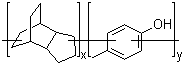 |
| CAS Registry Number | 68610-51-5 |
| EC Number | 271-867-2 |
| SMILES | Cc1ccc(O)cc1.C2CC3C4CCC(C4)C3C2 |
| Density | 1.04 |
|---|---|
| Melting point | 105 °C |
| Hazard Symbols |   GHS07;GHS08 Warning Details GHS07;GHS08 Warning Details | ||||||||||||||||||||||||||||||||
|---|---|---|---|---|---|---|---|---|---|---|---|---|---|---|---|---|---|---|---|---|---|---|---|---|---|---|---|---|---|---|---|---|---|
| Risk Statements | H315-H317-H319-H335-H361-H361d-H413 Details | ||||||||||||||||||||||||||||||||
| Safety Statements | P203-P261-P264-P264+P265-P271-P272-P273-P280-P302+P352-P304+P340-P305+P351+P338-P318-P319-P321-P332+P317-P333+P317-P337+P317-P362+P364-P403+P233-P405-P501 Details | ||||||||||||||||||||||||||||||||
| Hazard Classification | |||||||||||||||||||||||||||||||||
| |||||||||||||||||||||||||||||||||
| SDS | Available | ||||||||||||||||||||||||||||||||
 chemBlink Chemical Story
|
Poly(dicyclopentadiene-co-p-cresol) is a synthetic polymer that has attracted significant attention due to its unique combination of properties, including thermal stability, mechanical strength, and resistance to chemical degradation. The discovery of this polymer was driven by the need for materials that could withstand harsh environmental conditions while maintaining their structural integrity. Poly(dicyclopentadiene-co-p-cresol) is synthesized through the copolymerization of dicyclopentadiene (DCPD) and p-cresol, a process that results in a highly cross-linked network with a rigid backbone. The copolymerization process involves the ring-opening metathesis polymerization (ROMP) of dicyclopentadiene, which is initiated by a transition metal catalyst, typically ruthenium-based. p-Cresol, an aromatic compound, is then introduced into the reaction, where it forms covalent bonds with the DCPD chains. This incorporation of p-cresol enhances the polymer's thermal stability and imparts additional rigidity, making poly(dicyclopentadiene-co-p-cresol) suitable for demanding applications where both heat resistance and mechanical strength are crucial. One of the most significant applications of poly(dicyclopentadiene-co-p-cresol) is in the production of high-performance composites. These composites are used in industries such as aerospace, automotive, and construction, where materials are required to endure extreme temperatures, mechanical stress, and exposure to chemicals. The polymer's ability to maintain its properties under such conditions makes it an ideal matrix material for reinforcing fibers like carbon or glass, resulting in lightweight, durable composites that are essential in these advanced applications. In addition to its use in composites, poly(dicyclopentadiene-co-p-cresol) is employed as a protective coating in industrial settings. The polymer’s excellent resistance to corrosion, combined with its thermal stability, allows it to protect metal surfaces from degradation in harsh environments, such as those found in chemical processing plants, oil refineries, and marine applications. The coating forms a tough, impermeable barrier that prevents moisture, chemicals, and other corrosive agents from reaching the underlying metal, thereby extending the service life of the coated components. The electrical insulation properties of poly(dicyclopentadiene-co-p-cresol) have also led to its use in the electronics industry. The polymer's high dielectric strength and resistance to electrical breakdown make it an effective insulating material for electronic components, particularly those exposed to high temperatures or harsh conditions. Its application in the encapsulation of electronic devices ensures the protection of sensitive components from environmental factors, contributing to the reliability and longevity of the devices. Another area where poly(dicyclopentadiene-co-p-cresol) finds application is in the field of adhesives and sealants. The polymer's strong adhesive properties, combined with its resistance to heat and chemicals, make it suitable for bonding materials in environments where traditional adhesives would fail. This includes applications in the automotive and aerospace industries, where the polymer is used to bond and seal components that are exposed to extreme conditions. Research into poly(dicyclopentadiene-co-p-cresol) continues to explore its potential in new and emerging applications. For instance, its ability to form stable, high-performance networks is being investigated for use in advanced 3D printing technologies, where the polymer could enable the production of complex, high-strength structures. Additionally, efforts are being made to further enhance the polymer's properties through the modification of its chemical structure, opening up new possibilities for its use in a wider range of applications. The development of poly(dicyclopentadiene-co-p-cresol) represents a significant advancement in polymer chemistry, providing industries with a versatile material that meets the demands of modern technology. As research progresses, the applications of this polymer are expected to expand, further solidifying its role in the production of high-performance materials. |
| Market Analysis Reports |