
Online Database of Chemicals from Around the World
| Chengdu Herbpurify Co., Ltd. | China | |||
|---|---|---|---|---|
 | www.scstandards.com | |||
 | +86 028 8265-1368 | |||
 | 2851037747@qq.com | |||
 | QQ Chat | |||
 | WeChat: 18981950076 | |||
| Chemical manufacturer since 2019 | ||||
| chemBlink Standard supplier since 2026 | ||||
| Classification | Organic raw materials >> Ketone compound |
|---|---|
| Name | Betulone |
| Synonyms | 3-Oxobetulin; 1R,3aS,5aR,5bR,7aR,11aR,11bR,13aR,13bR)-3a-(hydroxymethyl)-5a,5b,8,8,11a-pentamethyl-1-prop-1-en-2-yl-2,3,4,5,6,7,7a,10,11,11b,12,13,13a,13b-tetradecahydro-1H-cyclopenta[a]chrysen-9-one |
| Molecular Structure | 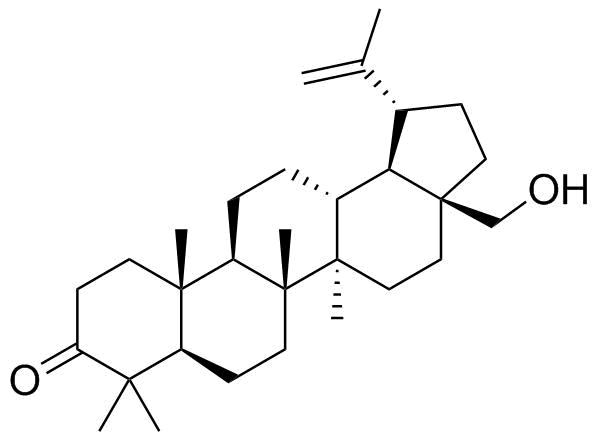 |
| Molecular Formula | C30H48O2 |
| Molecular Weight | 440.70 |
| CAS Registry Number | 7020-34-0 |
| SMILES | CC(=C)[C@@H]1CC[C@]2([C@H]1[C@H]3CC[C@@H]4[C@]5(CCC(=O)C([C@@H]5CC[C@]4([C@@]3(CC2)C)C)(C)C)C)CO |
| Density | 1.0±0.1 g/cm3 Calc.* |
|---|---|
| Boiling point | 520.1±23.0 °C 760 mmHg (Calc.)* |
| Flash point | 219.8±15.2 °C (Calc.)* |
| Index of refraction | 1.519 (Calc.)* |
| * | Calculated using Advanced Chemistry Development (ACD/Labs) Software. |
 chemBlink Chemical Story
|
Betulone is a naturally occurring pentacyclic triterpenoid belonging to the lupane-type family of plant-derived secondary metabolites. It is structurally related to other lupane triterpenes such as betulin, betulinic acid, and lupeol, which are widely distributed in higher plants, particularly in the outer bark of birch species (Betula spp.). Like other triterpenoids, betulone is biosynthesized from the isoprenoid pathway and contains a 30-carbon skeleton derived from the cyclization of squalene. The discovery of betulone is associated with systematic phytochemical investigations of birch bark extracts, which have long been known to contain a rich mixture of triterpenoid compounds. Early studies of Betula species in the nineteenth and twentieth centuries led to the isolation of several structurally related lupane derivatives, initially driven by interest in natural products with potential medicinal properties and industrial applications. As analytical techniques improved, particularly chromatographic separation and spectroscopic identification methods, individual triterpenoids such as betulone were distinguished and structurally characterized within complex plant extract mixtures. Betulone belongs to the lupane skeleton class, which is characterized by a five-ring fused system typical of pentacyclic triterpenes. These compounds arise biosynthetically through enzymatic cyclization of the linear precursor squalene via oxidosqualene cyclases. The resulting triterpene backbone undergoes further enzymatic modifications, including oxidation and rearrangement, to yield a variety of structurally diverse derivatives. Betulone is considered an oxidized derivative within this family, reflecting the chemical diversity generated through plant secondary metabolism. The structure of betulone is closely related to betulin and betulinic acid, differing in the oxidation state at specific positions on the lupane skeleton. Such variations in functional group oxidation significantly influence the physical, chemical, and biological properties of triterpenoids. In general, the presence of carbonyl or hydroxyl groups in lupane derivatives contributes to hydrogen bonding capability and affects solubility and intermolecular interactions. Triterpenoids like betulone are widely studied due to their ecological and biological roles in plants. In many species, these compounds contribute to structural integrity, act as protective agents against pathogens, and participate in defense mechanisms against herbivores and environmental stress. The high abundance of lupane triterpenes in birch bark is thought to be associated with the protective function of bark tissue, where hydrophobic secondary metabolites help form a barrier against water loss and microbial invasion. From a chemical perspective, betulone, like other pentacyclic triterpenes, exhibits low polarity and limited water solubility due to its large hydrocarbon framework. The molecule is predominantly hydrophobic, with localized polar functionality arising from oxygen-containing groups introduced through biosynthetic oxidation. This combination of a rigid hydrocarbon core and limited functionalization makes triterpenoids relatively stable under environmental conditions. Phytochemically, betulone is typically isolated alongside structurally related compounds, requiring chromatographic separation techniques for purification. Analytical characterization of triterpenoids commonly involves nuclear magnetic resonance spectroscopy, mass spectrometry, and infrared spectroscopy, which together allow determination of functional groups and confirmation of the pentacyclic skeleton. The structural similarity among lupane derivatives often necessitates detailed spectroscopic analysis to distinguish individual components. In terms of applications, betulone itself is primarily of interest in natural product chemistry and pharmacological research rather than as a commercial compound. Lupane triterpenoids as a class have been investigated for a range of biological activities, including anti-inflammatory, antimicrobial, and anticancer properties, although specific activity profiles vary significantly depending on functionalization. Betulone contributes to this broader area of research as part of the chemical diversity present in birch-derived triterpene mixtures. Overall, betulone is a lupane-type pentacyclic triterpenoid derived from plant secondary metabolism, structurally related to other birch bark triterpenes. Its significance lies in its role as part of the chemically diverse triterpenoid profile of Betula species and its relevance to studies of natural product biosynthesis, plant defense chemistry, and the structural diversity of isoprenoid-derived compounds. References 2017. Lupane-Type Triterpenes of Phoradendron vernicosum. Journal of Natural Products. DOI: 10.1021/acs.jnatprod.7b00177 2017. Preparation of novel ring-A fused azole derivatives of betulin and evaluation of their cytotoxicity. European Journal of Medicinal Chemistry. DOI: 10.1016/j.ejmech.2016.09.065 2015. Isolation, Structural Modification, and HIV Inhibition of Pentacyclic Lupane-Type Triterpenoids from Cassine xylocarpa and Maytenus cuzcoina. Journal of Natural Products. DOI: 10.1021/np501025r |
| Market Analysis Reports |