
Online Database of Chemicals from Around the World
| Zhejiang Metallurgical Research Institute Co., Ltd. | China | |||
|---|---|---|---|---|
 | www.pgmcatalyst.com | |||
 | +86 (571) 8817-8133 +86 (578) 814-5985 | |||
 | +86 (578) 814-5986 | |||
 | xk@pgmcatalyst.com scm@pgmcatalyst.com ylq@pgmcatalyst.com | |||
| Chemical manufacturer since 1958 | ||||
| chemBlink Standard supplier since 2008 | ||||
| Simagchem Corporation | China | |||
|---|---|---|---|---|
| www.simagchem.com | |||
| +86 13806087780 | |||
| +86 (592) 268-0237 | |||
| sale@simagchem.com | |||
| Chemical manufacturer since 2002 | ||||
| chemBlink Standard supplier since 2008 | ||||
| Sinocompound Catalysts Co., Ltd. | China | |||
|---|---|---|---|---|
| www.sinocompound.com | |||
| +86 (512) 6721-6630 | |||
| +86 (512) 5631-6689 | |||
| sales@sinocompound.com | |||
| Chemical manufacturer since 2008 | ||||
| chemBlink Standard supplier since 2010 | ||||
| Baoji Rock Pharmachem Co., Ltd. | China | |||
|---|---|---|---|---|
| www.bjrock.com | |||
| +86 (10) 8487-1070 8487-1071 8487-1072 | |||
| +86 (10) 8487-1078 | |||
| bjrock@163.com | |||
| Chemical manufacturer since 2003 | ||||
| chemBlink Standard supplier since 2010 | ||||
| BOC Sciences | USA | |||
|---|---|---|---|---|
| www.bocsci.com | |||
| +1 (631) 485-4226 | |||
| +1 (631) 614-7828 | |||
| info@bocsci.com | |||
| Chemical manufacturer | ||||
| chemBlink Standard supplier since 2010 | ||||
| Colonial Metals, Inc. | USA | |||
|---|---|---|---|---|
| www.colonialmetals.com | |||
| +1 (410) 398-7200 (800) 962-1537 | |||
| +1 (410) 398-2918 | |||
| sales@colonialmetals.com | |||
| Chemical manufacturer | ||||
| Anvia Chemicals, LLC | USA | |||
|---|---|---|---|---|
| www.anviachem.com | |||
| +1 (414) 534-7845 | |||
| +1 (414) 762-5539 | |||
| sales@anviachem.com | |||
| Chemical manufacturer | ||||
| Shanghai Worldyang Chemical Co., Ltd. | China | |||
|---|---|---|---|---|
| www.worldyachem.com | |||
| +86 13651600618 +86 (21) 5679-5779 | |||
| +86 (21) 5679-5266 | |||
| sales7777@worldyachem.com | |||
 | QQ Chat | |||
 | WeChat: 13651600618 | |||
 | WhatsApp:+86 13651600618 | |||
| Chemical manufacturer since 2012 | ||||
| Strem Chemicals, Inc. | USA | |||
|---|---|---|---|---|
| www.strem.com | |||
| +1 (978) 499-1600 | |||
| +1 (978) 465-3104 | |||
| info@strem.com | |||
| Chemical manufacturer | ||||
| Classification | Organic raw materials >> Organometallic compound >> Organic ruthenium |
|---|---|
| Name | Rhodium octanoate dimer |
| Synonyms | Rhodium(II) octanoate dimer |
| Molecular Structure | 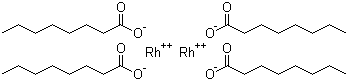 |
| Molecular Formula | C32H60O8Rh2 |
| Molecular Weight | 778.63 |
| CAS Registry Number | 73482-96-9 |
| EC Number | 615-980-0 |
| SMILES | CCCCCCCC1=O[Rh+2]([O-]C(CCCCCCC)=O2)([O-]C(CCCCCCC)=O3)(O=C(CCCCCCC)[O-]4)[Rh+2]234[O-]1 |
| Solubility | Soluble ( hot alcohol, dichloromethane, toluene, acetic acid) (Expl.) |
|---|---|
| Hazard Symbols |  GHS07 Warning Details GHS07 Warning Details | ||||||||||||||||||||||||||||||||
|---|---|---|---|---|---|---|---|---|---|---|---|---|---|---|---|---|---|---|---|---|---|---|---|---|---|---|---|---|---|---|---|---|---|
| Risk Statements | H315-H319-H335 Details | ||||||||||||||||||||||||||||||||
| Safety Statements | P261-P305+P351+P338 Details | ||||||||||||||||||||||||||||||||
| Hazard Classification | |||||||||||||||||||||||||||||||||
| |||||||||||||||||||||||||||||||||
| SDS | Available | ||||||||||||||||||||||||||||||||
 chemBlink Chemical Story
|
Rhodium octanoate dimer is an organometallic complex consisting of two rhodium(I) centers bridged by carboxylate ligands derived from octanoic acid (caprylic acid), a saturated fatty acid with the formula CH3(CH2)6COOH. Its chemical structure typically resembles that of other carboxylate-bridged rhodium dimers, where two rhodium atoms are connected via two bridging octanoate ligands, often forming a square planar geometry around each metal center. This compound belongs to a well-known class of rhodium(I) carboxylates that have been studied and applied extensively in homogeneous catalysis. Rhodium carboxylates are structurally analogous to the more commonly encountered rhodium acetate dimers, such as Rh2(OAc)4, but differ in that the ligand alkyl chain is longer and more hydrophobic, which affects solubility and reactivity in organic media. The synthesis of rhodium octanoate dimer can be achieved by treating a rhodium(I) precursor such as rhodium(I) chloride or rhodium(I) acetate with octanoic acid in the presence of a base or via salt metathesis reactions. Under appropriate conditions, the carboxylate ligand replaces halides or other anions, forming the desired dimeric complex. Structurally, the rhodium octanoate dimer features two rhodium atoms each coordinated in a square planar fashion, with two bridging octanoate ligands between them. The Rh–Rh bond length and geometry can be determined through X-ray crystallography, though detailed crystallographic data on this specific complex may be less abundant than for rhodium acetate analogs. Nonetheless, similar principles of bonding and coordination geometry apply. Rhodium carboxylate dimers, including rhodium octanoate, are often used as catalysts or catalyst precursors in a variety of organic transformations. These include hydroformylation of alkenes, carbonylation reactions, and asymmetric hydrogenation. Their catalytic activity arises from the rhodium center's ability to coordinate unsaturated substrates and facilitate bond-making or bond-breaking processes under mild conditions. In industrial settings, carboxylate rhodium complexes are particularly valued for their solubility in non-polar organic solvents and their compatibility with functionalized substrates. The long-chain alkyl groups of the octanoate ligands improve the complex’s solubility in organic media compared to shorter-chain analogs like rhodium acetate. This makes them useful in reactions where hydrophobic environments or organic-phase catalysis is advantageous. The electron-donating and steric properties of the octanoate ligands influence the reactivity of the rhodium centers, potentially modulating their behavior in catalytic cycles. The relatively low nucleophilicity and moderate basicity of the carboxylate ligands ensure that the rhodium center remains coordinatively unsaturated and available for substrate binding. Analytical techniques used for characterization include infrared (IR) spectroscopy to observe the symmetric and asymmetric stretches of the coordinated carboxylate groups, nuclear magnetic resonance (NMR) spectroscopy for studying ligand environments, and mass spectrometry to confirm the molecular weight and fragmentation pattern. Elemental analysis and thermogravimetric methods may also be applied to assess purity and composition. Rhodium octanoate dimer is typically handled as a solid or dissolved in organic solvents such as toluene, dichloromethane, or hexane. It should be stored under inert atmosphere and protected from moisture and light to preserve its integrity, as rhodium(I) complexes can be sensitive to oxidation and ligand exchange in air or aqueous environments. In summary, rhodium octanoate dimer is a carboxylate-bridged rhodium(I) complex used primarily in homogeneous catalysis. Its structural characteristics and solubility properties make it suitable for organic-phase catalytic transformations, and it plays a role in expanding the toolkit of rhodium-based catalysts beyond the more commonly used acetate-based systems. References 2008. Heterocycles by Cycloadditions of Carbonyl Ylides Generated from Diazo Ketones. Synthesis of Heterocycles via Cycloadditions I, 112. DOI: 10.1007/7081_2007_098 |
| Market Analysis Reports |