
Online Database of Chemicals from Around the World
| Simagchem Corporation | China | |||
|---|---|---|---|---|
 | www.simagchem.com | |||
 | +86 13806087780 | |||
 | +86 (592) 268-0237 | |||
 | sale@simagchem.com | |||
| Chemical manufacturer since 2002 | ||||
| chemBlink Standard supplier since 2008 | ||||
| Chengdu Hongsheng Sci-Tech Development Co., Ltd. | China | |||
|---|---|---|---|---|
| www.cdchemical.com | |||
| +86 (28) 3769-0186 +86 13568974161 | |||
| +86 (28) 8587-6205 | |||
| cdchemical@163.com cdchemi@gmail.com | |||
 | QQ Chat | |||
| Chemical manufacturer since 2009 | ||||
| chemBlink Standard supplier since 2009 | ||||
| Boulder Scientific Company | USA | |||
|---|---|---|---|---|
| www.bouldersci.com | |||
| +1 (970) 535-4494 | |||
| +1 (970) 535-4584 | |||
| sales@bouldersci.com | |||
| Chemical manufacturer | ||||
| Shanghai Worldyang Chemical Co., Ltd. | China | |||
|---|---|---|---|---|
| www.worldyachem.com | |||
| +86 13651600618 +86 (21) 5679-5779 | |||
| +86 (21) 5679-5266 | |||
| sales7777@worldyachem.com | |||
| QQ Chat | |||
 | WeChat: 13651600618 | |||
 | WhatsApp:+86 13651600618 | |||
| Chemical manufacturer since 2012 | ||||
| Classification | Organic raw materials >> Organometallic compound >> Organomagnesium |
|---|---|
| Name | 4-(N,N-Dimethyl)aniline magnesium bromide |
| Synonyms | 4-(Dimethylamino)phenylmagnesium bromide, 4-N,N-Dimethylaminophenylmagnesium bromide, Bromo(4-(dimethylamino)phenyl)magnesium, Bromo[4-(dimethylamino)phenyl]magnesium |
| Molecular Structure | 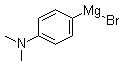 |
| Molecular Formula | C8H10BrMgN |
| Molecular Weight | 224.38 |
| CAS Registry Number | 7353-91-5 |
| EC Number | 615-983-7 |
| SMILES | CN(C)C1=CC=[C-]C=C1.[Mg+2].[Br-] |
| Melting point | 53-54 °C* |
|---|---|
| Boiling point | 65 °C (Expl.) |
| * | Mendel, Arthur |
| Hazard Symbols |  GHS05 Danger Details GHS05 Danger Details | ||||||||||||||||||||||||
|---|---|---|---|---|---|---|---|---|---|---|---|---|---|---|---|---|---|---|---|---|---|---|---|---|---|
| Risk Statements | H314 Details | ||||||||||||||||||||||||
| Safety Statements | P260-P264-P280-P301+P330+P331-P302+P361+P354-P304+P340-P305+P354+P338-P316-P321-P363-P405-P501 Details | ||||||||||||||||||||||||
| Hazard Classification | |||||||||||||||||||||||||
| |||||||||||||||||||||||||
| Transport Information | UN 2924 3/PG 2 | ||||||||||||||||||||||||
| SDS | Available | ||||||||||||||||||||||||
 chemBlink Chemical Story
|
4-(N,N-Dimethyl)aniline magnesium bromide is an organomagnesium halide belonging to the class of Grignard reagents. This compound, with the formula C8H10NMgBr, features a magnesium atom bonded to a bromine atom and the nitrogen of a dimethylaniline group. It is a key reagent in synthetic organic chemistry, enabling the formation of carbon-carbon and carbon-heteroatom bonds through nucleophilic addition or substitution reactions. The discovery and development of Grignard reagents, including derivatives like 4-(N,N-dimethyl)aniline magnesium bromide, trace back to the pioneering work of Victor Grignard in the early 20th century. Grignard’s research established the utility of organomagnesium compounds in forming bonds with electrophiles such as carbonyl compounds, revolutionizing synthetic methodologies. These reagents became indispensable in both academic and industrial chemistry. 4-(N,N-Dimethyl)aniline magnesium bromide is typically prepared by reacting 4-(N,N-dimethyl)aniline with magnesium turnings in the presence of bromine or an alkyl bromide in an anhydrous solvent such as tetrahydrofuran (THF) or diethyl ether. The solvent stabilizes the reactive magnesium center, ensuring the formation and stability of the Grignard reagent. Proper handling is crucial as Grignard reagents are highly reactive and sensitive to moisture and oxygen. This compound finds its primary application in the synthesis of various substituted aromatic compounds. The dimethylaniline group offers electron-donating properties that modulate the reactivity of the Grignard reagent, making it highly suitable for selective functionalization of electrophilic substrates. It is particularly valuable in synthesizing substituted aromatic amines, which serve as intermediates in pharmaceuticals, dyes, and agrochemicals. A significant use of 4-(N,N-dimethyl)aniline magnesium bromide is in the preparation of aromatic ketones through reaction with acyl chlorides or esters. These aromatic ketones are key precursors in the synthesis of active pharmaceutical ingredients and fine chemicals. The reagent also contributes to the synthesis of complex heterocyclic structures by enabling regioselective transformations in multi-step organic synthesis. In addition to its role in small-molecule synthesis, 4-(N,N-dimethyl)aniline magnesium bromide has been explored in polymer chemistry. It enables the functionalization of aromatic polymer backbones, thereby enhancing the mechanical, optical, or electronic properties of materials. Such modifications are critical in the development of advanced polymers for applications in electronics, coatings, and adhesives. The use of 4-(N,N-dimethyl)aniline magnesium bromide is not without challenges. Its high reactivity requires stringent control of reaction conditions, including anhydrous environments and inert atmospheres. Furthermore, the reagent's interaction with sensitive electrophiles must be carefully optimized to avoid side reactions. The versatility and effectiveness of 4-(N,N-dimethyl)aniline magnesium bromide make it a valuable reagent in organic synthesis. It continues to enable innovative transformations, contributing to advancements in pharmaceuticals, materials science, and fine chemical production. References 2012. Preparation of Organoalanes for Organic Synthesis. Topics in Organometallic Chemistry. DOI: 10.1007/3418_2012_36 2010. New Insights into the Copper-Catalyzed Alkylation of Grignard and Organolithium Reagents. Synlett. DOI: 10.1055/s-0029-1219222 1971. Action of grignard reagents on N-acylquinolinium salts in situ. Chemistry of Heterocyclic Compounds. DOI: 10.1007/bf00477403 |
| Market Analysis Reports |