
Online Database of Chemicals from Around the World
| Beijing Eagle Sky Pharmatech Co., Ltd. | China | |||
|---|---|---|---|---|
 | www.eagleskypharmatech.com | |||
 | +86 (10) 5979-9429 8875-5821 | |||
 | +86 (10) 5804-3698 | |||
 | sophia_818@126.com contact@eagleskypharmatech.com | |||
 | QQ Chat | |||
| Chemical manufacturer since 2009 | ||||
| chemBlink Premium supplier since 2010 | ||||
| Classification | API >> Antibiotics >> Peptide drug |
|---|---|
| Name | Elamipretide |
| Synonyms | (2S)-6-amino-2-[[(2S)-2-[[(2R)-2-amino-5-(diaminomethylideneamino)pentanoyl]amino]-3-(4-hydroxy-2,6-dimethylphenyl)propanoyl]amino]-N-[(2S)-1-amino-1-oxo-3-phenylpropan-2-yl]hexanamide |
| Molecular Structure | 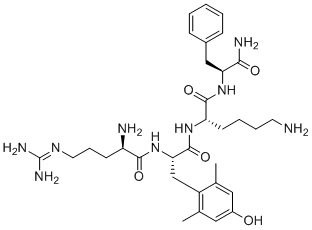 |
| Molecular Formula | C32H49N9O5 |
| Molecular Weight | 639.79 |
| Protein Sequence | RXKF |
| CAS Registry Number | 736992-21-5 |
| SMILES | CC1=CC(=CC(=C1C[C@@H](C(=O)N[C@@H](CCCCN)C(=O)N[C@@H](CC2=CC=CC=C2)C(=O)N)NC(=O)[C@@H](CCCN=C(N)N)N)C)O |
| Density | 1.3±0.1 g/cm3 Calc.* |
|---|---|
| Index of refraction | 1.634 (Calc.)* |
| * | Calculated using Advanced Chemistry Development (ACD/Labs) Software. |
| Hazard Symbols |  GHS07 Warning Details GHS07 Warning Details |
|---|---|
| Risk Statements | H315-H319-H335 Details |
| Safety Statements | P261-P305+P351+P338-P302+P352 Details |
| SDS | Available |
 chemBlink Chemical Story
|
Elamipretide is a mitochondria-targeting peptide drug candidate developed to address mitochondrial dysfunction, which is a contributing factor in a range of degenerative diseases. It is a synthetic tetrapeptide with the sequence D-Arg-dimethylTyr-Lys-Phe-NH2 and is characterized by its ability to selectively localize to the inner mitochondrial membrane where it interacts with cardiolipin, a unique phospholipid essential for mitochondrial structure and function. The discovery of elamipretide originated from research into compounds that could stabilize mitochondrial membranes and improve bioenergetic efficiency. Mitochondria are critical for ATP production and cell survival, and their dysfunction has been implicated in diseases such as heart failure, Barth syndrome, mitochondrial myopathies, and certain types of retinal degeneration. In the late 1990s and early 2000s, scientists at Stealth BioTherapeutics began developing mitochondria-targeted peptides to address these issues, leading to the identification of elamipretide as a lead compound with significant potential for therapeutic application. Elamipretide exerts its primary effects by binding to cardiolipin, stabilizing it and protecting it from peroxidation, which is a key pathway leading to mitochondrial damage. This interaction improves the organization of mitochondrial cristae, enhances electron transport chain efficiency, reduces production of reactive oxygen species (ROS), and ultimately improves ATP synthesis. These effects help to maintain mitochondrial integrity and function under pathological conditions that otherwise lead to energy failure and cell death. In terms of application, elamipretide has been evaluated in a range of clinical settings. One of the most extensively studied indications is heart failure with reduced ejection fraction (HFrEF). In early-phase trials, elamipretide demonstrated improvements in cardiac mitochondrial function and hemodynamics. However, a large phase 2 trial did not meet its primary endpoint, though some secondary endpoints suggested potential benefit. Research is ongoing to further evaluate its effects in cardiomyopathies. Another major application has been in rare mitochondrial disorders. Elamipretide was granted orphan drug status for the treatment of Barth syndrome, a rare X-linked disorder caused by mutations in the TAZ gene that impair cardiolipin remodeling and mitochondrial function. In a phase 2/3 clinical trial, elamipretide showed encouraging effects on cardiac and skeletal muscle performance in some patients. The U.S. FDA has continued to review the data for potential approval under expanded access and compassionate use frameworks. In ophthalmology, elamipretide has been studied for dry age-related macular degeneration (dry AMD), particularly for geographic atrophy, a form of the disease characterized by mitochondrial dysfunction in retinal pigment epithelium. The compound demonstrated early promise in preserving visual acuity and slowing the progression of retinal lesions in phase 1 and 2 trials, although subsequent studies have produced mixed results. Elamipretide is typically administered via subcutaneous or intravenous injection. It is rapidly taken up into tissues and selectively accumulates in mitochondria. Its safety profile has generally been favorable, with the most common side effects including mild injection site reactions and gastrointestinal discomfort. No severe mitochondrial toxicity or off-target effects have been identified in clinical studies to date. Mechanistically, elamipretide represents a novel pharmacologic approach by targeting the inner mitochondrial membrane directly to restore mitochondrial dynamics and function. Unlike traditional antioxidants, which neutralize ROS after formation, elamipretide works upstream by preventing ROS overproduction and improving mitochondrial resilience under stress. This property has positioned it as a prototype for a new class of mitochondria-targeting therapeutics. Ongoing research continues to assess elamipretide’s role in other conditions with a mitochondrial component, including primary mitochondrial myopathies, Friedreich’s ataxia, and chronic kidney disease. Its development has helped advance the broader field of mitochondrial medicine and has catalyzed interest in targeting mitochondrial bioenergetics as a strategy to treat systemic and neurodegenerative diseases. References 2007. Potent mitochondria-targeted peptides reduce myocardial infarction in rats. Coronary Artery Disease, 18(3). DOI: 10.1097/01.mca.0000236285.71683.b6 2024. Genotype-specific effects of elamipretide in patients with primary mitochondrial myopathy: a post hoc analysis of the MMPOWER-3 trial. Orphanet Journal of Rare Diseases, 19(1). DOI: 10.1186/s13023-024-03421-5 2024. Megalin-targeting and ROS-responsive elamipretide-conjugated polymeric prodrug for treatment of acute kidney injury. Biomedicine & Pharmacotherapy, 176. DOI: 10.1016/j.biopha.2024.116804 |
| Market Analysis Reports |