
Online Database of Chemicals from Around the World
| Shanghai 3s Technology Co., Ltd. | China | |||
|---|---|---|---|---|
 | www.3s-tech.net | |||
 | +86 (021) 5290-7809 | |||
 | market@3s-tech.net | |||
| Chemical manufacturer since 2019 | ||||
| chemBlink Standard supplier since 2025 | ||||
| Classification | Chemical reagent >> Organic reagent >> Amide |
|---|---|
| Name | N1-(2,4-Dimethoxybenzyl)-N2-(2-(pyridin-2-yl)ethyl)oxalamide |
| Synonyms | N'-[(2,4-dimethoxyphenyl)methyl]-N-(2-pyridin-2-ylethyl)oxamide |
| Molecular Structure | 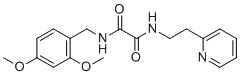 |
| Molecular Formula | C18H21N3O4 |
| Molecular Weight | 343.38 |
| CAS Registry Number | 745047-53-4 |
| SMILES | COC1=CC(=C(C=C1)CNC(=O)C(=O)NCCC2=CC=CC=N2)OC |
| Hazard Symbols |    GHS07;GHS08;GHS09 Danger Details GHS07;GHS08;GHS09 Danger Details |
|---|---|
| Risk Statements | H302-H319-H372-H410 Details |
| Safety Statements | P260-P264-P273-P301+P312-P305+P351+P338-P314 Details |
| SDS | Available |
 chemBlink Chemical Story
|
N1-(2,4-Dimethoxybenzyl)-N2-(2-(pyridin-2-yl)ethyl)oxalamide is a synthetic organic compound belonging to the class of substituted oxalamides. Its structure includes an oxalamide backbone with two distinct N-substituents: one derived from 2,4-dimethoxybenzylamine and the other from 2-(pyridin-2-yl)ethylamine. The presence of both aromatic and heterocyclic moieties contributes to the molecule's potential utility in coordination chemistry and molecular recognition studies. Oxalamide derivatives are widely studied for their ability to engage in multiple hydrogen bonding interactions, owing to the presence of two adjacent amide groups. The oxalamide unit in this compound serves as a rigid linker that maintains spatial orientation between the two nitrogen substituents, which may influence molecular conformation and binding properties. Substitution with a 2,4-dimethoxybenzyl group introduces electron-rich aromatic character, while the 2-(pyridin-2-yl)ethyl moiety provides a site capable of metal coordination or heteroaromatic interactions. The synthesis of N1-(2,4-dimethoxybenzyl)-N2-(2-(pyridin-2-yl)ethyl)oxalamide can be achieved by reacting oxalyl chloride with the respective amines in a stepwise manner under controlled conditions. This type of methodology for preparing asymmetrically substituted oxalamides is well-documented in the literature and allows for precise control over substitution patterns. Purification is typically performed using chromatographic techniques due to the compound's moderate polarity and solubility in common organic solvents. This compound has been studied in the context of supramolecular chemistry, where oxalamide-based ligands are utilized for their hydrogen bonding capabilities and ability to act as bidentate or tridentate ligands in metal coordination complexes. The pyridyl group at the N2 position is particularly significant in this context, as it can coordinate to transition metals such as copper, zinc, or palladium. As a result, derivatives of this type have been examined for use in molecular assemblies, catalytic systems, and crystal engineering. In addition, the presence of the 2,4-dimethoxybenzyl group may impart certain lipophilic and electronic properties that influence the compound’s behavior in chemical and biological systems. Dimethoxybenzyl groups are commonly found in bioactive molecules, and although this compound is not known to be used as a therapeutic agent, its components are structurally related to fragments observed in compounds with neuropharmacological or antimicrobial properties. However, no specific pharmaceutical application has been established for this molecule as of current literature. Oxalamide compounds such as this one are also used in materials chemistry. Their ability to form stable hydrogen-bonded networks can be exploited in the development of functionalized surfaces, organogels, or self-assembled molecular systems. In solid-state studies, oxalamide derivatives are known to display well-defined hydrogen bonding patterns, making them attractive for the design of materials with predictable crystallographic features. In summary, N1-(2,4-dimethoxybenzyl)-N2-(2-(pyridin-2-yl)ethyl)oxalamide is a synthetically accessible oxalamide compound with defined structural features suited for applications in coordination chemistry and supramolecular design. Its combination of a hydrogen-bond-rich oxalamide core, a pyridyl moiety capable of metal binding, and an electron-rich aromatic substituent provides a basis for its use as a ligand or molecular building block in research focused on molecular recognition, catalysis, and materials science. |
| Market Analysis Reports |