
Online Database of Chemicals from Around the World
| Chizhou Dongsheng Pharmaceutical Co., Ltd. | China | |||
|---|---|---|---|---|
 | www.dspharmchem.com | |||
 | +86 (576) 8429-2571 | |||
 | +86 (576) 8429-2560 | |||
 | ksz@dspharmchem.com | |||
| Chemical manufacturer since 1995 | ||||
| chemBlink Premium supplier since 2011 | ||||
| Classification | API >> Digestive system medication >> Liver disease medication |
|---|---|
| Name | Diammonium glycyrrhizinate |
| Synonyms | (2S,3S,4S,5R,6R)-6-[(2S,3R,4S,5S,6S)-2-[[(3S,4aR,6aR,6bS,8aS,11S,12aR,14aR,14bS)-11-carboxy-4,4,6a,6b,8a,11,14b-heptamethyl-14-oxo-2,3,4a,5,6,7,8,9,10,12,12a,14a-dodecahydro-1H-picen-3-yl]oxy]-6-carboxy-4,5-dihydroxyoxan-3-yl]oxy-3,4,5-trihydroxyoxane-2-carboxylic acid azane |
| Molecular Structure | 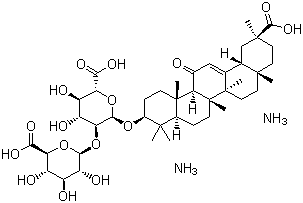 |
| Molecular Formula | C42H62O16.2(NH3) |
| Molecular Weight | 857.00 |
| CAS Registry Number | 79165-06-3 |
| EC Number | 258-887-7 |
| SMILES | C[C@]12CC[C@](C[C@H]1C3=CC(=O)[C@@H]4[C@]5(CC[C@@H](C([C@@H]5CC[C@]4([C@@]3(CC2)C)C)(C)C)O[C@@H]6[C@@H]([C@H]([C@@H]([C@H](O6)C(=O)O)O)O)O[C@H]7[C@@H]([C@H]([C@@H]([C@H](O7)C(=O)O)O)O)O)C)(C)C(=O)O.N.N |
| Boiling point | 1021.4 °C (760 mmHg) |
|---|---|
| Hazard Symbols |  GHS07 Warning Details GHS07 Warning Details |
|---|---|
| Risk Statements | H319 Details |
| Safety Statements | P264+P265-P280-P305+P351+P338-P337+P317 Details |
| SDS | Available |
 chemBlink Chemical Story
|
Diammonium glycyrrhizinate is a chemical compound derived from glycyrrhizic acid, a naturally occurring triterpenoid saponin found in the root of Glycyrrhiza glabra, commonly known as licorice. This compound is distinguished by the presence of two ammonium groups attached to the glycyrrhizinate moiety, which enhances its solubility and stability compared to its parent glycyrrhizic acid. The discovery of diammonium glycyrrhizinate is linked to efforts to improve the pharmacological properties of glycyrrhizic acid. Glycyrrhizic acid itself has long been known for its sweetening properties and has been used in traditional medicine for its anti-inflammatory, antiviral, and hepatoprotective effects. However, its use is limited by poor solubility in water and potential side effects related to sodium retention. Diammonium glycyrrhizinate was developed to address these issues by enhancing solubility and reducing adverse effects. Synthesis of diammonium glycyrrhizinate typically involves the reaction of glycyrrhizic acid with ammonia or ammonium salts under controlled conditions. This chemical modification introduces ammonium groups to the molecule, which improves its solubility in aqueous solutions. This characteristic makes diammonium glycyrrhizinate particularly useful in various pharmaceutical and cosmetic formulations. In the pharmaceutical field, diammonium glycyrrhizinate is valued for its anti-inflammatory and antioxidant properties. It has been incorporated into topical treatments for skin conditions such as dermatitis, eczema, and psoriasis, where it can help reduce inflammation and promote healing. Additionally, it is used in oral formulations to provide liver protection and support digestive health, capitalizing on the hepatoprotective properties of glycyrrhizic acid. In the cosmetic industry, diammonium glycyrrhizinate is utilized for its skin-soothing and anti-inflammatory effects. It is a common ingredient in skincare products aimed at reducing redness and irritation. Its ability to improve skin hydration and barrier function makes it beneficial in products designed for sensitive or dry skin. Its inclusion in cosmetic formulations often helps enhance the overall efficacy of products and contributes to their soothing properties. Diammonium glycyrrhizinate's applications extend beyond pharmaceuticals and cosmetics. Research has explored its potential in various other fields, including its role as an adjunct in cancer therapies and as a component in dietary supplements. Its safety profile and solubility make it a versatile compound for different uses. In summary, diammonium glycyrrhizinate represents an important advancement in the utilization of glycyrrhizic acid. By enhancing solubility and stability, it extends the application range of this valuable natural product, benefiting pharmaceutical, cosmetic, and potentially other industries. Its development underscores the significance of chemical modification in improving the properties and applications of bioactive compounds. References 2024. Antimicrobial Activity of Glycyrrhizinic Acid Is pH-Dependent. ACS Applied Bio Materials, 7(11). DOI: 10.1021/acsabm.4c00942 2024. Glycyrrhizic Acid Formulated in Hydrotalcite Nanocarriers Intended to Act as a Hepatoprotective Agent. The AAPS Journal, 26(6). DOI: 10.1208/s12248-024-00986-8 2012. Phenotypic and functional maturation of murine dendritic cells (DCs) induced by purified Glycyrrhizin (GL). International Immunopharmacology, 12(3). DOI: 10.1016/j.intimp.2012.01.006 |
| Market Analysis Reports |