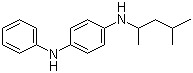
N-(1,3-Dimethylbutyl)-N'-phenyl-p-phenylenediamine, commonly known as 6PPD, is a substituted p-phenylenediamine antidegradant widely associated with tire and rubber technology. For decades, its principal story was an engineering success: a relatively small additive could protect rubber against ozone, oxygen, heat, and repeated flexing, extending the useful life of products exposed to demanding conditions. In the twenty-first century, however, 6PPD became the center of a remarkable environmental chemistry story after researchers discovered that one of its transformation products, 6PPD-quinone, was responsible for acute mortality in coho salmon exposed to urban stormwater.
The original problem solved by 6PPD is rooted in the molecular structure of rubber. Natural rubber and several synthetic elastomers contain carbon-carbon double bonds that contribute to their useful mechanical properties but are vulnerable to oxidation and ozonation. Atmospheric ozone is especially aggressive toward stretched unsaturated rubber. Even at low concentrations, it can attack double bonds and initiate characteristic cracks that grow under mechanical stress.
Rubber manufacturers therefore use antidegradants that react preferentially with damaging chemical species. 6PPD combines antioxidant and antiozonant functions. Instead of allowing ozone and oxidative radicals to attack the polymer network unchecked, the additive participates in sacrificial reactions that consume the damaging species. Its ability to migrate within rubber also helps replenish antidegradant near exposed surfaces. This combination of chemical reactivity and mobility contributed to the widespread use of 6PPD in tire formulations and other rubber products.
For many years, the environmental story of tire wear focused mainly on particles themselves. Tires gradually lose material through abrasion, releasing complex mixtures containing rubber polymers, fillers, metals, processing chemicals, and additives. Rain can wash these materials from roads into streams. In the Pacific Northwest of North America, researchers had observed a particularly dramatic phenomenon: adult coho salmon returning to urban streams sometimes died rapidly after exposure to stormwater, often before they could spawn.
The cause remained mysterious for years. Researchers eventually linked the mortality to roadway runoff and tire-wear particles, but identifying the responsible molecule required sophisticated analytical chemistry. In 2020, Tian and colleagues reported the isolation and identification of a previously unrecognized tire-derived transformation product. They named it 6PPD-quinone, or 6PPD-Q, because it forms through oxidation of 6PPD.
The discovery transformed understanding of the problem. The chemical intentionally added to tires was not itself the entire story. 6PPD reacts with ozone and other oxidants during tire use and environmental exposure, producing 6PPD-Q. Experiments showed that 6PPD-Q is acutely toxic to coho salmon at very low concentrations. Subsequent research demonstrated striking differences in sensitivity among fish species, making the ecological chemistry more complex than a simple universal toxicity response.
The finding also changed how scientists think about chemical risk. Traditional assessment often focuses on the substance deliberately manufactured and added to a product. The 6PPD story demonstrated why transformation products may be equally important. A useful additive can undergo predictable chemistry during its working life and generate a new molecule with very different environmental properties.
This discovery triggered extensive research into tire-derived chemicals, stormwater treatment, environmental monitoring, alternative antidegradants, and the mechanisms underlying 6PPD-Q toxicity. Regulatory agencies and tire manufacturers have also begun evaluating alternatives, although replacing 6PPD is technically challenging. Any substitute must protect rubber effectively for years under ozone, heat, mechanical stress, and changing weather while also meeting manufacturing, performance, safety, and environmental requirements.
6PPD therefore occupies an unusual place in modern applied chemistry. It remains an example of highly effective materials engineering, but it has also become a case study in unintended environmental transformation. Its story connects polymer chemistry, transportation, analytical chemistry, toxicology, ecology, and urban stormwater management.
The lesson extends far beyond tires. Designing a chemical for a product is no longer enough. Modern chemistry increasingly has to ask what that molecule becomes while performing its job and where those transformation products travel afterward. In the case of 6PPD, solving a decades-old mystery about dying salmon began with precisely that question.
References
1. Tian, Z. et al. (2021). "A ubiquitous tire rubber-derived chemical induces acute mortality in coho salmon." Science, 371, 185-189. https://doi.org/10.1126/science.abd6951
2. Tian, Z. et al. (2022). "6PPD-Quinone: Revised toxicity assessment and quantification with a commercial standard." Environmental Science & Technology Letters, 9, 140-146. https://doi.org/10.1021/acs.estlett.1c00910
3. Brinkmann, M. et al. (2022). "Acute toxicity of the tire rubber-derived chemical 6PPD-quinone to four fishes of commercial, cultural, and ecological importance." Environmental Science & Technology Letters, 9, 333-338. https://doi.org/10.1021/acs.estlett.2c00050
4. U.S. Environmental Protection Agency. 6PPD-quinone. Research and information on tire-derived 6PPD-Q and aquatic ecosystems. https://www.epa.gov/chemical-research/6ppd-quinone
|






 GHS07;GHS08;GHS09 Danger Details
 chemBlink Chemical Story