
Online Database of Chemicals from Around the World
| Nanjing Lifenergy R & D Co., Ltd. | China | |||
|---|---|---|---|---|
 | www.njsmn.com | |||
 | +86 (25) 8481-5560 | |||
 | +86 (25) 8481-5560 | |||
 | hegxnew@163.com | |||
| Chemical manufacturer since 1999 | ||||
| chemBlink Standard supplier since 2007 | ||||
| Simagchem Corporation | China | |||
|---|---|---|---|---|
| www.simagchem.com | |||
| +86 13806087780 | |||
| +86 (592) 268-0237 | |||
| sale@simagchem.com | |||
| Chemical manufacturer since 2002 | ||||
| chemBlink Standard supplier since 2008 | ||||
| Zhejiang Ouhua Chemical Imp. & Exp. Co., Ltd. | China | |||
|---|---|---|---|---|
| www.ouhuachem.com | |||
| +86 (576) 8882-6717 | |||
| +86 (576) 8882-8330 | |||
| ouhuachem@gmail.com | |||
| Chemical distributor | ||||
| chemBlink Standard supplier since 2009 | ||||
| Hefei TNJ Chemical Industry Co., Ltd. | China | |||
|---|---|---|---|---|
| www.tnjchem.com | |||
| +86 (551) 6541-8684 | |||
| +86 (551) 6541-8697 | |||
| sales@tnjchem.com | |||
| Chemical manufacturer since 2001 | ||||
| chemBlink Standard supplier since 2010 | ||||
| BOC Sciences | USA | |||
|---|---|---|---|---|
| www.bocsci.com | |||
| +1 (631) 485-4226 | |||
| +1 (631) 614-7828 | |||
| info@bocsci.com | |||
| Chemical manufacturer | ||||
| chemBlink Standard supplier since 2010 | ||||
| Hangzhou Leap Chem Co., Ltd. | China | |||
|---|---|---|---|---|
| www.leapchem.com | |||
| +86 (571) 8771-1850 | |||
| market19@leapchem.com | |||
 | QQ Chat | |||
| Chemical manufacturer since 2006 | ||||
| chemBlink Standard supplier since 2015 | ||||
| Jinan Yufeng Bioengineering Co., Ltd. | China | |||
|---|---|---|---|---|
| www.yufengpharm.com | |||
| +86 (531) 8313-0528 | |||
| +86 (531) 8313-0526 | |||
| sales@yufengpharm.com | |||
| Chemical manufacturer since 2012 | ||||
| chemBlink Standard supplier since 2015 | ||||
| Carbosynth China Ltd. | China | |||
|---|---|---|---|---|
| www.carbosynth.cn | |||
| +86 (512) 6260-5585 | |||
| +86 (512) 6260-5576 | |||
| sales@carbosynth.com | |||
| QQ Chat | |||
| Chemical manufacturer since 2006 | ||||
| chemBlink Standard supplier since 2016 | ||||
| Shanghai Yingrui Biopharm Co., Ltd. | China | |||
|---|---|---|---|---|
| www.shyrchem.com | |||
| +86 (21) 3358-5366 3466-6753 +86 13311639313 | |||
| +86 (21) 3497-9012 | |||
| sales02@shyrchem.com | |||
| QQ Chat | |||
 | Skype Chat | |||
| Chemical manufacturer since 2009 | ||||
| chemBlink Standard supplier since 2017 | ||||
| Hubei Teyer Pharmaceutical Co., Ltd. | China | |||
|---|---|---|---|---|
| www.hubeiteyer.com | |||
| +86 (728) 533-2622 | |||
| info@hubeiteyer.com | |||
| Chemical manufacturer since 2002 | ||||
| Santa Cruz Biotechnology, Inc. | USA | |||
|---|---|---|---|---|
| www.scbt.com | |||
| +1 (831) 457-3800 | |||
| +1 (831) 457-3801 | |||
| scbt@scbt.com | |||
| Chemical manufacturer | ||||
| Classification | API >> Circulatory system medication >> Antiarrhythmic drug |
|---|---|
| Name | Esmolol hydrochloride |
| Synonyms | Methyl 3-[4-(2-hydroxy-3-propan-2-ylamino-propoxy)phenyl]propanoate hydrochloride; Brevibloc |
| Molecular Structure | 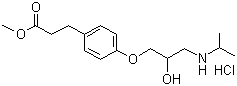 |
| Molecular Formula | C16H25NO4.HCl;C16H26ClNO4 |
| Molecular Weight | 331.15 |
| CAS Registry Number | 81161-17-3 |
| EC Number | 636-017-0 |
| SMILES | CC(C)NCC(COC1=CC=C(C=C1)CCC(=O)OC)O.Cl |
| Density | 1.026 g/mL |
|---|---|
| Melting point | 48-50 °C |
| Water solubility | Slightly soluble 10 mM (Expl.) |
| Hazard Symbols |   GHS06;GHS07 Danger Details GHS06;GHS07 Danger Details | ||||||||||||||||||||
|---|---|---|---|---|---|---|---|---|---|---|---|---|---|---|---|---|---|---|---|---|---|
| Risk Statements | H301-H311-H319-H331 Details | ||||||||||||||||||||
| Safety Statements | P261-P262-P264-P264+P265-P270-P271-P280-P301+P316-P302+P352-P304+P340-P305+P351+P338-P316-P321-P330-P337+P317-P361+P364-P403+P233-P405-P501 Details | ||||||||||||||||||||
| Hazard Classification | |||||||||||||||||||||
| |||||||||||||||||||||
| SDS | Available | ||||||||||||||||||||
 chemBlink Chemical Story
|
Esmolol hydrochloride is a short-acting beta-blocker that is primarily used in the management of acute cardiovascular conditions, particularly in situations requiring rapid onset and quick offset of action. It is a selective beta-1 adrenergic receptor antagonist, which means it primarily affects the heart, reducing heart rate and myocardial contractility without significant effects on beta-2 receptors, which are more involved in smooth muscle relaxation. Esmolol was developed in the 1980s as a drug designed for intravenous (IV) use in acute clinical settings. It has a very short half-life, typically between 9 to 30 minutes, making it ideal for use in situations where rapid titration is necessary, such as controlling acute episodes of supraventricular tachycardia (SVT), managing perioperative hypertension, or stabilizing heart rate during certain surgical procedures. The rapid onset and offset of action allow for precise control of the drug’s effects and easy adjustment during treatment. The main mechanism of action of esmolol is its ability to block the beta-1 receptors in the heart, leading to a decrease in heart rate (negative chronotropic effect), reduced myocardial contractility (negative inotropic effect), and a reduction in myocardial oxygen demand. This makes it effective in treating conditions like tachycardia, atrial fibrillation, and other arrhythmias where the heart rate needs to be controlled urgently. Esmolol also reduces blood pressure through its effects on the heart, making it beneficial in the management of hypertensive emergencies, particularly when rapid blood pressure reduction is required. Esmolol is primarily administered intravenously, as its rapid metabolism and short half-life make oral administration unsuitable. The drug is rapidly hydrolyzed in the blood by esterases, which results in its quick elimination. This characteristic of esmolol is especially advantageous in emergency settings, where the physician may need to rapidly discontinue treatment without leaving long-lasting effects. For example, if a patient experiences side effects or if the desired therapeutic effect is achieved, the infusion can be stopped immediately, and the effects will wear off within minutes. In clinical practice, esmolol is commonly used in emergency rooms, intensive care units (ICUs), and perioperative settings. It is particularly useful in managing situations such as acute SVT, where the heart rate is dangerously high and needs to be brought under control rapidly. Esmolol has also been used to manage tachycardia during surgery or after surgery, particularly for patients undergoing high-risk procedures or those with pre-existing heart conditions. The drug is also used to treat postoperative hypertension and in cases of acute myocardial ischemia, where controlling the heart rate and reducing the demand on the heart is critical. Additionally, esmolol has been employed to manage conditions like thyrotoxicosis or pheochromocytoma, which can cause significant tachycardia and hypertension. Esmolol is generally well tolerated when used appropriately, with side effects typically being mild and related to its heart rate-lowering effects. The most common side effects include bradycardia (slow heart rate), hypotension (low blood pressure), and fatigue. In rare cases, more severe reactions can occur, such as severe hypotension, heart block, or bronchospasm, particularly in patients with pre-existing respiratory conditions like asthma or chronic obstructive pulmonary disease (COPD). As with other beta-blockers, esmolol should be used cautiously in patients with a history of heart failure, as it can further reduce myocardial contractility in these individuals. Esmolol is contraindicated in patients with certain conditions, such as second- or third-degree heart block, sinus bradycardia, or decompensated heart failure, unless a temporary pacemaker is in place. It is also contraindicated in patients with known hypersensitivity to the drug or its components. While esmolol is effective in acute settings, it is not typically used for long-term management of chronic conditions like hypertension or chronic arrhythmias due to its short duration of action. For these chronic conditions, longer-acting beta-blockers such as metoprolol or atenolol are preferred. In summary, esmolol hydrochloride is a short-acting beta-blocker with a rapid onset and quick offset of action, making it a useful drug in the acute management of cardiovascular conditions, particularly in emergency and perioperative settings. Its ability to control heart rate and blood pressure without prolonged effects allows for precise management of patients experiencing tachycardia, arrhythmias, or hypertensive crises. However, its use is reserved for short-term treatment, and it is not suitable for long-term control of cardiovascular diseases. References 1983. First ultra-short-acting beta-adrenergic blocking agent: Its effect on size and segmental wall dynamics of reperfused myocardial infarcts in dogs. The American Journal of Cardiology, 51(10). DOI: 10.1016/0002-9149(83)90224-2 2024. The role of esmolol in sepsis: a meta-analysis based on randomized controlled trials. BMC Anesthesiology, 24(1). DOI: 10.1186/s12871-024-02714-3 2024. Perioperative effects of different hypotensive anesthesia techniques in orthognathic surgery. Medicina oral, pathology oral y surgery bucal, 29(5). DOI: 10.4317/medoral.26662 |
| Market Analysis Reports |