
Online Database of Chemicals from Around the World
| Hangzhou Verychem Science And Technology Co., Ltd. | China | |||
|---|---|---|---|---|
 | www.verychem.com | |||
 | +86 (571) 8816-2785 +86 13606544505 | |||
 | +86 (571) 8816-2787 | |||
 | lucy@verychem.com | |||
| Chemical manufacturer since 2004 | ||||
| chemBlink Massive supplier since 2021 | ||||
| Simagchem Corporation | China | |||
|---|---|---|---|---|
| www.simagchem.com | |||
| +86 13806087780 | |||
| +86 (592) 268-0237 | |||
| sale@simagchem.com | |||
| Chemical manufacturer since 2002 | ||||
| chemBlink Standard supplier since 2008 | ||||
| HBCChem, Inc. | USA | |||
|---|---|---|---|---|
| www.hbcchem-inc.com | |||
| +1 (510) 219-6317 | |||
| +1 (510) 675-0318 | |||
| sales@hbcchem-inc.com | |||
| Chemical manufacturer | ||||
| chemBlink Standard supplier since 2008 | ||||
| Changzhou Tianhua Pharmaceutical Co., Ltd. | China | |||
|---|---|---|---|---|
| www.tianhuachem.com | |||
| +86 (519) 8289-1186 | |||
| +86 (519) 8289-9734 | |||
| tianhua@tianhuachem.com ctianhua@hotmail.com | |||
 | QQ Chat | |||
| Chemical manufacturer since 1995 | ||||
| chemBlink Standard supplier since 2008 | ||||
| Discovery Fine Chemicals Ltd. | UK | |||
|---|---|---|---|---|
| www.discofinechem.com | |||
| +44 (1202) 874-517 | |||
| +44 (845) 094-4385 | |||
| pjc@discofinechem.com | |||
| Chemical manufacturer | ||||
| chemBlink Standard supplier since 2009 | ||||
| BOC Sciences | USA | |||
|---|---|---|---|---|
| www.bocsci.com | |||
| +1 (631) 485-4226 | |||
| +1 (631) 614-7828 | |||
| info@bocsci.com | |||
| Chemical manufacturer | ||||
| chemBlink Standard supplier since 2010 | ||||
| Hangzhou Minko Chemical Co., Ltd. | China | |||
|---|---|---|---|---|
| www.minkochem.com | |||
| +86 (571) 5602-1871 | |||
| +86 (571) 8720-9919 | |||
| info@minkochem.com frank_vetpharm@hotmail.com | |||
| QQ Chat | |||
| Chemical manufacturer | ||||
| chemBlink Standard supplier since 2011 | ||||
| Shanghai Hongsheng Industry Limited Company | China | |||
|---|---|---|---|---|
| www.shhschem.net | |||
| +86 (21) 5426-5267 +86 13901708303 | |||
| +86 (21) 5426-5268 | |||
| chshhsc@online.sh.cn zhgshhs@hotmail.com | |||
| QQ Chat | |||
| Chemical manufacturer since 1998 | ||||
| chemBlink Standard supplier since 2012 | ||||
| Hangzhou Leap Chem Co., Ltd. | China | |||
|---|---|---|---|---|
| www.leapchem.com | |||
| +86 (571) 8771-1850 | |||
| market19@leapchem.com | |||
| QQ Chat | |||
| Chemical manufacturer since 2006 | ||||
| chemBlink Standard supplier since 2015 | ||||
| Amadis Chemical Co., Ltd. | China | |||
|---|---|---|---|---|
| www.amadischem.com | |||
| +86 (571) 8992-5085 | |||
| +86 (571) 8992-5065 | |||
| sales@amadischem.com | |||
| Chemical manufacturer since 2010 | ||||
| chemBlink Standard supplier since 2015 | ||||
| Kingchem Inc. | USA | |||
|---|---|---|---|---|
| www.kingchem.com | |||
| +1 (800) 211-4330 (201) 825-9988 | |||
| +1 (201) 825-9148 | |||
| customer-service@kingchem.com | |||
| Chemical manufacturer since 1994 | ||||
| Anvia Chemicals, LLC | USA | |||
|---|---|---|---|---|
| www.anviachem.com | |||
| +1 (414) 534-7845 | |||
| +1 (414) 762-5539 | |||
| sales@anviachem.com | |||
| Chemical manufacturer | ||||
| Chem Service, Inc. | USA | |||
|---|---|---|---|---|
| www.chemservice.com | |||
| +1 (610) 692-3026 | |||
| +1 (610) 692-8729 | |||
| info@chemservice.com | |||
| Chemical manufacturer since 1962 | ||||
| CABB AG | Switzerland | |||
|---|---|---|---|---|
| www.cabb-chemicals.com | |||
| +41 (61) 825-3111 | |||
| +41 (61) 825-3636 | |||
| contact@cabb-chemicals.com | |||
| Chemical manufacturer | ||||
| Classification | Chemical reagent >> Organic reagent >> Oxime |
|---|---|
| Name | Bis(2-chloroethyl)amine hydrochloride |
| Synonyms | 2-chloro-N-(2-chloroethyl)ethanamine hydrochloride |
| Molecular Structure | 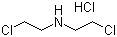 |
| Molecular Formula | C4H9Cl2N.HCl |
| Molecular Weight | 178.49 |
| CAS Registry Number | 821-48-7 |
| EC Number | 212-479-5 |
| SMILES | C(CCl)NCCCl.Cl |
| Melting point | 212-214 °C (Expl.) |
|---|---|
| Water solubility | soluble (Expl.) |
| Hazard Symbols |     GHS05;GHS06;GHS07;GHS08 Danger Details GHS05;GHS06;GHS07;GHS08 Danger Details | ||||||||||||||||||||||||||||||||||||||||||||||||||||||||||||||||||||||||||||||||||||||||||||
|---|---|---|---|---|---|---|---|---|---|---|---|---|---|---|---|---|---|---|---|---|---|---|---|---|---|---|---|---|---|---|---|---|---|---|---|---|---|---|---|---|---|---|---|---|---|---|---|---|---|---|---|---|---|---|---|---|---|---|---|---|---|---|---|---|---|---|---|---|---|---|---|---|---|---|---|---|---|---|---|---|---|---|---|---|---|---|---|---|---|---|---|---|---|
| Risk Statements | H290-H302-H314-H315-H319-H331-H335-H340-H341-H350 Details | ||||||||||||||||||||||||||||||||||||||||||||||||||||||||||||||||||||||||||||||||||||||||||||
| Safety Statements | P203-P234-P260-P261-P264-P264+P265-P270-P271-P280-P301+P317-P301+P330+P331-P302+P352-P302+P361+P354-P304+P340-P305+P351+P338-P305+P354+P338-P316-P318-P319-P321-P330-P332+P317-P337+P317-P362+P364-P363-P390-P403+P233-P405-P406-P501 Details | ||||||||||||||||||||||||||||||||||||||||||||||||||||||||||||||||||||||||||||||||||||||||||||
| Hazard Classification | |||||||||||||||||||||||||||||||||||||||||||||||||||||||||||||||||||||||||||||||||||||||||||||
| |||||||||||||||||||||||||||||||||||||||||||||||||||||||||||||||||||||||||||||||||||||||||||||
| SDS | Available | ||||||||||||||||||||||||||||||||||||||||||||||||||||||||||||||||||||||||||||||||||||||||||||
 chemBlink Chemical Story
|
Bis(2-chloroethyl)amine hydrochloride, commonly known as nitrogen mustard, is a chemical compound with the molecular formula C4H10Cl2N·HCl. It is a toxic substance that has historically been significant both as a chemical warfare agent and for its medical applications, particularly in the field of oncology. The compound consists of two 2-chloroethyl groups attached to a nitrogen atom, making it a bifunctional alkylating agent. The discovery of bis(2-chloroethyl)amine dates back to the early 20th century during the period of World War I. The compound was first synthesized as part of a series of nitrogen-containing mustard agents. Researchers were exploring chemical warfare agents, and bis(2-chloroethyl)amine was identified as one of the compounds with potent toxic effects. It was later found that this substance could cause severe blistering of the skin and mucous membranes, along with other harmful effects on the respiratory system and internal organs. Due to its toxicity, bis(2-chloroethyl)amine was used as a chemical weapon, notably during World War II. In addition to its use as a chemical warfare agent, bis(2-chloroethyl)amine found an unexpected application in medicine. During the 1940s, scientists discovered that it could be used as an anticancer agent. The compound was shown to have potent cytotoxic properties, meaning it could destroy rapidly dividing cells, which include cancer cells. As a result, bis(2-chloroethyl)amine became one of the first chemotherapy agents, though it was later largely replaced by less toxic treatments. The application of bis(2-chloroethyl)amine in cancer treatment was groundbreaking, leading to the development of other alkylating agents used in chemotherapy. These agents, such as cyclophosphamide and chlorambucil, were designed to retain the tumor-fighting properties of bis(2-chloroethyl)amine while reducing its severe side effects. The alkylation process works by adding an alkyl group to the DNA of cancer cells, preventing them from dividing and leading to cell death. In modern medicine, bis(2-chloroethyl)amine and other nitrogen mustards are primarily used in combination therapies for cancers such as lymphoma, leukemia, and certain solid tumors. However, due to their toxic nature, their use is highly regulated, and newer, more specific treatments have largely replaced them in many clinical settings. Bis(2-chloroethyl)amine also has applications in laboratory research. As a chemical reagent, it is used to study DNA interactions and mechanisms of cell division. Its role in research has helped scientists understand the process of alkylation and its impact on cellular functions. Despite its limited use in clinical therapy, its legacy in chemotherapy research continues to shape cancer treatment strategies. Handling bis(2-chloroethyl)amine requires caution due to its toxic nature. It can cause severe burns, irritation to the eyes, respiratory distress, and long-term health issues. In industrial and laboratory settings, strict safety protocols are necessary, including the use of personal protective equipment, proper ventilation, and disposal methods that minimize environmental contamination. In conclusion, bis(2-chloroethyl)amine hydrochloride is a chemical compound with a significant historical impact. Initially discovered as a chemical warfare agent, it later found use as a chemotherapy treatment for cancer. While it is no longer commonly used in clinical practice due to its toxicity, its discovery paved the way for the development of other more effective cancer treatments. Research on bis(2-chloroethyl)amine continues to provide insights into the mechanisms of chemotherapy and the impact of alkylating agents on DNA. References 2007. Three-component condensation of pyridin-2-one, bis(2-chloroethyl)amine hydrochloride, and K2CO3 in DMF as a new method for oxazolidinylethylation. Russian Chemical Bulletin, 56(5). DOI: 10.1007/s11172-007-0163-4 1979. Bis(2-chloroethyl)amino derivatives of tertiary acetylenic alcohols and ethers. Pharmaceutical Chemistry Journal, 13(12). DOI: 10.1007/bf00781195 1976. Synthesis and investigation of imidazole derivatives. IX. Amides containing the DI(2-chloroethyl)amino group. Pharmaceutical Chemistry Journal, 10(9). DOI: 10.1007/bf01156270 |
| Market Analysis Reports |