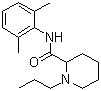
Ropivacaine is the S-enantiomer of an amide local anesthetic in the pipecoloxylidide family. Its development is closely tied to bupivacaine, whose long duration was accompanied by concern about serious cardiovascular and central nervous system toxicity. Investigation of optical isomers encouraged single-enantiomer alternatives, and ropivacaine was selected as the pure S-(-) form. A historical review notes extensive toxicological study before clinical introduction in 1996. Ropivacaine blocks voltage-gated sodium channels, preventing nerve-impulse propagation and producing reversible local anesthesia. It is long acting and can show differential sensory and motor block. FDA records identify CAS 84057-95-4 as ropivacaine itself; clinical products commonly use its hydrochloride salt, so the free base and formulated salt should not be conflated.
The exact registry identity matters because free forms, salts, hydrates, stereoisomers, metabolites, intermediates and finished medicines can have separate CAS numbers even when their names are closely related. This distinction affects molecular weight, analytical standards, formulation, manufacturing specifications and interpretation of published data. A reliable database story therefore follows the exact substance rather than silently borrowing every property of a related compound.
Structure also shows how chemists use functional groups as deliberate tools. Aromatic and heterocyclic frameworks establish molecular shape and electronics, while amines, hydroxyl groups, carbonyls, carboxyl functions or ionic centers determine reactivity and intermolecular interactions. In multistep synthesis, a compound may be valuable precisely because one position can be transformed selectively while the rest of a complex framework survives.
Modern development is also an analytical-control problem. Researchers must establish identity and purity, distinguish relevant stereoisomers or salt forms, monitor process-related species and define reproducible specifications. These requirements explain why an intermediate, metabolite or reagent can be scientifically important even when it is never administered as an independent medicine.
A Chemical Story must distinguish documented use from structural possibility. A familiar scaffold may suggest an activity, but resemblance is not evidence that the exact CAS substance has been tested or approved for that purpose. Verified history and demonstrated applications therefore take priority over attractive but unsupported extrapolation.
Seen broadly, practical performance emerges from the entire molecular system rather than one recognizable group. Structure, stereochemistry, physical form, synthetic route, metabolism and reaction environment can all determine what a substance actually does. Connecting those molecular details to its documented role is what turns a registry entry into a meaningful chemical story.
The exact registry identity matters because free forms, salts, hydrates, stereoisomers, metabolites, intermediates and finished medicines can have separate CAS numbers even when their names are closely related. This distinction affects molecular weight, analytical standards, formulation, manufacturing specifications and interpretation of published data. A reliable database story therefore follows the exact substance rather than silently borrowing every property of a related compound.
Structure also shows how chemists use functional groups as deliberate tools. Aromatic and heterocyclic frameworks establish molecular shape and electronics, while amines, hydroxyl groups, carbonyls, carboxyl functions or ionic centers determine reactivity and intermolecular interactions. In multistep synthesis, a compound may be valuable precisely because one position can be transformed selectively while the rest of a complex framework survives.
Modern development is also an analytical-control problem. Researchers must establish identity and purity, distinguish relevant stereoisomers or salt forms, monitor process-related species and define reproducible specifications. These requirements explain why an intermediate, metabolite or reagent can be scientifically important even when it is never administered as an independent medicine.
References:
1. PubChem. Ropivacaine, CID 175805.
2. FDA GSRS. Ropivacaine, UNII 7IO5LYA57N.
3. Ruetsch YA et al. From cocaine to ropivacaine: the history of local anesthetic drugs. Curr Top Med Chem. 2001.
|




 GHS07 Warning Details
 chemBlink Chemical Story