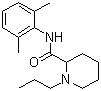
Ropivacaine (CAS 84057-95-4) has a chemical story that connects molecular identity with practical chemistry. Ropivacaine is the S-enantiomer of an amide local anesthetic in the pipecoloxylidide family. Its development is closely tied to bupivacaine, whose long duration was accompanied by concern about serious cardiovascular and central nervous system toxicity. Investigation of optical isomers encouraged single-enantiomer alternatives, and ropivacaine was selected as the pure S-(-) form. A historical review notes extensive toxicological study before clinical introduction in 1996. Ropivacaine blocks voltage-gated sodium channels, preventing nerve-impulse propagation and producing reversible local anesthesia. It is long acting and can show differential sensory and motor block. FDA records identify CAS 84057-95-4 as ropivacaine itself; clinical products commonly use its hydrochloride salt, so the free base and formulated salt should not be conflated.
The exact registered form matters because related salts, stereoisomers, metabolites, intermediates or finished medicines can occupy very different roles even when their names look nearly interchangeable.

Global Chemical Database