
Online Database of Chemicals from Around the World
| wuhan chemi Pharmacy Chemical Technology Co., Ltd. | China | |||
|---|---|---|---|---|
 | www.chemipharm.com.cn | |||
 | +86 13971619949 | |||
 | gmn424@chemipharm.com.cn | |||
 | QQ Chat | |||
 | WeChat: 13971619949 | |||
| Chemical manufacturer since 2014 | ||||
| chemBlink Standard supplier since 2026 | ||||
| Classification | Organic raw materials >> Ketone compound |
|---|---|
| Name | 1-Ethylimidazolidin-2-one |
| Molecular Structure | 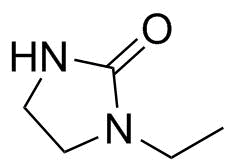 |
| Molecular Formula | C5H10N2O |
| Molecular Weight | 114.15 |
| CAS Registry Number | 872-69-5 |
| EC Number | 864-809-8 |
| SMILES | CCN1CCNC1=O |
| Density | 1.0±0.1 g/cm3 Calc.* |
|---|---|
| Boiling point | 290.8±7.0 °C 760 mmHg (Calc.)* |
| Flash point | 129.6±18.2 °C (Calc.)* |
| Index of refraction | 1.462 (Calc.)* |
| * | Calculated using Advanced Chemistry Development (ACD/Labs) Software. |
| Hazard Symbols |  GHS07 Warning Details GHS07 Warning Details | ||||||||||||||||
|---|---|---|---|---|---|---|---|---|---|---|---|---|---|---|---|---|---|
| Risk Statements | H315-H319-H335 Details | ||||||||||||||||
| Safety Statements | P261-P264-P264+P265-P271-P280-P302+P352-P304+P340-P305+P351+P338-P319-P321-P332+P317-P337+P317-P362+P364-P403+P233-P405-P501 Details | ||||||||||||||||
| Hazard Classification | |||||||||||||||||
| |||||||||||||||||
| SDS | Available | ||||||||||||||||
 chemBlink Chemical Story
|
1-Ethylimidazolidin-2-one is a substituted cyclic urea derivative belonging to the class of imidazolidin-2-one compounds. It consists of a five-membered heterocyclic ring containing two nitrogen atoms and one carbonyl group, with an ethyl substituent attached to the nitrogen at position 1. The parent imidazolidin-2-one scaffold is structurally related to urea and other cyclic carbamates, and it is characterized by strong hydrogen-bonding ability due to the presence of both a carbonyl group and nitrogen atoms. The chemistry of cyclic ureas such as imidazolidin-2-ones has been studied extensively in organic chemistry and medicinal chemistry due to their stability and ability to mimic peptide bond geometries. The imidazolidinone ring system is a constrained analogue of urea in which the carbonyl group is incorporated into a five-membered ring, resulting in restricted conformational flexibility and distinct hydrogen-bonding patterns. These properties make imidazolidinones useful as structural motifs in bioactive molecules and as intermediates in synthetic chemistry. 1-Ethylimidazolidin-2-one is derived from imidazolidin-2-one through N-alkylation, in which one of the ring nitrogen atoms is substituted with an ethyl group. N-alkylation of cyclic ureas is a well-established transformation in heterocyclic chemistry and is typically achieved using alkyl halides or related electrophiles under basic conditions. The introduction of an ethyl substituent modifies the electronic and steric environment of the ring nitrogen, influencing hydrogen-bonding capacity and solubility characteristics. Imidazolidin-2-one derivatives have been explored in a variety of chemical contexts, including as polar aprotic solvents, intermediates in pharmaceutical synthesis, and components of functional materials. Related compounds, such as N,N′-dimethylimidazolidin-2-one (DMI), are known for their high polarity and thermal stability, and are used as environmentally favorable alternatives to traditional polar solvents. While 1-ethylimidazolidin-2-one is less commonly cited than some of its more heavily substituted analogues, it belongs to the same broader family of polar cyclic ureas with similar structural features. The presence of a carbonyl group within the five-membered ring gives imidazolidin-2-ones significant polarity and the ability to act as both hydrogen-bond acceptors and donors (in the unsubstituted form). In 1-ethylimidazolidin-2-one, one nitrogen atom is substituted, reducing the number of hydrogen-bond donors but maintaining strong hydrogen-bond acceptor capability through the carbonyl oxygen. This balance of polarity contributes to favorable solvation properties in polar media. From a physicochemical standpoint, 1-ethylimidazolidin-2-one is expected to be a polar, relatively high-boiling organic compound with good miscibility in water and organic solvents. The cyclic urea structure contributes to thermal and chemical stability, while the ethyl group introduces mild hydrophobic character compared with unsubstituted imidazolidinones. These combined features influence its behavior in solution and potential utility in synthetic applications. Cyclic ureas such as this compound are also of interest in supramolecular chemistry due to their ability to participate in directional hydrogen-bonding interactions. The imidazolidinone core can engage in structured intermolecular associations, which can be relevant in crystal engineering and molecular recognition studies. Substitution patterns on the nitrogen atoms can significantly influence these interactions by altering steric accessibility and electronic distribution. In synthetic chemistry, imidazolidinone derivatives serve as useful intermediates for further functionalization. The ring system can undergo hydrolysis under strong conditions, ring-opening reactions, or substitution at nitrogen depending on the substitution pattern and reaction environment. These transformation pathways make cyclic ureas versatile building blocks in heterocyclic synthesis. Overall, 1-ethylimidazolidin-2-one is a polar cyclic urea derivative featuring a constrained five-membered heterocycle with an N-ethyl substitution. Its significance lies in its structural relationship to imidazolidinone-based systems widely used in synthetic chemistry, solvent applications, and molecular design, where hydrogen-bonding characteristics and polarity play important roles in determining chemical behavior. |
| Market Analysis Reports |