
Online Database of Chemicals from Around the World
| Simagchem Corporation | China | |||
|---|---|---|---|---|
 | www.simagchem.com | |||
 | +86 13806087780 | |||
 | +86 (592) 268-0237 | |||
 | sale@simagchem.com | |||
| Chemical manufacturer since 2002 | ||||
| chemBlink Standard supplier since 2008 | ||||
| Hefei TNJ Chemical Industry Co., Ltd. | China | |||
|---|---|---|---|---|
| www.tnjchem.com | |||
| +86 (551) 6541-8684 | |||
| +86 (551) 6541-8697 | |||
| sales@tnjchem.com | |||
| Chemical manufacturer since 2001 | ||||
| chemBlink Standard supplier since 2010 | ||||
| BOC Sciences | USA | |||
|---|---|---|---|---|
| www.bocsci.com | |||
| +1 (631) 485-4226 | |||
| +1 (631) 614-7828 | |||
| info@bocsci.com | |||
| Chemical manufacturer | ||||
| chemBlink Standard supplier since 2010 | ||||
| Foodchem International | China | |||
|---|---|---|---|---|
| www.foodchemadditives.com | |||
| +86 (21) 3126-7000 | |||
| tjmwa7@gmail.com | |||
| Chemical manufacturer since 2006 | ||||
| chemBlink Standard supplier since 2014 | ||||
| Hangzhou Leap Chem Co., Ltd. | China | |||
|---|---|---|---|---|
| www.leapchem.com | |||
| +86 (571) 8771-1850 | |||
| market19@leapchem.com | |||
 | QQ Chat | |||
| Chemical manufacturer since 2006 | ||||
| chemBlink Standard supplier since 2015 | ||||
| Carbosynth China Ltd. | China | |||
|---|---|---|---|---|
| www.carbosynth.cn | |||
| +86 (512) 6260-5585 | |||
| +86 (512) 6260-5576 | |||
| sales@carbosynth.com | |||
| QQ Chat | |||
| Chemical manufacturer since 2006 | ||||
| chemBlink Standard supplier since 2016 | ||||
| Zibo Senlos Import&export Co., Ltd. | China | |||
|---|---|---|---|---|
| www.senloschem.com | |||
| +86 (533) 491-2094 | |||
| senloschem@gmail.com | |||
| Chemical distributor since 2018 | ||||
| chemBlink Standard supplier since 2018 | ||||
| Guilin Qihong Technology Co., Ltd. | China | |||
|---|---|---|---|---|
| www.qh-tech.cn | |||
| +86 13132738337 | |||
| online@qh-tech.cn | |||
| Chemical manufacturer since 2016 | ||||
| chemBlink Standard supplier since 2025 | ||||
| Classification | Biochemical >> Carbohydrate >> Polysaccharide |
|---|---|
| Name | Cellulose CM |
| Synonyms | CM-Cellulose; Carboxymethyl cellulose; Carboxymethyl cellulose ether; CMC |
| Molecular Structure | 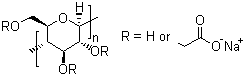 |
| Molecular Formula | C8H16O8 |
| Molecular Weight | 240.21 |
| CAS Registry Number | 9000-11-7 |
| EC Number | 618-326-2 |
| SMILES | CC(=O)O.C(C(C(C(C(C=O)O)O)O)O)O |
| SDS | Available |
|---|---|
 chemBlink Chemical Story
|
Carboxymethyl cellulose, commonly abbreviated as cellulose CM or CMC, is a water-soluble anionic derivative of cellulose in which carboxymethyl groups (–CH2COO−) are introduced into the cellulose backbone. This substitution imparts a number of desirable properties, including water solubility, thickening ability, and binding capacity. CMC is one of the most widely used cellulose derivatives in both industrial and pharmaceutical applications due to its safety, versatility, and compatibility with a broad range of materials. The discovery and development of carboxymethyl cellulose date back to the early 20th century. The chemical modification of cellulose began with the aim of improving solubility and reactivity for textile and paper processing. CMC was first synthesized by reacting alkali cellulose with monochloroacetic acid, which introduced carboxymethyl groups onto the polymer chain. This process was refined and scaled up for commercial production beginning in the 1920s and 1930s. Over the decades, CMC has been manufactured in different grades and purity levels depending on the intended use. In industrial applications, CMC serves a variety of functional roles. It is used as a thickener, stabilizer, and emulsifier in foods, cosmetics, detergents, textiles, and paints. In food processing, it is designated as a food additive (E466) and commonly found in products such as ice cream, sauces, and baked goods where it helps improve texture and shelf-life. In detergents and cleaning products, CMC acts as a soil-suspending agent that prevents dirt from re-depositing on fabrics. In paper manufacturing, it improves surface properties and enhances printability. Pharmaceutical and biomedical applications of CMC are well established. Pharmaceutical-grade CMC, often referred to as sodium carboxymethyl cellulose, is used as a binder in tablets, a disintegrant, a viscosity modifier in suspensions, and a component in controlled-release formulations. Its non-toxic and hypoallergenic nature makes it suitable for oral, topical, and ophthalmic use. CMC is also a major ingredient in artificial tear products for treating dry eye syndrome due to its lubricating and moisture-retaining properties. In research and biotechnology, CMC is used as a rheology modifier and a medium component for microbial culture. In enzyme assays, it serves as a model substrate for studying cellulase activity, as its carboxymethylated structure mimics native cellulose but is soluble in aqueous solutions. This facilitates quantification of enzymatic hydrolysis products. CMC is available in various degrees of substitution and viscosity grades, depending on the number of hydroxyl groups on the cellulose backbone replaced by carboxymethyl groups. The degree of substitution typically ranges from 0.4 to 1.4. The specific functional properties of a CMC sample, such as its solubility, thickening behavior, and gel-forming ability, are influenced by this substitution level as well as the molecular weight of the polymer. The stability and compatibility of CMC with a wide range of salts and organic compounds further enhance its usefulness across disciplines. It exhibits pseudoplastic behavior (shear-thinning), which is advantageous in applications requiring flow under stress, such as pumping or spreading. It is stable across a wide pH range and does not degrade easily, which contributes to its popularity in long-shelf-life products. In summary, cellulose CM (carboxymethyl cellulose) is a chemically modified, water-soluble cellulose derivative with wide-ranging applications in food, pharmaceuticals, industry, and scientific research. Its functional versatility, safety profile, and adaptability have made it a fundamental material in many commercial and research-based formulations. References 1964. Carboxymethylcellulose column chromatographic fractionation and starch gel-urea electrophoretic characterization of soft wheat proteins. Analytical Biochemistry, 8(4). DOI: 10.1016/0003-2697(64)90241-6 2003. Functional stabilization of trypsin by conjugation with beta-cyclodextrin-modified carboxymethylcellulose. Preparative Biochemistry and Biotechnology, 33(1). DOI: 10.1081/pb-120018369 |
| Market Analysis Reports |