
Online Database of Chemicals from Around the World
| Simagchem Corporation | China | |||
|---|---|---|---|---|
 | www.simagchem.com | |||
 | +86 13806087780 | |||
 | +86 (592) 268-0237 | |||
 | sale@simagchem.com | |||
| Chemical manufacturer since 2002 | ||||
| chemBlink Standard supplier since 2008 | ||||
| Aversion Technologies, Inc. | USA | |||
|---|---|---|---|---|
| www.aversiontech.com | |||
| +1 (202) 657-6300 | |||
| service@aversiontech.com | |||
| Chemical manufacturer | ||||
| chemBlink Standard supplier since 2008 | ||||
| Discovery Fine Chemicals Ltd. | UK | |||
|---|---|---|---|---|
| www.discofinechem.com | |||
| +44 (1202) 874-517 | |||
| +44 (845) 094-4385 | |||
| pjc@discofinechem.com | |||
| Chemical manufacturer | ||||
| chemBlink Standard supplier since 2009 | ||||
| Zhejiang Synose Tech Co., Ltd. | China | |||
|---|---|---|---|---|
| www.synose.com | |||
| +86(579)8227-5537 8917-2081 | |||
| +86 (579) 8227-7133 | |||
| expo@synose.com | |||
| Chemical manufacturer since 1996 | ||||
| chemBlink Standard supplier since 2011 | ||||
| Hangzhou Leap Chem Co., Ltd. | China | |||
|---|---|---|---|---|
| www.leapchem.com | |||
| +86 (571) 8771-1850 | |||
| market19@leapchem.com | |||
 | QQ Chat | |||
| Chemical manufacturer since 2006 | ||||
| chemBlink Standard supplier since 2015 | ||||
| Sinocure Chemical Group | China | |||
|---|---|---|---|---|
| www.sinocurechem.com | |||
| +86 15550440621 | |||
| info@sinocurechem.com | |||
| Chemical manufacturer since 2020 | ||||
| Classification | Chemical reagent >> Organic reagent >> Amide |
|---|---|
| Name | Denatonium saccharide |
| Synonyms | Benzyldiethyl-[(2,6-xylylcarbamoyl)methyl]-ammonium saccharide; N-(2-((2,6-Dimethylphenyl)amino)-2-oxoethyl)-N,N-diethyl-benzenemethanaminium saccharide |
| Molecular Structure | 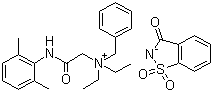 |
| Molecular Formula | C21H29N2O.C7H4NO3S;C28H33N3O4S |
| Molecular Weight | 507.65 |
| CAS Registry Number | 90823-38-4 |
| EC Number | 623-097-7 |
| SMILES | CC[N+](CC)(CC1=CC=CC=C1)CC(=O)NC2=C(C=CC=C2C)C.C1=CC=C2C(=C1)C(=O)N=S2(=O)[O-] |
| Hazard Symbols |  GHS07 Warning Details GHS07 Warning Details | ||||||||||||||||
|---|---|---|---|---|---|---|---|---|---|---|---|---|---|---|---|---|---|
| Risk Statements | H302 Details | ||||||||||||||||
| Safety Statements | P264-P270-P301+P317-P330-P501 Details | ||||||||||||||||
| Hazard Classification | |||||||||||||||||
| |||||||||||||||||
| SDS | Available | ||||||||||||||||
 chemBlink Chemical Story
|
Denatonium saccharide is known as the most bitter chemical compound, commonly used as a deterrent in various products to prevent accidental ingestion. It was discovered in 1958 by MacFarlan Smith, a Scottish pharmaceutical company, during the research of anesthetics. Denatonium compounds, including denatonium benzoate and denatonium saccharide, are quinoline derivatives, but their extreme bitterness has been their most significant characteristic. Even in minute concentrations, denatonium saccharide imparts a highly unpleasant taste, which has led to its use in a wide range of applications as an aversive agent. The compound’s primary application is as a bitterant in products that pose potential risks of accidental ingestion by humans or animals. It is added to household cleaners, antifreeze, paints, pesticides, and cosmetics to discourage consumption due to its intense bitterness. The concentration of denatonium saccharide used in such applications is generally very low—often parts per million—because even at these minimal levels, the compound’s taste is effective. In addition to household products, denatonium saccharide is used in industrial products such as solvents and fuels to prevent misuse, such as inhalant abuse or accidental poisoning. Its presence can make these substances unpalatable, significantly reducing the likelihood of ingestion. In veterinary applications, denatonium saccharide is incorporated into animal repellents and products intended to stop pets from chewing on surfaces or objects they shouldn't. It can be found in formulations designed to deter cats and dogs from biting or licking furniture, cords, or bandages. Denatonium saccharide is also used in the medical field. It is added to alcohol-based hand sanitizers to prevent children from consuming these products. Moreover, it has been applied in denaturing ethanol, making it undrinkable to prevent its consumption as an alcoholic beverage. Although denatonium saccharide is not harmful at the low concentrations used in these applications, its extreme bitterness is enough to discourage ingestion. This makes it an invaluable tool for enhancing the safety of many everyday products, reducing the risk of accidental poisoning. References 2008. Norepinephrine Is Coreleased with Serotonin in Mouse Taste Buds. The Journal of neuroscience : the official journal of the Society for Neuroscience, 28(49). DOI: 10.1523/jneurosci.4187-08.2008 1999. Ggamma13 colocalizes with gustducin in taste receptor cells and mediates IP3 responses to bitter denatonium. Nature Neuroscience, 2(12). DOI: 10.1038/15981 1987. Analyzing Aversiveness of Denatonium Saccharide and Quinine in Rats. Perceptual and Motor Skills, 64(3). DOI: 10.2466/pms.1987.64.3c.1215 |
| Market Analysis Reports |