
Online Database of Chemicals from Around the World
| Simagchem Corporation | China | |||
|---|---|---|---|---|
 | www.simagchem.com | |||
 | +86 13806087780 | |||
 | +86 (592) 268-0237 | |||
 | sale@simagchem.com | |||
| Chemical manufacturer since 2002 | ||||
| chemBlink Standard supplier since 2008 | ||||
| Hangzhou Haichem Co., Ltd. | China | |||
|---|---|---|---|---|
| www.haichem.com | |||
| +86 (571) 8602-5531 | |||
| +86 (571) 8602-6912 | |||
| info@haichem.com | |||
| Chemical manufacturer | ||||
| chemBlink Standard supplier since 2009 | ||||
| Yixing Xinyu Chemicals Co., Ltd. | China | |||
|---|---|---|---|---|
| www.xinyuchem.com | |||
| +86 (510) 8744-6558 8744-1150 | |||
| +86 (510) 8744-2808 / 8744-2345 | |||
| sales@xinyuchem.com | |||
 | QQ Chat | |||
| Chemical manufacturer since 1993 | ||||
| chemBlink Standard supplier since 2009 | ||||
| Winchem Industrial Co., Ltd. | China | |||
|---|---|---|---|---|
| www.win-chemical.com | |||
| +86 (574) 8385-1061 | |||
| +86 (574) 8708-3209 | |||
| info@win-chemical.com hhp13@hotmail.com | |||
| Chemical manufacturer | ||||
| chemBlink Standard supplier since 2010 | ||||
| BOC Sciences | USA | |||
|---|---|---|---|---|
| www.bocsci.com | |||
| +1 (631) 485-4226 | |||
| +1 (631) 614-7828 | |||
| info@bocsci.com | |||
| Chemical manufacturer | ||||
| chemBlink Standard supplier since 2010 | ||||
| Hubei Tuoyuan Fine Chemical Co., Ltd. | China | |||
|---|---|---|---|---|
| www.chemty.com | |||
| +86 (027) 8470-0466 | |||
| +86 (027) 8470-0466 | |||
| 59741184@qq.com | |||
| QQ Chat | |||
 | WeChat: 13260668040 | |||
| Chemical manufacturer since 2025 | ||||
| chemBlink Standard supplier since 2011 | ||||
| Wuhan Kemi-works Chemical Co., Ltd. | China | |||
|---|---|---|---|---|
| www.kemiworks.net | |||
| +86 (27) 8573-6489 | |||
| +86 (27) 8573-6485 | |||
| info@kemiworks.net sales@kemiworks.com | |||
| Chemical manufacturer | ||||
| chemBlink Standard supplier since 2011 | ||||
| Hangzhou Leap Chem Co., Ltd. | China | |||
|---|---|---|---|---|
| www.leapchem.com | |||
| +86 (571) 8771-1850 | |||
| market19@leapchem.com | |||
| QQ Chat | |||
| Chemical manufacturer since 2006 | ||||
| chemBlink Standard supplier since 2015 | ||||
| Chiron AS | Norway | |||
|---|---|---|---|---|
| www.chiron.no | |||
| +47 (73) 874-490 | |||
| +47 (73) 874-499 | |||
| chiron@chiron.no | |||
| Chemical manufacturer | ||||
| Molekula Ltd | UK | |||
|---|---|---|---|---|
| www.molekula.com | |||
| +44 (1747) 831-066 | |||
| +44 (1747) 831-199 | |||
| info@molekula.com | |||
| Chemical manufacturer | ||||
| Nantong Baisheng Chemical Co., Ltd. | China | |||
|---|---|---|---|---|
| www.jgbschem.com | |||
| +86 (513) 8275-1999 8275-9880 ex 8812 | |||
| +86 (513) 8275-9881 | |||
| xwr@hi2000.com | |||
| Chemical manufacturer | ||||
| Classification | Organic raw materials >> Hydrocarbon compounds and their derivatives >> Aromatic hydrocarbon |
|---|---|
| Name | 2,3-Dihydroxynaphthalene |
| Synonyms | 2,3-Naphthalenediol |
| Molecular Structure | 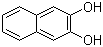 |
| Molecular Formula | C10H8O2 |
| Molecular Weight | 160.17 |
| CAS Registry Number | 92-44-4 |
| EC Number | 202-156-7 |
| SMILES | C1=CC=C2C=C(C(=CC2=C1)O)O |
| Density | 1.3±0.1 g/cm3 Calc.* |
|---|---|
| Melting point | 161 - 165 °C (Expl.) |
| Boiling point | 353.9±15.0 °C 760 mmHg (Calc.)* |
| Flash point | 181.0±15.0 °C (Calc.)*, 175 °C (Expl.) |
| Index of refraction | 1.726 (Calc.)* |
| Water solubility | slightly soluble |
| * | Calculated using Advanced Chemistry Development (ACD/Labs) Software. |
| Hazard Symbols |   GHS05;GHS07 Danger Details GHS05;GHS07 Danger Details | ||||||||||||||||||||||||||||||||||||||||
|---|---|---|---|---|---|---|---|---|---|---|---|---|---|---|---|---|---|---|---|---|---|---|---|---|---|---|---|---|---|---|---|---|---|---|---|---|---|---|---|---|---|
| Risk Statements | H302-H315-H318-H319-H335 Details | ||||||||||||||||||||||||||||||||||||||||
| Safety Statements | P261-P264-P264+P265-P270-P271-P280-P301+P317-P302+P352-P304+P340-P305+P351+P338-P305+P354+P338-P317-P319-P321-P330-P332+P317-P337+P317-P362+P364-P403+P233-P405-P501 Details | ||||||||||||||||||||||||||||||||||||||||
| Hazard Classification | |||||||||||||||||||||||||||||||||||||||||
| |||||||||||||||||||||||||||||||||||||||||
| SDS | Available | ||||||||||||||||||||||||||||||||||||||||
 chemBlink Chemical Story
|
2,3-Dihydroxynaphthalene is a dihydroxy-substituted derivative of naphthalene, a polycyclic aromatic hydrocarbon. It is classified as a naphthalenediol and is structurally composed of a naphthalene ring with hydroxyl groups attached to the 2 and 3 positions. The compound exists as a solid at room temperature and exhibits properties characteristic of aromatic diols, including the ability to participate in hydrogen bonding and redox reactions. The synthesis of 2,3-dihydroxynaphthalene has been accomplished through various established organic methods, often involving hydroxylation of naphthalene derivatives. One common method starts with 2-naphthol, which can undergo directed hydroxylation at the 3-position to yield the desired diol. Alternatively, oxidative processes using reagents such as alkaline potassium permanganate or other metal-catalyzed systems have been employed in laboratory settings to achieve regioselective hydroxylation of the naphthalene ring. This compound has been studied extensively for its redox properties and is known to participate in reversible oxidation-reduction processes. It can be oxidized to form 2,3-naphthoquinone, an important intermediate in organic and biochemical pathways. The dihydroxynaphthalene–naphthoquinone redox pair has been of particular interest in the study of electron transport systems and enzymatic redox cycles. These systems are relevant in the context of natural product biosynthesis and the mechanistic understanding of oxidative enzymes. In analytical chemistry and biochemistry, 2,3-dihydroxynaphthalene has served as a chromogenic or fluorogenic substrate in various assays. Upon enzymatic oxidation, it can form colored or fluorescent products, enabling the detection of specific enzymatic activities. Its behavior in such systems is often compared to other dihydroxy aromatic compounds such as catechol or hydroquinone, though the extended aromatic system of the naphthalene ring imparts distinct electronic properties. The compound has also been investigated in coordination chemistry, where it can act as a bidentate ligand due to its two hydroxyl groups positioned on adjacent carbon atoms. Chelation with transition metal ions has been explored, and the resulting complexes have been characterized for their structural and spectroscopic properties. These studies contribute to a broader understanding of metal-ligand interactions and the potential applications of such complexes in catalysis or material science. In the context of biological research, derivatives of 2,3-dihydroxynaphthalene have been evaluated for their antimicrobial and antitumor activities, though the parent compound itself is not typically used directly as a therapeutic agent. Its oxidative metabolites and analogues, however, have been of interest for their bioactive properties and interactions with biomolecules such as DNA and enzymes. The ability of naphthoquinones, including those derived from 2,3-dihydroxynaphthalene, to generate reactive oxygen species has implications for their mechanism of action in biological systems. Environmental studies have also included 2,3-dihydroxynaphthalene among polycyclic aromatic compound derivatives that may result from incomplete combustion of organic matter. While not a common environmental pollutant, its formation and degradation pathways are of relevance in the analysis of naphthalene transformation products in soil and water systems. Microbial degradation of naphthalene and related compounds often involves hydroxylated intermediates, and 2,3-dihydroxynaphthalene can appear as a transient species during such biodegradation processes. Overall, 2,3-dihydroxynaphthalene is a chemically and biologically relevant compound with applications in organic synthesis, analytical chemistry, coordination chemistry, and environmental science. Its study has provided insight into redox chemistry, enzymatic processes, and the behavior of polycyclic aromatic compounds in both laboratory and natural settings. References 1965. Oxidative metabolism of phenanthrene and anthracene by soil pseudomonads. The ring-fission mechanism. The Biochemical Journal, 95(3). DOI: 10.1042/bj0950819 2023. A basidomycetous hydroxynaphthalene-prenylating enzyme exhibits promiscuity toward prenyl donors. Applied Microbiology and Biotechnology, 107(15). DOI: 10.1007/s00253-023-12621-1 2024. Yttrium-90 recovery from carbonate media with binary extractants based on hydroxyaromatic compounds and methyltrioctylammonium carbonate. Journal of Radioanalytical and Nuclear Chemistry, 333(12). DOI: 10.1007/s10967-024-09910-y |
| Market Analysis Reports |