
Online Database of Chemicals from Around the World
| Shanghai MOF Chemical Tech Limited | China | |||
|---|---|---|---|---|
 | www.mofchem.com | |||
 | +86 (21) 6420-1062 | |||
 | sales@mofchem.com | |||
| Chemical manufacturer | ||||
| chemBlink Standard supplier since 2013 | ||||
| Hangzhou Qichuang Chemical Co., Ltd. | China | |||
|---|---|---|---|---|
| www.qc-chemical.com | |||
| +86 (571) 8893-5129 | |||
 | +86 (571) 8825-0182 | |||
| david@qc-chemical.com sales@qc-chemical.com davidw0828@gmail.com | |||
 | QQ Chat | |||
| Chemical distributor since 2009 | ||||
| chemBlink Standard supplier since 2013 | ||||
| Hangzhou Leap Chem Co., Ltd. | China | |||
|---|---|---|---|---|
| www.leapchem.com | |||
| +86 (571) 8771-1850 | |||
| market19@leapchem.com | |||
| QQ Chat | |||
| Chemical manufacturer since 2006 | ||||
| chemBlink Standard supplier since 2015 | ||||
| Enki Biopharmaceuticals (Shanghai) Limited | China | |||
|---|---|---|---|---|
| www.enkibiopharma.com | |||
| +86 (21) 5768-0965 +86 13916707528 | |||
| +86 (21) 5768-0922 | |||
| info@enkibiopharma.com | |||
| QQ Chat | |||
| Chemical distributor since 2014 | ||||
| chemBlink Standard supplier since 2015 | ||||
| NANJING DAOGE BIOPHARMA CO., LTD. | China | |||
|---|---|---|---|---|
| www.daogepharm.com | |||
| +86 18021503536 | |||
| sale@daogepharm.com | |||
| QQ Chat | |||
| Chemical manufacturer since 2021 | ||||
| chemBlink Standard supplier since 2021 | ||||
| Shaoxing Kaibang New Material Technology Co., Ltd. | China | |||
|---|---|---|---|---|
| www.kaibangchem.com | |||
| +86 (0575) 8717-5118 | |||
| sales01@huayangco.com | |||
| QQ Chat | |||
 | WeChat: +86 13486096626 | |||
 | WhatsApp:+86 13486096626 | |||
| Chemical manufacturer since 2023 | ||||
| chemBlink Standard supplier since 2024 | ||||
| Classification | Organic raw materials >> Heterocyclic compound |
|---|---|
| Name | 1-Cyclopropyl-1,4-dihydro-6,7-difluoro-4-oxoquinoline-3-carboxylic acid |
| Molecular Structure | 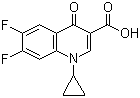 |
| Molecular Formula | C13H9F2NO3 |
| Molecular Weight | 265.21 |
| CAS Registry Number | 93107-30-3 |
| EC Number | 413-760-7 |
| SMILES | C1CC1N2C=C(C(=O)C3=CC(=C(C=C32)F)F)C(=O)O |
| Hazard Symbols |  GHS08 Warning Details GHS08 Warning Details | ||||||||||||||||
|---|---|---|---|---|---|---|---|---|---|---|---|---|---|---|---|---|---|
| Risk Statements | H361-H412 Details | ||||||||||||||||
| Safety Statements | P203-P273-P280-P318-P405-P501 Details | ||||||||||||||||
| Hazard Classification | |||||||||||||||||
| |||||||||||||||||
| SDS | Available | ||||||||||||||||
 chemBlink Chemical Story
|
1-Cyclopropyl-1,4-dihydro-6,7-difluoro-4-oxoquinoline-3-carboxylic acid, a quinolone derivative, was discovered during efforts to develop new broad-spectrum antibiotics. Part of the fluoroquinolone class, this compound was synthesized to enhance antibacterial activity and overcome resistance mechanisms seen with older antibiotics. The synthesis involves incorporating a cyclopropyl group and difluorination on the quinolone scaffold, significantly improving its ability to inhibit bacterial DNA gyrase and topoisomerase IV. These modifications result in a potent antibiotic with enhanced spectrum and stability, paving the way for its use in treating various bacterial infections. This compound is a broad-spectrum antibacterial agent effective against a variety of Gram-positive and Gram-negative bacteria. By targeting DNA gyrase and topoisomerase IV, crucial enzymes for bacterial DNA replication and repair, it disrupts bacterial cell processes leading to cell death. This mechanism makes it valuable in treating infections where other antibiotics fail, particularly those caused by drug-resistant strains. It is effective in treating respiratory tract infections, including bronchitis, pneumonia, and chronic obstructive pulmonary disease (COPD) exacerbations. Its action against common respiratory pathogens like *Streptococcus pneumoniae* and *Haemophilus influenzae* provides a robust therapeutic option for managing these conditions. The compound's efficacy extends to urinary tract infections, often caused by *Escherichia coli* and *Klebsiella pneumoniae*. Its broad-spectrum activity and good tissue penetration make it suitable for treating complicated and uncomplicated UTIs, providing relief from symptoms and preventing recurrence. The inclusion of fluorine atoms and the cyclopropyl group enhances the compound's stability and resistance to bacterial efflux pumps and other resistance mechanisms. This makes it effective against multidrug-resistant (MDR) bacteria, including methicillin-resistant *Staphylococcus aureus* (MRSA) and fluoroquinolone-resistant *Pseudomonas aeruginosa*. Its ability to combat resistance offers a critical tool in managing infections where conventional antibiotics are ineffective.Its broad-spectrum efficacy allows for its use in combination therapies with other antibiotics to enhance treatment outcomes and delay the development of resistance. Combining it with beta-lactams or aminoglycosides can provide synergistic effects, improving bacterial eradication rates in severe or complicated infections. The compound can be formulated for both oral and parenteral administration, providing flexibility in treating various infections. Its oral bioavailability allows for convenient outpatient therapy, while intravenous formulations can be used for severe infections requiring hospitalization. This dual formulation enhances its utility across different clinical settings. Its chemical structure allows for excellent tissue penetration, reaching high concentrations in the lungs, kidneys, and other tissues. This property ensures effective treatment of infections localized in these areas, such as pneumonia or pyelonephritis, contributing to faster clinical recovery. The compound is generally well-tolerated, with a side effect profile similar to other fluoroquinolones, including gastrointestinal disturbances and potential central nervous system effects. Ongoing monitoring and dose adjustments can manage these side effects, making it a safe option for a wide range of patients. Its broad-spectrum activity and safety profile make it a versatile option for both pediatric and geriatric patients. Tailored dosing regimens can accommodate different age groups, ensuring effective and safe treatment across a broad patient demographic. References 2017. Topological pattern for the search of new active drugs against methicillin resistant Staphylococcus aureus. European Journal of Medicinal Chemistry, 140. DOI: 10.1016/j.ejmech.2017.07.010 2015. Palladium-Catalyzed Decarboxylative Csp2-Csp2 Cross-Coupling Reactions: An Efficient Route for Synthesis of Azaisoflavone Derivatives. Catalysis Letters, 145(8). DOI: 10.1007/s10562-015-1558-8 |
| Market Analysis Reports |