
Online Database of Chemicals from Around the World
| Bio-sugars Technology Co., Ltd. | China | |||
|---|---|---|---|---|
 | www.bio-sugars.com | |||
 | +86 (579) 8901-8388 +86 15167971485 | |||
 | +86 (579) 8855-6787 | |||
 | syngars@hotmail.com | |||
 | QQ Chat | |||
| Chemical manufacturer since 2008 | ||||
| chemBlink Standard supplier since 2006 | ||||
| Xiamen Kaijia Imp & Exp Co., Ltd. | China | |||
|---|---|---|---|---|
| www.kaijiachem.com | |||
| +86 (592) 510-1177 | |||
| +86 (592) 565-3685 | |||
| jojo@kaijiachem.com kaijiachem@163.com | |||
| Chemical distributor since 2006 | ||||
| chemBlink Standard supplier since 2008 | ||||
| Simagchem Corporation | China | |||
|---|---|---|---|---|
| www.simagchem.com | |||
| +86 13806087780 | |||
| +86 (592) 268-0237 | |||
| sale@simagchem.com | |||
| Chemical manufacturer since 2002 | ||||
| chemBlink Standard supplier since 2008 | ||||
| Extrasynthese Chemical S.A.S. | France | |||
|---|---|---|---|---|
| www.extrasynthese.com | |||
| +33 (47) 898-2034 | |||
| +33 (47) 898-1945 | |||
| info@extrasynthese.com | |||
| Chemical manufacturer | ||||
| chemBlink Standard supplier since 2009 | ||||
| Hefei TNJ Chemical Industry Co., Ltd. | China | |||
|---|---|---|---|---|
| www.tnjchem.com | |||
| +86 (551) 6541-8684 | |||
| +86 (551) 6541-8697 | |||
| sales@tnjchem.com | |||
| Chemical manufacturer since 2001 | ||||
| chemBlink Standard supplier since 2010 | ||||
| Wilshire Technologies, Inc. | USA | |||
|---|---|---|---|---|
| www.wilshiretechnologies.com | |||
| +1 (609) 683-1117 | |||
| +1 (732) 274-0049 | |||
| Wilshire-info@evonik.com | |||
| Chemical manufacturer since 1997 | ||||
| chemBlink Standard supplier since 2010 | ||||
| BOC Sciences | USA | |||
|---|---|---|---|---|
| www.bocsci.com | |||
| +1 (631) 485-4226 | |||
| +1 (631) 614-7828 | |||
| info@bocsci.com | |||
| Chemical manufacturer | ||||
| chemBlink Standard supplier since 2010 | ||||
| Chiralblock Bioscience LLC | China | |||
|---|---|---|---|---|
| www.chiralblock.com | |||
| +86 18143482572 | |||
| +86 (571) 8848-7672 | |||
| info@chiralblock.com | |||
| Chemical manufacturer | ||||
| chemBlink Standard supplier since 2012 | ||||
| Biosynth AG. | Switzerland | |||
|---|---|---|---|---|
| www.biosynth.com | |||
| +41 (71) 858-2020 | |||
| +41 (71) 858-2030 | |||
| welcome@biosynth.ch | |||
| Chemical manufacturer | ||||
| chemBlink Standard supplier since 2014 | ||||
| Shanghai Hongbang Medical Technology Co., Ltd. | China | |||
|---|---|---|---|---|
| www.hongbangpharma.com | |||
| +86 (21) 2428-0809 +86 13671516988 | |||
| +86 (21) 2428-0809 | |||
| kimberly-hongbangpharma@hotmail.com 1377976036@qq.com | |||
| QQ Chat | |||
| Chemical manufacturer since 2010 | ||||
| chemBlink Standard supplier since 2014 | ||||
| Hangzhou Leap Chem Co., Ltd. | China | |||
|---|---|---|---|---|
| www.leapchem.com | |||
| +86 (571) 8771-1850 | |||
| market19@leapchem.com | |||
| QQ Chat | |||
| Chemical manufacturer since 2006 | ||||
| chemBlink Standard supplier since 2015 | ||||
| Zhejiang Medicines & Health Products Import & Export Co., Ltd. | China | |||
|---|---|---|---|---|
| www.zmcchina.com | |||
| +86 (0571) 281-9008 | |||
| anna@zmcchina.com | |||
| Chemical distributor since 1984 | ||||
| chemBlink Standard supplier since 2023 | ||||
| Melford Laboratories Limited | UK | |||
|---|---|---|---|---|
| www.melford.co.uk | |||
| +44 (1449) 741-178 | |||
| +44 (1449) 741-217 | |||
| pfranklin@melford.co.uk sales@melford.co.uk | |||
| Chemical manufacturer since 1985 | ||||
| City Chemical LLC | USA | |||
|---|---|---|---|---|
| www.citychemical.com | |||
| +1 (203) 932-2489 | |||
| +1 (203) 937-8400 | |||
| sales@citychemical.com | |||
| Chemical distributor | ||||
| Shanghai Worldyang Chemical Co., Ltd. | China | |||
|---|---|---|---|---|
| www.worldyachem.com | |||
| +86 13651600618 +86 (21) 5679-5779 | |||
| +86 (21) 5679-5266 | |||
| sales7777@worldyachem.com | |||
| QQ Chat | |||
 | WeChat: 13651600618 | |||
 | WhatsApp:+86 13651600618 | |||
| Chemical manufacturer since 2012 | ||||
| Santa Cruz Biotechnology, Inc. | USA | |||
|---|---|---|---|---|
| www.scbt.com | |||
| +1 (831) 457-3800 | |||
| +1 (831) 457-3801 | |||
| scbt@scbt.com | |||
| Chemical manufacturer | ||||
| Classification | Pharmaceutical intermediate >> Heterocyclic compound intermediate >> Pyrimidine compound >> Fluoropyrimidine |
|---|---|
| Name | Lactobionic acid |
| Synonyms | 4-O-beta-D-Galactopyranosyl-D-gluconic acid |
| Molecular Structure | 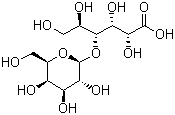 |
| Molecular Formula | C12H22O12 |
| Molecular Weight | 358.30 |
| CAS Registry Number | 96-82-2 |
| EC Number | 202-538-3 |
| SMILES | C([C@@H]1[C@@H]([C@@H]([C@H]([C@@H](O1)O[C@H]([C@@H](CO)O)[C@@H]([C@H](C(=O)O)O)O)O)O)O)O |
| Melting point | 113-118 °C |
|---|---|
| alpha | 22.8 ° (c=10, H2O) |
| Water solubility | 10 g/100 mL |
| Hazard Symbols |  GHS07 Warning Details GHS07 Warning Details | ||||||||||||||||||||
|---|---|---|---|---|---|---|---|---|---|---|---|---|---|---|---|---|---|---|---|---|---|
| Risk Statements | H315-H319-H335 Details | ||||||||||||||||||||
| Safety Statements | P233-P260-P261-P264-P271-P280-P302+P352-P304-P304+P340-P305+P351+P338-P312-P321-P332+P313-P337+P313-P340-P362-P403-P403+P233-P405-P501 Details | ||||||||||||||||||||
| Hazard Classification | |||||||||||||||||||||
| |||||||||||||||||||||
| SDS | Available | ||||||||||||||||||||
 chemBlink Chemical Story
|
Lactobionic acid is a compound derived from the combination of gluconic acid and galactose, first synthesized in the 1960s by oxidative modification of gluconic acid with galactose. The resulting compound, lactobionic acid, has a biomimetic acid structure (a carboxylic acid group attached to a carbohydrate portion), which enhances its solubility and biocompatibility. Lactobionic acid consists of a gluconic acid core and a galactose molecule linked by a lactone ring and is highly soluble in water and alcohol. It is stable under normal storage conditions and resistant to heat and pH changes. Lactobionic acid can be used as a stabilizer in drug formulations, especially for proteins and enzymes. Its ability to form complexes with metal ions helps prevent drug degradation, extend shelf life and improve efficacy. It can be used in organ preservation solutions due to its ability to mitigate oxidative stress during low-temperature storage. Lactobionic acid protects tissues from damage and prolongs the survival time of organ transplants. Lactobionic acid is used in cosmetics and skin care products for its moisturizing properties, attracting water molecules to hydrate the skin without causing irritation, suitable for sensitive skin. Lactobionic acid acts as an antioxidant by scavenging free radicals that cause skin aging. Its mild exfoliating properties promote cell renewal, improve skin texture, and reduce fine lines and wrinkles. Lactobionic acid is used as a food additive, primarily in dietary supplements and functional foods. Lactobionic acid enhances the stability of vitamins and nutrients, extending their shelf life and maintaining their nutritional value. Lactobionic acid is used in cryopreservation of cells and tissues in biotechnology. Lactobionic acid maintains the integrity of cells by minimizing the formation of ice crystals during freezing, which is essential for maintaining cell viability after thawing. Lactobionic acid is used in biosensors to detect pathogens and environmental pollutants. Lactobionic acid-modified surfaces enhance the specificity and sensitivity of biosensor devices, allowing for rapid and accurate detection. Lactobionic acid acts as a chelator, binding to metal ions such as calcium and magnesium. This property is essential in research to study metal-protein interactions and develop metal detoxification therapies. Studies have shown that as carrier molecules in gene delivery systems, lactobionic acid conjugates help deliver therapeutic genes to liver cells in a targeted manner, with the potential to treat liver diseases and genetic disorders. References 2022. The antimicrobial and bioactive properties of lactobionic acid. Journal of the Science of Food and Agriculture, 102(10). DOI: 10.1002/jsfa.11823 2022. Conjugates of lactobionic acid and IR820: New photosensitizers for efficient photodynamic therapy of hepatoma cells. Drug Development Research, 83(7). DOI: 10.1002/ddr.22007 2024. Quantitative Analysis of Lactobionic Acid in Bioreactor Cultures and Selected Biological Activities. Molecules (Basel, Switzerland), 29(22). DOI: 10.3390/molecules29225400 |
| Market Analysis Reports |