
Online Database of Chemicals from Around the World
| Simagchem Corporation | China | |||
|---|---|---|---|---|
 | www.simagchem.com | |||
 | +86 13806087780 | |||
 | +86 (592) 268-0237 | |||
 | sale@simagchem.com | |||
| Chemical manufacturer since 2002 | ||||
| chemBlink Standard supplier since 2008 | ||||
| Amadis Chemical Co., Ltd. | China | |||
|---|---|---|---|---|
| www.amadischem.com | |||
| +86 (571) 8992-5085 | |||
| +86 (571) 8992-5065 | |||
| sales@amadischem.com | |||
| Chemical manufacturer since 2010 | ||||
| chemBlink Standard supplier since 2015 | ||||
| Shanghai Send Pharmaceutical Technology Co., Ltd. | China | |||
|---|---|---|---|---|
| www.shsendpharma.com | |||
| +86 (0)21) 5808-8081 | |||
| sale@shsendpharm.com | |||
 | QQ Chat | |||
| Chemical manufacturer since 2012 | ||||
| chemBlink Standard supplier since 2024 | ||||
| City Chemical LLC | USA | |||
|---|---|---|---|---|
| www.citychemical.com | |||
| +1 (203) 932-2489 | |||
| +1 (203) 937-8400 | |||
| sales@citychemical.com | |||
| Chemical distributor | ||||
| ECA International Corporation | USA | |||
|---|---|---|---|---|
| www.ecacorporation.com | |||
| +1 (847) 358-8178 | |||
| +1 (847) 358-8179 | |||
| order@ecacorporation.com | |||
| Chemical manufacturer | ||||
| Classification | Biochemical >> Peptide |
|---|---|
| Name | 2-Amino-4-nitro anisidine |
| Synonyms | 5-Nitro-o-anisidine; Azoamine Scarlet K; 2-Methoxy-5-nitroaniline |
| Molecular Structure | 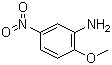 |
| Molecular Formula | C7H8N2O3 |
| Molecular Weight | 168.15 |
| CAS Registry Number | 99-59-2 |
| EC Number | 202-770-5 |
| SMILES | COC1=C(C=C(C=C1)[N+](=O)[O-])N |
| Water solubility | Slightly soluble. <0.01 g/100 mL at 19.5 °C |
|---|---|
| Density | 1.3±0.1 g/cm3, Calc.*, 1.2068 g/m |
| Melting point | 117-119 °C |
| Index of Refraction | 1.601, Calc.* |
| Boiling Point | 351.8±22.0 °C (760 mmHg), Calc.* |
| Flash Point | 166.6±22.3 °C, Calc.*, 119 °C |
| * | Calculated using Advanced Chemistry Development (ACD/Labs) Software. |
| Hazard Symbols |   GHS07;GHS08 Warning Details GHS07;GHS08 Warning Details | ||||||||||||||||||||||||||||||||||||
|---|---|---|---|---|---|---|---|---|---|---|---|---|---|---|---|---|---|---|---|---|---|---|---|---|---|---|---|---|---|---|---|---|---|---|---|---|---|
| Risk Statements | H302-H312-H315-H319-H332-H335-H351 Details | ||||||||||||||||||||||||||||||||||||
| Safety Statements | P203-P261-P264-P264+P265-P270-P271-P280-P301+P317-P302+P352-P304+P340-P305+P351+P338-P317-P318-P319-P321-P330-P332+P317-P337+P317-P362+P364-P403+P233-P405-P501 Details | ||||||||||||||||||||||||||||||||||||
| Hazard Classification | |||||||||||||||||||||||||||||||||||||
| |||||||||||||||||||||||||||||||||||||
| SDS | Available | ||||||||||||||||||||||||||||||||||||
 chemBlink Chemical Story
|
2-Amino-4-nitro anisidine, a significant derivative of anisidine, has attracted attention in both organic chemistry and industrial applications due to its unique chemical properties. The discovery of this compound can be traced back to efforts aimed at synthesizing nitroaniline derivatives, which are vital in various chemical processes. The introduction of both amino and nitro functional groups at specific positions on the anisidine ring enhances its reactivity and expands its utility in synthetic organic chemistry. The synthesis of 2-Amino-4-nitro anisidine typically involves the nitration of anisidine followed by a careful reduction process. The nitration introduces the nitro group at the para position relative to the methoxy group, while the amino group is already present at the ortho position. This synthetic approach allows for the selective formation of the desired compound while minimizing the production of by-products. The resulting compound features both electron-donating and electron-withdrawing groups, which play a critical role in its reactivity and interactions with other chemical entities. 2-Amino-4-nitro anisidine finds various applications across multiple fields. In dye manufacturing, it serves as a key intermediate for producing azo dyes, which are widely used in textiles and printing. The ability of this compound to participate in diazotization reactions makes it a valuable precursor for generating vibrant colorants. Furthermore, its structure allows it to act as a coupling agent in the synthesis of other organic compounds, enhancing its importance in the chemical industry. In addition to its role in dye chemistry, 2-Amino-4-nitro anisidine has also been explored for its potential biological activities. Some studies suggest that compounds with similar structures may exhibit antibacterial or antitumor properties, prompting research into their therapeutic potential. The presence of the amino and nitro groups may contribute to interactions with biological targets, making it a candidate for further pharmacological studies. Despite its utility, there are considerations regarding the safety and environmental impact of 2-Amino-4-nitro anisidine. The compound, like many nitroaromatic compounds, may pose toxicity risks, necessitating careful handling and regulation in industrial settings. Ongoing research aims to better understand its toxicological profile and to explore safer alternatives in applications where possible. In conclusion, 2-Amino-4-nitro anisidine represents a versatile compound with significant importance in both synthetic organic chemistry and industrial applications. Its unique structure and properties enable it to function as a crucial intermediate in dye production and potentially offer therapeutic benefits. Continued research into its applications and safety will enhance its contribution to various fields, highlighting the relevance of such compounds in modern chemistry. References 2005. Synthesis and antitumor activity of 5-(9-acridinylamino)anisidine derivatives. Bioorganic & Medicinal Chemistry, 13(24). DOI: 10.1016/j.bmc.2005.07.018 2018. 2,4 Dinitroanisole (DNAN). Emerging Energetic Materials: Synthesis, Physicochemical, and Detonation Properties. DOI: DOI: 10.1007/s10600-024-04479-0 |
| Market Analysis Reports |