Imagine a long polymer chain as a line of molecular code. Most of its building blocks create the basic material—but occasionally, chemists insert a special monomer that gives the entire chain a new instruction.
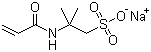
Sodium AMPS is one of those molecular instructions.
One part of the molecule allows it to join a growing polymer chain permanently. Another part carries a strongly water-loving, negatively charged sulfonate group.
Once polymerized, that functionality can't simply wash away. It has become part of the material itself.
Add enough of these units and a polymer can become dramatically more attracted to water, more ionic, and better suited to environments containing dissolved salts.

Global Chemical Database