
Online Database of Chemicals from Around the World
| Mascot I.E. CO.,Ltd. | China | |||
|---|---|---|---|---|
 | www.mascotchem.com | |||
 | +86 (519) 8501-0339 +86 13584504415 | |||
 | +86 (519) 8501-0366 | |||
 | info@mascotchem.com | |||
 | QQ Chat | |||
| Chemical distributor since 2006 | ||||
| chemBlink Standard supplier since 2006 | ||||
| Vinati Organics Limited | India | |||
|---|---|---|---|---|
| www.vinatiorganics.com | |||
| +91 (22) 6124-0444 | |||
| +91 (22) 2851-0729 | |||
| siddhant.choudhary@vinatiorganics.com | |||
| Chemical manufacturer since 1989 | ||||
| chemBlink Standard supplier since 2006 | ||||
| Simagchem Corporation | China | |||
|---|---|---|---|---|
| www.simagchem.com | |||
| +86 13806087780 | |||
| +86 (592) 268-0237 | |||
| sale@simagchem.com | |||
| Chemical manufacturer since 2002 | ||||
| chemBlink Standard supplier since 2008 | ||||
| Hefei TNJ Chemical Industry Co., Ltd. | China | |||
|---|---|---|---|---|
| www.tnjchem.com | |||
| +86 (551) 6541-8684 | |||
| +86 (551) 6541-8697 | |||
| sales@tnjchem.com | |||
| Chemical manufacturer since 2001 | ||||
| chemBlink Standard supplier since 2010 | ||||
| BOC Sciences | USA | |||
|---|---|---|---|---|
| www.bocsci.com | |||
| +1 (631) 485-4226 | |||
| +1 (631) 614-7828 | |||
| info@bocsci.com | |||
| Chemical manufacturer | ||||
| chemBlink Standard supplier since 2010 | ||||
| Nanjing All-plus Chemical Co., Ltd. | China | |||
|---|---|---|---|---|
| www.allplusgroup.com | |||
| +86 (25) 8320-3063 | |||
| +86 (25) 8320-3093 | |||
| mary.chen@allplusgroup.com | |||
| Chemical manufacturer since 2004 | ||||
| chemBlink Standard supplier since 2017 | ||||
| Riverland Trading LLC. | USA | |||
|---|---|---|---|---|
| www.riverlandtrading.com | |||
| +1 (336).944-2293 | |||
| bens@riverlandtrading.com | |||
| Chemical distributor | ||||
| chemBlink Standard supplier since 2023 | ||||
| Gelest, Inc. | USA | |||
|---|---|---|---|---|
| www.gelest.com | |||
| +1 (215) 547-1015 | |||
| +1 (215) 547-2484 | |||
| info@gelest.com | |||
| Chemical manufacturer | ||||
| Scientific Polymer Products, Inc. | USA | |||
|---|---|---|---|---|
| www.scientificpolymer.com | |||
| +1 (585) 265-0413 | |||
| +1 (585) 265-1390 | |||
| custserv@scipoly.com | |||
| Chemical manufacturer | ||||
| Classification | Organic raw materials >> Organometallic compound >> Organic sodium |
|---|---|
| Name | 2-Acrylamido-2-methyl-1-propanesulfonic acid sodium salt |
| Synonyms | Sodium 2-methyl-2-[(1-oxoallyl)amino]propanesulphonate |
| Molecular Structure | 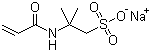 |
| Molecular Formula | C7H12NNaO4S |
| Molecular Weight | 229.23 |
| CAS Registry Number | 5165-97-9 |
| EC Number | 225-948-4 |
| SMILES | CC(C)(CS(=O)(=O)[O-])NC(=O)C=C.[Na+] |
| Density | 1.2055 |
|---|---|
| Refractive index | 1.4220 |
| Hazard Symbols |  GHS07 Warning Details GHS07 Warning Details | ||||||||||||||||
|---|---|---|---|---|---|---|---|---|---|---|---|---|---|---|---|---|---|
| Risk Statements | H315-H319 Details | ||||||||||||||||
| Safety Statements | P264-P280-P302+P352-P337+P313-P305+P351+P338-P362+P364-P332+P313 Details | ||||||||||||||||
| Hazard Classification | |||||||||||||||||
| |||||||||||||||||
| SDS | Available | ||||||||||||||||
 chemBlink Chemical Story
|
2-Acrylamido-2-methyl-1-propanesulfonic acid sodium salt, commonly called sodium AMPS or Na-AMPS, is the sodium salt of 2-acrylamido-2-methylpropanesulfonic acid. Like its parent acid, it combines a polymerizable carbon-carbon double bond, an amide group, and a strongly hydrophilic sulfonate group within a single molecule. This combination makes sodium AMPS a useful functional monomer for introducing permanent ionic character, water affinity, and electrolyte tolerance into polymers. The distinction between AMPS and its sodium salt may appear minor, but it is important in practical polymer chemistry. AMPS contains a sulfonic acid group, whereas sodium AMPS contains the corresponding sulfonate anion associated with Na+. In aqueous systems, the sulfonate functionality is strongly ionized and strongly hydrated. Supplying the monomer directly in its sodium salt form can therefore be convenient for water-based polymerization and formulation processes where neutralization and pH control are important. When sodium AMPS undergoes free-radical polymerization, its carbon-carbon double bond becomes part of the growing polymer backbone while the sulfonate group remains attached as an ionic side group. A relatively small monomer is thus able to permanently install large numbers of hydrophilic, negatively charged sites along a macromolecular chain. Unlike additives that can gradually diffuse out of a material, these functional groups are covalently incorporated into the polymer structure. This architecture gives sodium-AMPS-containing polymers several characteristic behaviors. Sulfonate groups attract water strongly and generate electrostatic repulsion between charged segments of the polymer chain. These interactions can promote hydration, solubility, swelling, dispersion, and ion transport. Sulfonate groups also remain ionized over a broad range of conditions, which makes them particularly useful where polymers must operate in saline or otherwise demanding aqueous environments. One important application is the preparation of water-soluble copolymers. Sodium AMPS can be copolymerized with acrylamide and numerous other vinyl monomers to modify viscosity, salt tolerance, dispersion behavior, and interactions with mineral surfaces. Such polymers are useful in industrial water treatment, scale control, dispersants, coatings, paper processing, and oilfield formulations. In oil and gas applications, AMPS-derived ionic groups are particularly valued because conventional water-soluble polymers can lose performance when exposed to elevated temperature and high concentrations of dissolved salts. Crosslinking introduces another possibility. Instead of producing a soluble polymer, sodium AMPS can become part of a three-dimensional hydrogel network. The fixed sulfonate groups draw water and mobile counterions into the network, allowing substantial swelling. By combining sodium AMPS with other monomers and controlling crosslink density, researchers can tune water uptake, mechanical strength, ionic conductivity, and responsiveness to surrounding solutions. These properties have made sulfonated hydrogels interesting for technologies far removed from conventional industrial polymers. AMPS-derived networks have been studied for absorbent materials, membranes, controlled-release systems, biomedical hydrogels, sensors, and ion-conducting materials. Although the applications differ greatly, the underlying molecular principle remains the same: fixed ionic groups incorporated into a polymer can control how the entire material interacts with water and dissolved ions. Sodium AMPS therefore illustrates the distinction between an ordinary additive and a functional monomer. An additive is mixed into a material and may eventually migrate away. A functional monomer becomes part of the material itself. Once sodium AMPS is polymerized, its sulfonate functionality is written directly into the macromolecular architecture. This concept is central to modern polymer science. Chemists increasingly design materials not simply by choosing a polymer, but by deciding which molecular functions should appear along its chains and how frequently they should occur. Hydrophilicity, ionic charge, adhesion, responsiveness, and compatibility can all be adjusted through the selection of appropriate comonomers. Sodium AMPS is therefore best understood as a molecular instruction rather than merely another acrylic monomer. Its polymerizable group says, in effect, "build me into the chain," while its sulfonate group determines one of the behaviors that the resulting polymer will carry. From water-treatment polymers to hydrogels and ion-containing materials, sodium AMPS demonstrates how modern chemists can program useful properties into materials one monomer at a time. References 1. Okay, O.; Durmaz, S. (2002). "Charge density dependence of elastic modulus of strong polyelectrolyte hydrogels." Polymer, 43, 1215-1221. https://doi.org/10.1016/S0032-3861(01)00664-1 2. Okay, O.; Sariisik, S. B. (2000). "Swelling behavior of poly(acrylamide-co-sodium acrylate) hydrogels in aqueous salt solutions: theory versus experiments." European Polymer Journal, 36, 393-399. 3. Li, S.; Long, W.; Wei, Z.; Zhao, Y.; Sun, X.; Zhou, F. (2024). "Source, type, controlling, and utilization of by-and side-products arising from the production process of 2-acrylamido-2-methyl propane sulfonic acid (AMPS): A review." Journal of Cleaner Production, 438, 140671. https://doi.org/10.1016/j.jclepro.2024.140671 |
| Market Analysis Reports |