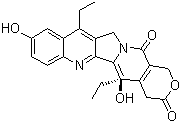
7-Ethyl-10-hydroxycamptothecin (CAS 86639-52-3) has a chemical story that connects molecular identity with practical chemistry. 7-Ethyl-10-hydroxycamptothecin is better known as SN-38, the active metabolite responsible for much of the antitumor activity of irinotecan. Camptothecin was isolated in the 1960s from Camptotheca acuminata, but direct development was complicated by solubility and toxicity. Medicinal chemistry produced derivatives including irinotecan, a clinically useful prodrug. Carboxylesterases convert irinotecan to SN-38 in the body. PubChem identifies SN-38 as C22H20N2O5 and a DNA topoisomerase I inhibitor. It stabilizes the normally transient topoisomerase I-DNA cleavage complex; collision with replication machinery can then produce damaging DNA lesions. SN-38 is substantially more potent than irinotecan in cellular systems, making its formation and subsequent glucuronidation central to irinotecan efficacy, variability and toxicity.
The exact registered form matters because related salts, stereoisomers, metabolites, intermediates or finished medicines can occupy very different roles even when their names look nearly interchangeable.

Global Chemical Database