
Online Database of Chemicals from Around the World
| Nanjing Search Biotech Co., Ltd. | China | |||
|---|---|---|---|---|
 | www.searchbio.com.cn | |||
 | +86 (25) 8168-2922 8586-0978 +86 18913919581 | |||
 | +86 (25) 8586-0962 | |||
 | trade@searchbio.com.cn sales@searchbio.com.cn Linda@searchbio.com.cn | |||
 | QQ Chat | |||
| Chemical manufacturer since 2007 | ||||
| chemBlink Standard supplier since 2007 | ||||
| Simagchem Corporation | China | |||
|---|---|---|---|---|
| www.simagchem.com | |||
| +86 13806087780 | |||
| +86 (592) 268-0237 | |||
| sale@simagchem.com | |||
| Chemical manufacturer since 2002 | ||||
| chemBlink Standard supplier since 2008 | ||||
| Discovery Fine Chemicals Ltd. | UK | |||
|---|---|---|---|---|
| www.discofinechem.com | |||
| +44 (1202) 874-517 | |||
| +44 (845) 094-4385 | |||
| pjc@discofinechem.com | |||
| Chemical manufacturer | ||||
| chemBlink Standard supplier since 2009 | ||||
| Hangzhou TJM Chemical Co., Ltd. | China | |||
|---|---|---|---|---|
| www.tjmchem.com | |||
| +86 13388471767 | |||
| +86 (571) 8822-3279 | |||
| sales@tjmchem.com | |||
| Chemical manufacturer | ||||
| chemBlink Standard supplier since 2011 | ||||
| Alfa Chemistry | USA | |||
|---|---|---|---|---|
| www.alfa-chemistry.com | |||
| +1 (201) 478-8534 | |||
| +1 (516) 927-0118 | |||
| inquiry@alfa-chemistry.com | |||
| Chemical distributor since 2012 | ||||
| chemBlink Standard supplier since 2012 | ||||
| Hangzhou Leap Chem Co., Ltd. | China | |||
|---|---|---|---|---|
| www.leapchem.com | |||
| +86 (571) 8771-1850 | |||
| market19@leapchem.com | |||
| QQ Chat | |||
| Chemical manufacturer since 2006 | ||||
| chemBlink Standard supplier since 2015 | ||||
| Shanghai Fuxin Pharmaceutical Co., Ltd. | China | |||
|---|---|---|---|---|
| www.fuxinpharm.com | |||
| +86 (21) 3130-0828 +86 18645121291 | |||
| +86 (21) 3130-0828 | |||
| contact@fuxinpharm.com | |||
| Chemical manufacturer since 2016 | ||||
| chemBlink Standard supplier since 2018 | ||||
| Hubei xindesheng Material Technology Co., Ltd | China | |||
|---|---|---|---|---|
| www.deshengivd.com | |||
| +86 18971041571 | |||
| zjing@gmail.com | |||
| QQ Chat | |||
| Chemical manufacturer since 2017 | ||||
| chemBlink Standard supplier since 2021 | ||||
| Dalo Chem Life Sciences (Dongguan) Co., Ltd. | China | |||
|---|---|---|---|---|
| www.dalochem.com | |||
| +86 15019076757 | |||
| sales@dalochem.com | |||
 | WhatsApp:+86-15019076757 | |||
| Chemical distributor since 2023 | ||||
| chemBlink Standard supplier since 2024 | ||||
| Indofine Chemical Company, Inc. | USA | |||
|---|---|---|---|---|
| www.indofinechemical.com | |||
| +1 (888) 463-6346 | |||
| +1 (908) 359-1179 | |||
| info@indofinechemical.com | |||
| Chemical manufacturer since 1981 | ||||
| Suzhou BEC Fine Chemicals Co., Ltd. | China | |||
|---|---|---|---|---|
| www.bek.com.cn | |||
| +86 (512) 6809-5917 +86 13806207098 | |||
| +86 (512) 6841-7933 | |||
| bek@bek.com.cn | |||
| Chemical manufacturer | ||||
| Chemos GmbH & Co. KG | Germany | |||
|---|---|---|---|---|
| www.chemos.de | |||
| +49 871-966346-0 | |||
| +49 871-966346-13 | |||
| chemos@chemos.de | |||
| Chemical distributor | ||||
| Melford Laboratories Limited | UK | |||
|---|---|---|---|---|
| www.melford.co.uk | |||
| +44 (1449) 741-178 | |||
| +44 (1449) 741-217 | |||
| pfranklin@melford.co.uk sales@melford.co.uk | |||
| Chemical manufacturer since 1985 | ||||
| Santa Cruz Biotechnology, Inc. | USA | |||
|---|---|---|---|---|
| www.scbt.com | |||
| +1 (831) 457-3800 | |||
| +1 (831) 457-3801 | |||
| scbt@scbt.com | |||
| Chemical manufacturer | ||||
| Aronis | Russia | |||
|---|---|---|---|---|
| www.aronis.ru | |||
| +7 (926) 578-0336 | |||
| +7 (495) 426-5336 | |||
| rakishev@aronis.ru | |||
| Chemical manufacturer | ||||
| Alfa Aesar. | USA | |||
|---|---|---|---|---|
| www.alfa.com | |||
| +1 (978) 521-6300 | |||
| +1 (978) 521-6350 | |||
| info@alfa.com | |||
| Chemical manufacturer | ||||
| Kishida Chemical Co., Ltd. | Japan | |||
|---|---|---|---|---|
| www.kishida.co.jp | |||
| +81 (6) 6946-8061 | |||
| +81 (6) 6946-1607 | |||
| shiyaku@kishida.co.jp | |||
| Chemical manufacturer | ||||
| Classification | Pharmaceutical intermediate >> Heterocyclic compound intermediate >> Piperazine |
|---|---|
| Name | Hepps |
| Synonyms | 4-(2-Hydroxyethyl)-1-piperazinepropanesulfonic acid; 3-[4-(2-Hydroxyethyl)-1-piperazine]propanesulfonic acid; N-(2-Hydroxyethyl)piperazine-N'-(3-propanesulfonic acid) |
| Molecular Structure | 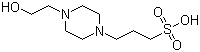 |
| Molecular Formula | C9H20N2O4S |
| Molecular Weight | 252.33 |
| CAS Registry Number | 16052-06-5 |
| EC Number | 240-198-8 |
| SMILES | C1CN(CCN1CCCS(=O)(=O)O)CCO |
| Solubility | 100 mM (water) |
|---|---|
| Melting point | 237-239 °C |
| Hazard Symbols |  GHS07 Warning Details GHS07 Warning Details | ||||||||||||||||||||||||||||||||
|---|---|---|---|---|---|---|---|---|---|---|---|---|---|---|---|---|---|---|---|---|---|---|---|---|---|---|---|---|---|---|---|---|---|
| Risk Statements | H302-H315-H319-H335 Details | ||||||||||||||||||||||||||||||||
| Safety Statements | P261-P305+P351+P338 Details | ||||||||||||||||||||||||||||||||
| Hazard Classification | |||||||||||||||||||||||||||||||||
| |||||||||||||||||||||||||||||||||
| SDS | Available | ||||||||||||||||||||||||||||||||
 Discovery and Applications
|
HEPPS, or N-(2-hydroxyethyl)piperazine-N'-(3-propanesulfonic acid), is a zwitterionic buffer that belongs to the Good family of buffers. These buffers were developed by Dr. Norman Good and his colleagues in the 1960s to provide a stable pH environment for biochemical and biological research. HEPPS has been specifically synthesized to provide effective buffering in a slightly alkaline pH range, which is critical for many biological and chemical processes. The molecular formula of HEPPS is C9H20N2O4S. Structurally, it consists of a piperazine ring substituted with hydroxyethyl and propanesulfonic acid groups. This combination gives HEPPS a zwitterionic nature that contributes to its stability and solubility. HEPPS has a pKa of approximately 8.0 at 25°C, making it suitable for buffering in the pH range of 7.5 to 9.0. HEPPS is widely used as a buffer in a variety of biochemical and molecular biology experiments. Its stability and compatibility with a range of biomolecules make it ideal for maintaining pH in enzymatic reactions, nucleic acid purification, and protein assays. HEPPS is particularly useful in experiments that require a stable, slightly alkaline pH environment. In electrophoresis, HEPPS is used to prepare buffer solutions that maintain a stable pH during protein and nucleic acid separations. For example, in HEPPS buffer systems, it ensures consistent migration of macromolecules, allowing for accurate analysis and characterization. HEPPS is used in protein purification protocols such as ion exchange chromatography and affinity chromatography. Its buffering capacity helps maintain the pH of the solution, ensuring that proteins remain in their native functional state during purification. This stability is essential for maintaining protein activity and integrity. In cell culture applications, HEPPS helps maintain the pH of the culture medium, providing a stable environment for cell growth and function. This stability is critical for sensitive cell lines and primary cultures, which require precise pH control for optimal growth and differentiation. HEPPS is an important ingredient in diagnostic reagent formulations, especially those that require a stable pH. Its nontoxic nature and compatibility with a variety of biological systems make it suitable for use in diagnostic assays and kits. References 1951. Der mikrobielle Abbau der Aminosäuren. Archiv für Mikrobiologie, 17, 217-232. DOI: 10.1007/bf00406733 2024. Investigation of Bottleneck Enzyme Through Flux Balance Analysis to Improve Glycolic Acid Production in Escherichia coli. Journal of Microbiology (Seoul, Korea), 62, 567-575. DOI: 10.1007/s12275-024-00175-4 |
| Market Analysis Reports |