
Online Database of Chemicals from Around the World
| Hangzhou Verychem Science And Technology Co., Ltd. | China | |||
|---|---|---|---|---|
 | www.verychem.com | |||
 | +86 (571) 8816-2785 +86 13606544505 | |||
 | +86 (571) 8816-2787 | |||
 | lucy@verychem.com | |||
| Chemical manufacturer since 2004 | ||||
| chemBlink Standard supplier since 2006 | ||||
| Capot Chemical Co., Ltd. | China | |||
|---|---|---|---|---|
| www.capotchem.com | |||
| +86 (571) 8558-6718 +86 13336195806 | |||
| +86 (571) 8586-4795 | |||
| capotchem@gmail.com sales@capotchem.com | |||
 | QQ Chat | |||
| Chemical manufacturer | ||||
| chemBlink Standard supplier since 2006 | ||||
| Cangzhou Goldlion Chemicals Co., Ltd. | China | |||
|---|---|---|---|---|
| www.goldlionchem.com | |||
| +86 13315721466 +86 (317) 530-4268 | |||
| +86 (317) 530-4268 | |||
| info@goldlionchem.com | |||
| Chemical manufacturer | ||||
| chemBlink Standard supplier since 2007 | ||||
| Hefei TNJ Chemical Industry Co., Ltd. | China | |||
|---|---|---|---|---|
| www.tnjchem.com | |||
| +86 (551) 6541-8684 | |||
| +86 (551) 6541-8697 | |||
| sales@tnjchem.com | |||
| Chemical manufacturer since 2001 | ||||
| chemBlink Standard supplier since 2010 | ||||
| Hangzhou Leap Chem Co., Ltd. | China | |||
|---|---|---|---|---|
| www.leapchem.com | |||
| +86 (571) 8771-1850 | |||
| market19@leapchem.com | |||
| QQ Chat | |||
| Chemical manufacturer since 2006 | ||||
| chemBlink Standard supplier since 2015 | ||||
| Shanghai Witofly Chemical Co., Ltd. | China | |||
|---|---|---|---|---|
| www.witofly.com | |||
| +86 (21) 5063-0626 | |||
| +86 (21) 5056-3898 | |||
| sales@witofly.com | |||
| QQ Chat | |||
| Chemical distributor since 2016 | ||||
| chemBlink Standard supplier since 2016 | ||||
| Hubei Huangshi Meifeng Chemical Co., Ltd. | China | |||
|---|---|---|---|---|
| www.mfci.com.cn | |||
| +86 (714) 651-6706 651-6707 | |||
| +86 (714) 651-6705 | |||
| hsmfci2@163.com | |||
| Chemical manufacturer since 2011 | ||||
| chemBlink Standard supplier since 2019 | ||||
| Shanghai Tajilin Industrial Co., Ltd. | China | |||
|---|---|---|---|---|
| www.tajilin.com | |||
| +86 (21) 5063-0626 | |||
| +86 (21) 5056-3898 | |||
| sales003@tajilin.com | |||
| Chemical manufacturer since 2019 | ||||
| chemBlink Standard supplier since 2020 | ||||
| Belchem Industries (india) Pvt. Ltd. | India | |||
|---|---|---|---|---|
| www.belchem.com | |||
| +91 (22) 2410-2278 | |||
| belchem.mktg@gmail.com | |||
| Chemical manufacturer since 1986 | ||||
| chemBlink Standard supplier since 2020 | ||||
| Wuhan Eastin Chemical Industry Co., Ltd. | China | |||
|---|---|---|---|---|
| www.eastinchem.com | |||
| +86 (27) 5940-3728 | |||
| +86 (27) 8324-2505 | |||
| 13907162606@163.com | |||
| Chemical manufacturer since 2001 | ||||
| Wuahan Meheke Co., Ltd. | China | |||
|---|---|---|---|---|
| www.meheke.com | |||
| +86 (27) 8535-3562 8535-3563 | |||
| +86 (27) 8580-0308 | |||
| liyu@vip.163.com | |||
| Chemical manufacturer since 2004 | ||||
| Classification | Catalysts and additives >> UV absorber |
|---|---|
| Name | Ensulizole |
| Synonyms | 2-Phenylbenzimidazole-5-sulfonic acid; 2-Phenyl-1H-benzo[d]imidazole-5-sulfonic acid |
| Molecular Structure | 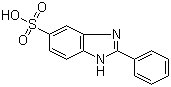 |
| Molecular Formula | C13H10N2O3S |
| Molecular Weight | 274.29 |
| CAS Registry Number | 27503-81-7 |
| EC Number | 248-502-0 |
| SMILES | C1=CC=C(C=C1)C2=NC3=C(N2)C=C(C=C3)S(=O)(=O)O |
| Water solubility | soluble |
|---|---|
| Density | 1.5±0.1 g/cm3, Calc.* |
| Melting point | 300 °C |
| Index of Refraction | 1.704, Calc.* |
| * | Calculated using Advanced Chemistry Development (ACD/Labs) Software. |
| Hazard Symbols |  GHS07 Warning Details GHS07 Warning Details | ||||||||||||
|---|---|---|---|---|---|---|---|---|---|---|---|---|---|
| Risk Statements | H315-H319 Details | ||||||||||||
| Safety Statements | P264-P264+P265-P280-P302+P352-P305+P351+P338-P321-P332+P317-P337+P317-P362+P364 Details | ||||||||||||
| Hazard Classification | |||||||||||||
| |||||||||||||
| SDS | Available | ||||||||||||
 Discovery and Applications
|
Ensulizole, also known as phenylbenzimidazole sulfonic acid, is a chemical compound used primarily as a sunscreen agent in cosmetics and personal care products. It is an organic compound with the ability to absorb ultraviolet (UV) light, particularly UVB radiation, which is a key contributor to skin damage and sunburn. Ensulizole is often included in sunscreens to protect the skin from harmful UV rays, thereby reducing the risk of skin aging, DNA damage, and skin cancer. The discovery of ensulizole is rooted in the search for more effective and safer UV filters. Early sunscreen formulations contained physical blockers, such as zinc oxide or titanium dioxide, but these ingredients were often associated with whitening effects on the skin. Over time, researchers began to develop organic UV filters that could absorb UV radiation more effectively and leave no visible residue. Ensulizole was identified as one of these organic compounds, with a structure that allows it to absorb UVB rays in the 280–320 nm range. Its development was part of a broader effort to create sunscreens that provide broad-spectrum protection while maintaining cosmetic elegance. Ensulizole's primary function in skincare products is to absorb UVB radiation, which is responsible for causing sunburns and contributing to the development of skin cancers. It works by converting the absorbed UVB energy into heat, thereby preventing the harmful effects of UV radiation on the skin. Ensulizole is typically used in combination with other sunscreen agents to provide more comprehensive protection, covering both UVA and UVB rays. Unlike some other UV filters, ensulizole is water-soluble, which makes it suitable for use in a variety of formulations, including gels, lotions, and sprays. One of the key applications of ensulizole is in the formulation of sunscreens designed to protect the skin from sun damage. It is particularly useful in products targeted at individuals with sensitive skin or those who seek a lightweight, non-greasy sunscreen option. Ensulizole is also commonly found in combination with other sunscreen agents such as avobenzone, octinoxate, or homosalate to provide broad-spectrum protection. This allows for the creation of sunscreens that offer more complete protection against the harmful effects of both UVA and UVB radiation, which can contribute to premature aging and increase the risk of skin cancer. In addition to its role in sun protection, ensulizole is used in a variety of cosmetic products, including moisturizers, foundations, and anti-aging creams. It is valued for its ability to provide UV protection without causing irritation or leaving a greasy residue, making it an ideal ingredient for products intended for daily use. Ensulizole's relatively mild and non-irritating properties make it particularly suitable for use in products designed for sensitive skin or for those prone to allergic reactions. Ensulizole is considered to be a safe and effective sunscreen agent when used as directed. However, like other sunscreen agents, it is important to apply products containing ensulizole regularly and in sufficient amounts to achieve the desired level of protection. Sunscreen effectiveness can diminish over time due to sweating, swimming, or towel-drying, so reapplication is recommended to maintain optimal protection. Despite its benefits, some concerns have been raised about the environmental impact of certain sunscreen ingredients, including ensulizole. Studies have suggested that some UV filters may contribute to coral reef degradation and other environmental issues. As a result, there has been growing interest in the development of more environmentally friendly alternatives to conventional sunscreen agents. Nonetheless, ensulizole remains a widely used ingredient in the cosmetic and personal care industry due to its effectiveness and favorable safety profile. In conclusion, ensulizole is a valuable ingredient in sunscreens and other cosmetic products, offering effective protection against UVB radiation. Its ability to absorb harmful UV rays and convert them into harmless heat makes it an essential tool in protecting the skin from sunburn, premature aging, and skin cancer. As the demand for more effective and environmentally conscious sun protection continues to grow, ensulizole will likely remain an important component in many skincare formulations. References 2024. Topical Sunscreening Agents. Cosmetic and Dermatological Application of Seaweed: Skincare Therapy-Cosmeceuticals. DOI: 10.1007/978-3-031-47802-4_7 2022. Enhanced photocatalytic treatment using plasmonic Ag@Ag3PO4/Ag@AgCl nanophotocatalyst for simultaneous degradation of multiple parabens and UV-filters in various aquatic environments under visible light irradiation. Environmental Science and Pollution Research, 29(45). DOI: 10.1007/s11356-022-19876-2 2021. Elucidating the Photoluminescence Quenching in Ensulizole: an Artificial Water Soluble Sunscreen. The Journal of Physical Chemistry A, 125(23). DOI: 10.1021/acs.jpca.1c02914 |
| Market Analysis Reports |