
Online Database of Chemicals from Around the World
| Fujian Wolfa Biotechnology Co., Ltd. | China | |||
|---|---|---|---|---|
 | www.wolfabio.com | |||
 | +86 18050950397 | |||
 | jomin@wolfabio.com | |||
 | WhatsApp:+86 18359103607 | |||
| Chemical manufacturer since 2023 | ||||
| chemBlink Standard supplier since 2024 | ||||
| Classification | Organic raw materials >> Organometallic compound >> Organic scandium, tantalum, thallium, tungsten, antimony, lanthanum, lead, vanadium, molybdenum, chromium, ytterbium, etc. |
|---|---|
| Name | Tricarbonyltris(propionitrile)molybdenum (0) |
| Synonyms | carbon monoxide molybdenum propanenitrile |
| Molecular Structure | 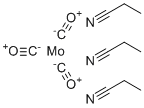 |
| Molecular Formula | C12H15MoN3O3 |
| Molecular Weight | 345.23 |
| CAS Registry Number | 103933-26-2 |
| EC Number | 812-500-3 |
| SMILES | CCC#N.CCC#N.CCC#N.[C-]#[O+].[C-]#[O+].[C-]#[O+].[Mo] |
| Hazard Symbols |  GHS07 Warning Details GHS07 Warning Details |
|---|---|
| Risk Statements | H315-H319-H335 Details |
| Safety Statements | P261-P264-P264+P265-P271-P280-P302+P352-P304+P340-P305+P351+P338-P319-P321-P332+P317-P337+P317-P362+P364-P403+P233-P405-P501 Details |
| SDS | Available |
 chemBlink Chemical Story
|
Tricarbonyltris(propionitrile)molybdenum(0) is an important chemical compound in the field of organometallic chemistry, characterized by its unique coordination environment and reactivity. This substance, often referred to as Mo(CO)_3(PN)_3, consists of a molybdenum center coordinated to three carbonyl (CO) groups and three propionitrile (PN) ligands. Its discovery and application provide valuable insights into transition metal chemistry and catalysis. The discovery of tricarbonyltris(propionitrile)molybdenum(0) can be traced back to research focused on exploring the chemistry of molybdenum carbonyl complexes. The initial synthesis involved the reaction of molybdenum hexacarbonyl with propionitrile under specific conditions, resulting in the formation of the tricarbonyltris(propionitrile)molybdenum(0) complex. The choice of propionitrile as a ligand, combined with the molybdenum center, led to the formation of a complex with distinct electronic and steric properties. The synthesis of this complex involves the reaction of molybdenum hexacarbonyl (Mo(CO)_6) with propionitrile (C_2H_5CN) in the presence of a suitable solvent and catalyst. The process typically requires controlled temperatures and pressures to ensure the successful formation of the desired product. The resulting tricarbonyltris(propionitrile)molybdenum(0) exhibits a stable structure with three CO groups and three PN ligands coordinated to the central molybdenum atom. Tricarbonyltris(propionitrile)molybdenum(0) has several notable applications, particularly in the field of catalysis. The compound is used as a catalyst in various chemical reactions due to its unique electronic configuration and coordination environment. Transition metal carbonyl complexes, including this one, are known for their ability to facilitate a range of transformations by interacting with substrates through their metal centers. One significant application of tricarbonyltris(propionitrile)molybdenum(0) is in catalytic hydrogenation reactions. The molybdenum center in the complex can activate hydrogen molecules and facilitate their addition to unsaturated substrates. This application is crucial in the synthesis of various chemicals and pharmaceuticals, where selective hydrogenation is often required. The presence of the propionitrile ligands helps stabilize the complex and enhance its reactivity. Additionally, tricarbonyltris(propionitrile)molybdenum(0) is employed in studies exploring the mechanisms of transition metal-catalyzed reactions. The well-defined structure of the complex allows researchers to investigate the interactions between the metal center and ligands, providing insights into the fundamental principles of catalysis. Understanding these interactions is essential for designing more efficient catalysts and optimizing reaction conditions in industrial processes. The compound's stability and solubility in organic solvents further enhance its utility in laboratory research. Its applications extend to academic studies focused on developing new catalytic processes and understanding the behavior of molybdenum complexes in various chemical environments. In summary, tricarbonyltris(propionitrile)molybdenum(0) is an important organometallic compound with significant implications for catalysis and chemical synthesis. Its discovery and subsequent applications underscore the role of transition metal carbonyl complexes in advancing chemical research and industrial processes. References 2011. Molybdenum-Catalyzed and Tungsten-Catalyzed Enantioselective Allylic Substitutions. Transition Metal Catalyzed Enantioselective Allylic Substitution in Organic Synthesis. DOI: 10.1007/3418_2011_11 1986. Preparation and properties of molybdenum and tungsten dinitrogen complexes. Inorganica Chimica Acta. DOI: 10.1016/S0020-1693(00)81199-2 1995. Synthesis and reactivity of molybdenum(0) complexes with nitrile ligands. Journal of Organometallic Chemistry. DOI: 10.1016/0022-328X(94)05230-7 |
| Market Analysis Reports |