
Online Database of Chemicals from Around the World
| Ereztech LLC | USA | |||
|---|---|---|---|---|
 | www.ereztech.com | |||
 | +1 (888) 658-1221 | |||
 | sales@ereztech.com | |||
| Chemical distributor since 2010 | ||||
| chemBlink Standard supplier since 2011 | ||||
| Intatrade Chemicals GmbH | Germany | |||
|---|---|---|---|---|
| www.intatrade.de | |||
| +49 (3493) 605-465 | |||
 | +49 (3493) 605-470 | |||
| sales@intatrade.de | |||
| Chemical distributor | ||||
| chemBlink Standard supplier since 2011 | ||||
| Fujian Wolfa Biotechnology Co., Ltd. | China | |||
|---|---|---|---|---|
| www.wolfabio.com | |||
| +86 18050950397 | |||
| jomin@wolfabio.com | |||
 | WhatsApp:+86 18359103607 | |||
| Chemical manufacturer since 2023 | ||||
| chemBlink Standard supplier since 2024 | ||||
| Classification | Organic raw materials >> Organometallic compound >> Organic scandium, tantalum, thallium, tungsten, antimony, lanthanum, lead, vanadium, molybdenum, chromium, ytterbium, etc. |
|---|---|
| Name | Tricarbonyl(pi-methyl benzoate)chromium |
| Synonyms | Methyl benchrotrene carboxylate; Tricarbonyl(methyl benzoate)chromium; Tricarbonyl(eta6-methyl benzoate)chromium |
| Molecular Structure | 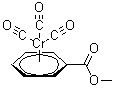 |
| Molecular Formula | C11H8CrO5 |
| Molecular Weight | 272.17 |
| CAS Registry Number | 12125-87-0 |
| EC Number | 631-408-2 |
| SMILES | COC(=O)C1=CC=CC=C1.[C-]#[O+].[C-]#[O+].[C-]#[O+].[Cr] |
| Melting point | 93-95 °C* |
|---|---|
| * | Kostermans, G. B. M. |
| Hazard Symbols |  GHS07 Warning Details GHS07 Warning Details | ||||||||||||||||
|---|---|---|---|---|---|---|---|---|---|---|---|---|---|---|---|---|---|
| Risk Statements | H302-H312-H332 Details | ||||||||||||||||
| Safety Statements | P261-P264-P270-P271-P280-P301+P317-P302+P352-P304+P340-P317-P321-P330-P362+P364-P501 Details | ||||||||||||||||
| Hazard Classification | |||||||||||||||||
| |||||||||||||||||
 chemBlink Chemical Story
|
Tricarbonyl(pi-methyl benzoate)chromium, with the chemical formula Cr(C₆H₅COOCH₃)(CO)₃, is a notable organometallic compound recognized for its unique structure and diverse applications. This compound represents a significant development in the field of organometallic chemistry and catalysis. The synthesis of tricarbonyl(pi-methyl benzoate)chromium is attributed to advancements in the study of transition metal carbonyl complexes during the latter half of the 20th century. Researchers interested in the interactions between transition metals and organic ligands discovered that chromium could form stable complexes with carbon monoxide and various aromatic carboxylate esters. The synthesis typically involves reacting chromium carbonyl with methyl benzoate under controlled conditions, resulting in the formation of Cr(C₆H₅COOCH₃)(CO)₃. This discovery added to the growing body of knowledge regarding metal-carbonyl and metal-carboxylate interactions. One of the primary applications of tricarbonyl(pi-methyl benzoate)chromium is in catalysis. The compound is utilized as a catalyst in various chemical reactions, including carbonylation and hydroformylation processes. In carbonylation reactions, tricarbonyl(pi-methyl benzoate)chromium facilitates the introduction of carbonyl groups into organic molecules. This reaction is essential in the synthesis of various chemicals and intermediates used in pharmaceuticals and agrochemicals. The compound’s ability to stabilize reactive intermediates and control reaction pathways enhances the efficiency and selectivity of these processes. In hydroformylation, tricarbonyl(pi-methyl benzoate)chromium aids in the addition of formyl groups (CHO) to alkenes in the presence of hydrogen and carbon monoxide. This reaction is crucial for producing aldehydes, which serve as intermediates in the synthesis of alcohols, acids, and other chemicals. The use of this compound as a catalyst in hydroformylation improves the yield and selectivity of the desired products, making it valuable in industrial applications. The study of tricarbonyl(pi-methyl benzoate)chromium also contributes to the understanding of metal-organic interactions. The compound serves as a model for investigating the bonding and reactivity of transition metal complexes with carboxylate esters and carbon monoxide. Its well-defined structure and stable coordination provide insights into the electronic and geometric effects of such interactions, advancing the field of organometallic chemistry. In addition to its catalytic applications, tricarbonyl(pi-methyl benzoate)chromium is used in the synthesis of chromium-containing materials and coatings. The compound can be employed to prepare materials with specific properties, such as chromium-based thin films and nanoparticles. These materials have potential applications in electronics, magnetic devices, and other advanced technologies. Handling tricarbonyl(pi-methyl benzoate)chromium requires careful attention due to the toxicity of carbon monoxide. The compound should be used in well-ventilated areas with appropriate safety measures to prevent exposure to toxic fumes. Proper storage and handling procedures are essential to ensure safe use in both laboratory and industrial settings. Ongoing research continues to explore new applications and optimize the properties of tricarbonyl(pi-methyl benzoate)chromium. Advances in organometallic chemistry and materials science are leading to the development of novel catalysts and materials based on this compound, with potential implications for various industrial and technological applications. In summary, tricarbonyl(pi-methyl benzoate)chromium is an important organometallic compound with significant applications in catalysis, materials science, and the study of metal-organic interactions. Its discovery and development have made notable contributions to the field of chemistry, and continued research holds promise for discovering further uses and improvements. References Derek R. Boyd, Narain D. Sharma, Nigel I. Bowers, Gerard B. Coen, John F. Malone, Colin R. O'Dowd, Paul J. Stevenson and Christopher C. R. Allen. Chemoenzymatic synthesis of the carbasugars carba-β-l-galactopyranose, carba-β-l-talopyranose and carba-α-l-talopyranose from methyl benzoate, Org. Biomol. Chem., 2010, 8, 1415. |
| Market Analysis Reports |