
Online Database of Chemicals from Around the World
| Fujian Wolfa Biotechnology Co., Ltd. | China | |||
|---|---|---|---|---|
 | www.wolfabio.com | |||
 | +86 18050950397 | |||
 | jomin@wolfabio.com | |||
 | WhatsApp:+86 18359103607 | |||
| Chemical manufacturer since 2023 | ||||
| chemBlink Standard supplier since 2024 | ||||
| Classification | Organic raw materials >> Organometallic compound >> Organic scandium, tantalum, thallium, tungsten, antimony, lanthanum, lead, vanadium, molybdenum, chromium, ytterbium, etc. |
|---|---|
| Name | Tricarbonyl((1,2,3,4,5,6-eta)-1,3,5-trimethylbenzene)chromium |
| Synonyms | carbon monoxide chromium 1,3,5-trimethylbenzene |
| Molecular Structure | 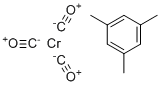 |
| Molecular Formula | C12H12CrO3 |
| Molecular Weight | 256.22 |
| CAS Registry Number | 12129-67-8 |
| EC Number | 235-205-6 |
| SMILES | CC1=CC(=CC(=C1)C)C.[C-]#[O+].[C-]#[O+].[C-]#[O+].[Cr] |
| Hazard Symbols |  GHS07 Warning Details GHS07 Warning Details | ||||||||||||||||
|---|---|---|---|---|---|---|---|---|---|---|---|---|---|---|---|---|---|
| Risk Statements | H302-H312-H332 Details | ||||||||||||||||
| Safety Statements | P261-P264-P270-P271-P280-P301+P317-P302+P352-P304+P340-P317-P321-P330-P362+P364-P501 Details | ||||||||||||||||
| Hazard Classification | |||||||||||||||||
| |||||||||||||||||
 chemBlink Chemical Story
|
Tricarbonyl((1,2,3,4,5,6-eta)-1,3,5-trimethylbenzene)chromium is a significant organometallic compound characterized by its complex structure and versatile applications in chemical synthesis and catalysis. This substance, also known as Tricarbonyl(η^6-1,3,5-trimethylbenzene)chromium, features a chromium center coordinated to three carbonyl groups and a 1,3,5-trimethylbenzene ligand, forming a stable and reactive complex. The discovery of tricarbonyl((1,2,3,4,5,6-eta)-1,3,5-trimethylbenzene)chromium dates back to research focused on exploring the chemistry of transition metal carbonyl complexes. This compound was synthesized as part of efforts to investigate the coordination behavior of chromium with aromatic ligands. The η^6-coordination mode of the 1,3,5-trimethylbenzene ligand in this complex provides unique electronic and steric properties, enhancing our understanding of chromium's reactivity in organometallic chemistry. The synthesis of tricarbonyl((1,2,3,4,5,6-eta)-1,3,5-trimethylbenzene)chromium involves the reaction of chromium hexacarbonyl with 1,3,5-trimethylbenzene under controlled conditions. The process ensures the formation of the desired η^6-complex, where the aromatic ligand coordinates to the chromium center in a manner that stabilizes the metal-carbonyl interactions. This synthesis highlights the ability to manipulate transition metal-carbonyl interactions through the choice of ligands, which can significantly affect the reactivity and properties of the resulting complex. In terms of applications, tricarbonyl((1,2,3,4,5,6-eta)-1,3,5-trimethylbenzene)chromium is primarily used as a catalyst in various chemical reactions. Transition metal carbonyl complexes, including those of chromium, are known for their ability to facilitate a range of transformations due to their unique electronic properties and coordination environments. Tricarbonyl((1,2,3,4,5,6-eta)-1,3,5-trimethylbenzene)chromium is employed in reactions where its specific electronic configuration and coordination chemistry provide catalytic advantages. One notable application of this complex is in the field of organic synthesis, particularly in the development of new catalytic processes. The chromium center in the complex can activate carbonyl groups and facilitate various transformations, including olefin metathesis and hydrogenation reactions. These transformations are essential for the synthesis of a wide range of chemical products, including pharmaceuticals and fine chemicals. The presence of the 1,3,5-trimethylbenzene ligand in the complex can also influence the reactivity and selectivity of the catalytic process. Additionally, tricarbonyl((1,2,3,4,5,6-eta)-1,3,5-trimethylbenzene)chromium serves as a valuable tool in studying the mechanisms of transition metal-catalyzed reactions. The well-defined structure of the complex allows researchers to probe the interactions between the metal center and substrates, providing insights into the fundamental principles of catalysis. This knowledge is crucial for designing more efficient catalysts and optimizing reaction conditions in industrial applications. The compound's stability and solubility in various solvents further enhance its utility in laboratory research. Its applications extend to academic studies focused on exploring new catalytic strategies and understanding the behavior of transition metal complexes in various chemical environments. In summary, tricarbonyl((1,2,3,4,5,6-eta)-1,3,5-trimethylbenzene)chromium is an important organometallic compound with significant implications for catalysis and organic synthesis. Its discovery and subsequent applications underscore the role of transition metal carbonyl complexes in advancing chemical research and industrial processes. References 2003. Synthesis of eta6-Fulvene Complexes by Photochemical Substitution of Arenes in (eta6-Arene)tricarbonylchromium(0). Science of Synthesis. URL: https://science-of-synthesis.thieme.com/app/text/?id=SD-002-00256 2003. Substitution by Photolysis of a Heteroleptic Metal-Carbonyl Complex in the Presence of Alkyne. Science of Synthesis. URL: https://science-of-synthesis.thieme.com/app/text/?id=SD-002-00300 |
| Market Analysis Reports |