
Online Database of Chemicals from Around the World
| Hangzhou Verychem Science And Technology Co., Ltd. | China | |||
|---|---|---|---|---|
 | www.verychem.com | |||
 | +86 (571) 8816-2785 +86 13606544505 | |||
 | +86 (571) 8816-2787 | |||
 | lucy@verychem.com | |||
| Chemical manufacturer since 2004 | ||||
| chemBlink Massive supplier since 2021 | ||||
| BOC Sciences | USA | |||
|---|---|---|---|---|
| www.bocsci.com | |||
| +1 (631) 485-4226 | |||
| +1 (631) 614-7828 | |||
| info@bocsci.com | |||
| Chemical manufacturer | ||||
| chemBlink Standard supplier since 2010 | ||||
| Classification | API >> Other chemicals |
|---|---|
| Name | Diclofenac epolamine |
| Synonyms | DIEP; 2-((2,6-Dichlorophenyl)amino)benzeneacetic acid 1-pyrrolidineethanol |
| Molecular Structure | 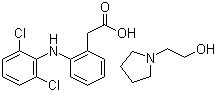 |
| Molecular Formula | C14H11Cl2NO2.C6H13NO |
| Molecular Weight | 411.32 |
| CAS Registry Number | 119623-66-4 |
| EC Number | 684-865-5 |
| SMILES | C1CCN(C1)CCO.C1=CC=C(C(=C1)CC(=O)O)NC2=C(C=CC=C2Cl)Cl |
| Hazard Symbols |   GHS06;GHS08 Danger Details GHS06;GHS08 Danger Details | ||||||||||||
|---|---|---|---|---|---|---|---|---|---|---|---|---|---|
| Risk Statements | H301-H360D-H412 Details | ||||||||||||
| Safety Statements | P203-P264-P270-P273-P280-P301+P316-P318-P321-P330-P405-P501 Details | ||||||||||||
| Hazard Classification | |||||||||||||
| |||||||||||||
| SDS | Available | ||||||||||||
 chemBlink Chemical Story
|
Diclofenac epolamine is a nonsteroidal anti-inflammatory drug (NSAID) that is widely used for the treatment of pain and inflammation. It is a salt form of diclofenac, combined with epolamine, which enhances its solubility and transdermal absorption. This formulation has gained importance in pharmaceutical applications, particularly in topical and transdermal drug delivery systems, due to its improved pharmacokinetic properties. The discovery of diclofenac epolamine is part of the broader development of diclofenac-based analgesic and anti-inflammatory drugs. Diclofenac itself was first introduced in the 1970s, and researchers later explored different salt forms to optimize its therapeutic potential. Epolamine, also known as ethanolamine, was selected as a counterion due to its ability to increase the permeability of diclofenac through the skin. This innovation led to the development of transdermal patches and topical gels that offer localized pain relief with reduced systemic side effects. One of the primary applications of diclofenac epolamine is in the management of musculoskeletal pain and inflammation. It is commonly used to treat conditions such as osteoarthritis, rheumatoid arthritis, sprains, and tendonitis. The transdermal patch formulation allows for sustained drug release, providing prolonged pain relief without the gastrointestinal side effects associated with oral NSAIDs. This makes it a preferred option for patients who require long-term pain management but are at risk of gastrointestinal complications. Diclofenac epolamine has also been investigated for its efficacy in postoperative pain management. Clinical studies have demonstrated its effectiveness in reducing pain and inflammation following minor surgical procedures. The localized application minimizes systemic drug exposure, reducing the risk of adverse effects commonly associated with systemic NSAIDs. The compound is also used in sports medicine for the treatment of acute injuries such as strains and bruises. Athletes often benefit from its anti-inflammatory properties without experiencing the systemic side effects that oral NSAIDs may cause. Its use in topical formulations has expanded to include over-the-counter pain relief products in several countries. In terms of safety, diclofenac epolamine is generally well tolerated when used as directed. However, prolonged use or excessive application may lead to skin irritation, allergic reactions, or systemic absorption, potentially causing NSAID-related side effects such as cardiovascular risks. Therefore, healthcare professionals recommend using it under medical supervision, particularly for long-term treatment. Future research on diclofenac epolamine aims to further optimize its formulation, improving its efficacy and minimizing potential side effects. Advances in nanotechnology and drug delivery systems may lead to new applications, including enhanced penetration enhancers and novel transdermal technologies that improve its therapeutic index. As research continues, diclofenac epolamine remains an important NSAID for localized pain management and anti-inflammatory therapy. References 2020. Fabrication, optimization, and in vitro/in vivo evaluation of diclofenac epolamine flash tablet. Drug Delivery and Translational Research. DOI: 10.1007/s13346-020-00709-4 2022. Development and evaluation of reservoir transdermal polymeric patches for controlled delivery of diclofenac sodium. Polymer Bulletin. DOI: 10.1007/s00289-022-04390-0 2021. Safety and Efficacy of the FLECTOR (Diclofenac Epolamine) Topical System in Children with Minor Soft Tissue Injuries: A Phase IV Non-randomized Clinical Trial. Clinical Drug Investigation. DOI: 10.1007/s40261-021-01101-x |
| Market Analysis Reports |