
Online Database of Chemicals from Around the World
| Wuhan Kemi-works Chemical Co., Ltd. | China | |||
|---|---|---|---|---|
 | www.kemiworks.net | |||
 | +86 (27) 8573-6489 | |||
 | +86 (27) 8573-6485 | |||
 | info@kemiworks.net sales@kemiworks.com | |||
| Chemical manufacturer | ||||
| chemBlink Premium supplier since 2011 | ||||
| Classification | Catalysts and additives >> Antioxidant |
|---|---|
| Name | Antioxidant GS |
| Synonyms | [2-[1-[2-hydroxy-3,5-bis(2-methylbutan-2-yl)phenyl]ethyl]-4,6-bis(2-methylbutan-2-yl)phenyl] prop-2-enoate |
| Molecular Structure | 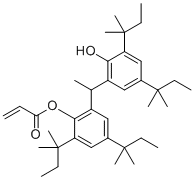 |
| Molecular Formula | C37H56O3 |
| Molecular Weight | 548.84 |
| CAS Registry Number | 123968-25-2 |
| EC Number | 413-850-6 |
| SMILES | CCC(C)(C)C1=CC(=C(C(=C1)C(C)(C)CC)O)C(C)C2=C(C(=CC(=C2)C(C)(C)CC)C(C)(C)CC)OC(=O)C=C |
| Density | 0.969 g/cm3 Calc. |
|---|---|
| Boiling point | 561.942 °C 760 mmHg (Calc.) |
| Flash point | 193.366 °C (Calc.) |
| Index of refraction | 1.512 (Calc.) |
| Hazard Symbols |  GHS07 Warning Details GHS07 Warning Details | ||||||||
|---|---|---|---|---|---|---|---|---|---|
| Risk Statements | H413 Details | ||||||||
| Safety Statements | P273-P501 Details | ||||||||
| Hazard Classification | |||||||||
| |||||||||
 chemBlink Chemical Story
|
Antioxidant GS, also known chemically as octadecyl-3-(3,5-di-tert-butyl-4-hydroxyphenyl)propionate, is a sterically hindered phenolic antioxidant widely used in polymer and materials science for thermal and oxidative stabilization. It belongs to the family of hindered phenols that contain bulky substituents around the phenolic OH group, which enhances the compound's ability to inhibit free radical-mediated degradation while maintaining thermal stability under processing conditions. The compound was developed as part of the search for antioxidants that could effectively stabilize polyolefins, such as polyethylene and polypropylene, during both processing and long-term use. These polymers are particularly susceptible to oxidative degradation due to the presence of tertiary hydrogen atoms, which readily form free radicals when exposed to heat or UV light. Antioxidant GS interrupts the free radical chain reactions that lead to the breakdown of polymer chains by donating hydrogen atoms from its phenolic hydroxyl group, forming a stabilized phenoxyl radical that resists further oxidation. Antioxidant GS is characterized by the presence of a long alkyl chain (octadecyl group) attached via an ester linkage to a 3-(3,5-di-tert-butyl-4-hydroxyphenyl)propionic acid moiety. This structure confers multiple advantageous properties. The long alkyl chain improves the compound's compatibility with non-polar polymer matrices and enhances its resistance to extraction or migration during washing or contact with other materials. The bulky tert-butyl groups protect the reactive phenolic site from premature degradation, thereby extending its stabilizing action over time. The compound is particularly effective in applications requiring long-term stabilization, such as in packaging films, molded plastic parts, pipes, automotive components, and electrical insulation materials. It is often used in conjunction with phosphite or phosphonite secondary antioxidants, which decompose hydroperoxides formed during oxidation, providing a synergistic effect that improves overall stability. In many commercial formulations, Antioxidant GS is blended with other additives including UV absorbers, metal deactivators, and processing stabilizers to provide comprehensive protection during manufacturing and end use. Synthesis of Antioxidant GS typically involves esterification of 3-(3,5-di-tert-butyl-4-hydroxyphenyl)propionic acid with stearyl alcohol under acid-catalyzed conditions. The resulting product is a waxy solid, soluble in organic solvents, and readily dispersible in polymer melt processes. Its non-volatile and non-staining nature makes it ideal for use in clear or light-colored polymer products where appearance is critical. Regulatory assessments have confirmed the safety of Antioxidant GS for use in food-contact plastics under certain conditions, making it suitable for packaging applications. It has low volatility and migration rates, contributing to its preferred status in many durable goods. However, like other synthetic stabilizers, attention has been directed toward understanding its environmental impact, particularly in terms of persistence and bioaccumulation. Despite the ongoing development of more biodegradable and sustainable antioxidant systems, Antioxidant GS remains a benchmark compound for evaluating the performance of new stabilizers. Its combination of high thermal stability, resistance to extraction, and compatibility with various polymers has cemented its role in modern plastic and rubber stabilization technologies. As research continues into more efficient and environmentally friendly stabilizers, the fundamental chemistry embodied by Antioxidant GS continues to guide the design of next-generation materials for long-term durability. |
| Market Analysis Reports |