
Online Database of Chemicals from Around the World
| Wuhan Kemi-works Chemical Co., Ltd. | China | |||
|---|---|---|---|---|
 | www.kemiworks.net | |||
 | +86 (27) 8573-6489 | |||
 | +86 (27) 8573-6485 | |||
 | info@kemiworks.net sales@kemiworks.com | |||
| Chemical manufacturer | ||||
| chemBlink Premium supplier since 2011 | ||||
| Classification | Catalysts and additives >> Antioxidant |
|---|---|
| Name | Antioxidant 425 |
| Synonyms | 2,2'-Methylenebis(4-ethyl-6-tert-butylphenol); 6,6'-Di-tert-butyl-4,4'-diethyl-2,2'-methylenediphenol |
| Molecular Structure | 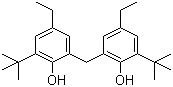 |
| Molecular Formula | C25H36O2 |
| Molecular Weight | 368.55 |
| CAS Registry Number | 88-24-4 |
| EC Number | 201-814-0 |
| SMILES | CCC1=CC(=C(C(=C1)C(C)(C)C)O)CC2=C(C(=CC(=C2)CC)C(C)(C)C)O |
| Density | 1.0±0.1 g/cm3 Calc.* |
|---|---|
| Melting point | 119 - 122 °C (Expl.) |
| Boiling point | 452.1±40.0 °C 760 mmHg (Calc.)* |
| Flash point | 187.5±21.9 °C (Calc.)* |
| Index of refraction | 1.544 (Calc.)* |
| * | Calculated using Advanced Chemistry Development (ACD/Labs) Software. |
| Hazard Symbols |  GHS07 Warning Details GHS07 Warning Details | ||||||||||||||||||||||||||||||||
|---|---|---|---|---|---|---|---|---|---|---|---|---|---|---|---|---|---|---|---|---|---|---|---|---|---|---|---|---|---|---|---|---|---|
| Risk Statements | H315-H319-H335-H413 Details | ||||||||||||||||||||||||||||||||
| Safety Statements | P261-P264-P264+P265-P271-P273-P280-P302+P352-P304+P340-P305+P351+P338-P319-P321-P332+P317-P337+P317-P362+P364-P403+P233-P405-P501 Details | ||||||||||||||||||||||||||||||||
| Hazard Classification | |||||||||||||||||||||||||||||||||
| |||||||||||||||||||||||||||||||||
| SDS | Available | ||||||||||||||||||||||||||||||||
 chemBlink Chemical Story
|
Antioxidant 425, also known by its chemical name octadecyl 3-(3,5-di-tert-butyl-4-hydroxyphenyl)propionate, is a sterically hindered phenolic antioxidant commonly used to protect polymers and organic substrates against oxidative degradation. It is a member of the phenolic ester class of antioxidants, characterized by a long-chain alkyl ester group attached to a substituted hydroxyphenylpropionate moiety. The molecule's design provides a balance between steric hindrance for oxidative resistance and lipophilicity for compatibility with hydrophobic polymer matrices. The antioxidant mechanism of Antioxidant 425 is based on the donation of a hydrogen atom from the phenolic hydroxyl group to neutralize peroxy and alkoxy radicals that are generated during the autoxidation of polymers. This termination of the radical chain reaction prevents the cleavage of polymer chains and formation of cross-linked or degraded structures. The presence of tert-butyl groups at the 3- and 5-positions of the phenol ring enhances the compound’s thermal stability and reduces its susceptibility to further oxidation, ensuring long-lasting antioxidant activity even during high-temperature processing. Antioxidant 425 was developed as an improvement over earlier hindered phenols that suffered from issues such as volatility, poor compatibility with non-polar polymers, and limited resistance to extraction by solvents or migration into surrounding materials. By introducing an octadecyl chain through esterification of the hydroxyphenylpropionic acid, the resulting molecule gained increased molecular weight and hydrophobic character. This modification substantially enhances its retention in polyolefins, rubbers, and synthetic resins, reducing loss during melt processing and improving performance during long-term aging. In application, Antioxidant 425 is extensively used in polyethylene, polypropylene, polybutene, polystyrene, ABS, PVC, and various synthetic elastomers. It is particularly valuable in the stabilization of food packaging, fibers, films, automotive components, and industrial-grade polymer products. Its low volatility and high compatibility make it ideal for extrusion, blow molding, and injection molding processes, where high shear and temperature conditions are typical. This antioxidant is often used in combination with secondary antioxidants, such as phosphite-based additives, to achieve a synergistic effect. While Antioxidant 425 neutralizes free radicals, secondary antioxidants decompose hydroperoxides before they can generate additional radicals. This dual-action strategy provides comprehensive stabilization, protecting polymers during both processing and long-term storage or use. Antioxidant 425 is typically added to polymer formulations at concentrations between 0.05% and 0.5% by weight, depending on the application and the level of oxidative stress expected. It is usually supplied as a white to off-white crystalline powder or waxy solid with good solubility in aliphatic and aromatic hydrocarbons, esters, and chlorinated solvents, but low solubility in water. The synthesis of Antioxidant 425 involves the esterification of 3-(3,5-di-tert-butyl-4-hydroxyphenyl)propionic acid with octadecanol, usually in the presence of acid catalysts under controlled temperature conditions. The resulting ester linkage is robust, and the overall structure is designed to resist hydrolysis and oxidative cleavage under typical use conditions. Owing to its low toxicity and high efficiency, Antioxidant 425 complies with several regulatory standards for indirect food contact and medical-grade materials. However, its use is subject to local regulations and specific migration limits when used in packaging or contact materials. In summary, Antioxidant 425 is a high-performance primary antioxidant that provides excellent oxidative stability to a wide range of polymeric materials. Its structural features ensure both processing stability and long-term protection, making it a staple in industrial polymer additive formulations. References 1992. Toxicity studies of a synthetic antioxidant, 2,2'-methylenebis (4-ethyl-6-tert-butylphenol) in rats. 1. Acute and subchronic toxicity. The Journal of Toxicological Sciences. DOI: 10.2131/jts.17.135 1996. Chronic oral toxicity of a synthetic antioxidant, 2,2'-methylenebis(4-ethyl-6-tert-butylphenol), in rats. Journal of Applied Toxicology. DOI: 10.1002/(sici)1099-1263(199601)16:1<15::aid-jat288>3.0.co;2-n 2019. Generating the Blood Exposome Database Using a Comprehensive Text Mining and Database Fusion Approach. Environmental Health Perspectives. DOI: 10.1289/ehp4713 |
| Market Analysis Reports |