
Online Database of Chemicals from Around the World
| Wuhan Kemi-works Chemical Co., Ltd. | China | |||
|---|---|---|---|---|
 | www.kemiworks.net | |||
 | +86 (27) 8573-6489 | |||
 | +86 (27) 8573-6485 | |||
 | info@kemiworks.net sales@kemiworks.com | |||
| Chemical manufacturer | ||||
| chemBlink Premium supplier since 2011 | ||||
| Classification | Food additive >> Antioxidants |
|---|---|
| Name | Antioxidant 24 |
| Synonyms | Bis(2,4-di-tert-butylphenyl) pentaerythritol diphosphite; 3,9-Bis(2,4-bis(1,1-dimethylethyl)phenoxy)-2,4,8,10-tetraoxa-3,9-diphosphaspiro(5.5)undecane; ADK Stab PEP 24; Mark PEP 24; Ultranox 626 |
| Molecular Structure | 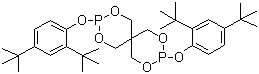 |
| Molecular Formula | C33H50O6P2 |
| Molecular Weight | 604.69 |
| CAS Registry Number | 26741-53-7 |
| EC Number | 247-952-5 |
| SMILES | CC(C)(C)C1=CC(=C(C=C1)OP2OCC3(CO2)COP(OC3)OC4=C(C=C(C=C4)C(C)(C)C)C(C)(C)C)C(C)(C)C |
| Melting point | 160-178 °C (Expl.) |
|---|---|
| Boiling point | 555.8±50.0 °C 760 mmHg (Calc.)* |
| Flash point | 363.9±30.4 °C (Calc.)* |
| * | Calculated using Advanced Chemistry Development (ACD/Labs) Software. |
| Hazard Symbols |   GHS07;GHS09 Warning Details GHS07;GHS09 Warning Details | ||||||||||||||||||||||||||||||||||||||||||||||||
|---|---|---|---|---|---|---|---|---|---|---|---|---|---|---|---|---|---|---|---|---|---|---|---|---|---|---|---|---|---|---|---|---|---|---|---|---|---|---|---|---|---|---|---|---|---|---|---|---|---|
| Risk Statements | H315-H319-H335-H410 Details | ||||||||||||||||||||||||||||||||||||||||||||||||
| Safety Statements | P261-P264-P264+P265-P271-P273-P280-P302+P352-P304+P340-P305+P351+P338-P319-P321-P332+P317-P337+P317-P362+P364-P391-P403+P233-P405-P501 Details | ||||||||||||||||||||||||||||||||||||||||||||||||
| Hazard Classification | |||||||||||||||||||||||||||||||||||||||||||||||||
| |||||||||||||||||||||||||||||||||||||||||||||||||
| SDS | Available | ||||||||||||||||||||||||||||||||||||||||||||||||
 chemBlink Chemical Story
|
Antioxidant 24, chemically known as phosphorous acid, cyclic neopentanetetrayl bis(2,4-di-tert-butylphenyl) ester, is a high-performance organophosphite antioxidant widely used to protect polymers during processing and long-term service. Although it is rarely visible to consumers, compounds of this type have played a crucial role in extending the lifetime of modern plastics. Their scientific importance lies not in becoming part of the final product, but in preventing the chemical reactions that gradually destroy polymer materials during manufacturing and use. The rapid expansion of the plastics industry after the Second World War created a new challenge. Polymers such as polyethylene, polypropylene, and engineering plastics offered excellent mechanical properties and low production costs, but they were vulnerable to oxidation. Heat, oxygen, ultraviolet light, and mechanical stress could generate free radicals within polymer chains, initiating a self-propagating degradation process. As oxidation progressed, plastics became discolored, brittle, and mechanically weaker, limiting both product performance and service life. Early stabilization strategies relied mainly on phenolic antioxidants, which effectively interrupted free-radical chain reactions by donating hydrogen atoms to reactive radical species. While highly successful, these primary antioxidants could not completely prevent degradation during high-temperature polymer processing. Researchers therefore sought complementary stabilizers capable of destroying hydroperoxides before they decomposed into additional radicals. This search led to the development of organophosphite antioxidants, establishing a second major class of polymer stabilizers. Antioxidant 24 belongs to this family of secondary antioxidants. Rather than directly scavenging free radicals, organophosphites react rapidly with hydroperoxides formed during polymer oxidation, converting them into more stable products before extensive chain degradation can occur. Because primary phenolic antioxidants and secondary phosphite antioxidants operate through different mechanisms, they are frequently used together, producing synergistic stabilization that is considerably more effective than either additive alone. This principle has become one of the foundations of modern polymer stabilization technology. The molecular design of Antioxidant 24 reflects decades of research into balancing stability and reactivity. Its bulky 2,4-di-tert-butylphenyl groups protect the phosphorus center from premature hydrolysis while maintaining sufficient chemical activity to decompose hydroperoxides efficiently during polymer processing. The cyclic phosphite structure further contributes to thermal stability, making the compound particularly suitable for demanding applications involving elevated processing temperatures. Such stabilizers have become indispensable in the manufacture of polypropylene, polyethylene, engineering plastics, synthetic fibers, films, pipes, automotive components, electrical insulation, and countless consumer products. Without antioxidant systems, many polymer products would suffer rapid degradation during extrusion, injection molding, or long-term outdoor exposure. Although present only in very small quantities, these additives have a disproportionate influence on product durability, appearance, and reliability. The evolution of polymer antioxidants also reflects a broader shift in materials science. Modern polymer development no longer focuses solely on creating new polymers but also on designing sophisticated additive systems that preserve material performance throughout an entire product lifecycle. Antioxidants, light stabilizers, UV absorbers, flame retardants, and processing aids together form an integrated approach to materials engineering. In this context, Antioxidant 24 represents an important example of how carefully designed molecular additives can significantly improve the performance of bulk materials. The scientific significance of Antioxidant 24 therefore extends beyond its individual chemistry. It illustrates the often-overlooked principle that the durability of modern materials frequently depends not on their major components, but on precisely engineered additives present at concentrations of less than one percent. These invisible molecular protectors quietly extend the lifetime of plastics used in medicine, transportation, construction, electronics, and everyday life, making them essential contributors to modern materials technology. References 1. Zweifel, H. (ed.) Plastics Additives Handbook. 6th ed. Hanser Publishers, 2009. 2. Gugumus, F. (1990). "Processing and Long-Term Thermal Stabilization of Polyolefins." Polymer Degradation and Stability. 3. U.S. Food and Drug Administration (2019). Food Contact Substance Notification No. 1988: Phosphorous acid, cyclic neopentanetetrayl bis(2,4-di-tert-butylphenyl) ester (CAS 26741-53-7). https://www.fda.gov/media/135097/download |
| Market Analysis Reports |