In the realm of organic chemistry, certain compounds stand out not only for their structural elegance but also for their practical utility. One such compound is 3,3-Bis(4-diethylamino-2-ethoxyphenyl)-4-azaphthalide, a chromogenic molecule that has left an indelible mark on the development of recording materials. Belonging to the azaphthalide family, this compound is celebrated for its ability to form vivid colors upon interaction with acidic substances, a property that has fueled its application in pressure- and heat-sensitive recording technologies since its discovery in the late 20th century.
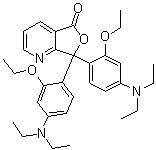
The discovery of 3,3-Bis(4-diethylamino-2-ethoxyphenyl)-4-azaphthalide emerged from efforts to enhance the performance of color-forming agents used in copying and recording systems. Researchers at Yamamoto Chemicals, Inc., building on earlier work with phthalide derivatives like Crystal Violet Lactone, sought to create a compound with improved solubility, stability, and color intensity. By the mid-1980s, they synthesized this novel azaphthalide, incorporating a pyridine ring (the "aza" component) into the phthalide backbone and attaching two 4-diethylamino-2-ethoxyphenyl groups at the 3-position. This structural innovation, patented in 1988, resulted in a molecule with superior properties compared to its predecessors, as detailed in early studies on azaphthalide chemistry. The synthesis typically involves reacting a substituted pyridine derivative with diethylamino-ethoxyphenyl intermediates under controlled conditions, yielding a stable, colorless lactone that transforms into a colored species upon protonation.
The compound’s chromogenic mechanism hinges on its lactone ring, which remains closed and colorless in its neutral state. When exposed to an acidic environment—such as that provided by phenolic resins or clay in recording papers—the ring opens, forming a resonance-stabilized cationic dye with intense blue-green hues. This pH-dependent color change, coupled with its high molar absorptivity, made it an ideal candidate for pressure-sensitive copying papers (e.g., carbonless copy paper) and heat-sensitive recording sheets used in fax machines and receipts during the late 20th century. Unlike earlier fluoran dyes, this azaphthalide exhibited enhanced solubility in organic solvents, facilitating its incorporation into microcapsules or coatings, and reduced unwanted color development during preparation, a common issue with prior compounds.
Applications of 3,3-Bis(4-diethylamino-2-ethoxyphenyl)-4-azaphthalide extend beyond traditional recording media. Its stability and vivid color output have been leveraged in the development of security inks, where its reversible color change can serve as an anti-counterfeiting measure. Additionally, its chemical versatility has sparked interest in sensor technology, where it can detect acidic vapors or pH shifts in industrial or environmental monitoring systems. While its commercial prominence peaked during the era of analog documentation, ongoing research explores its potential in modern optoelectronic materials, capitalizing on its photochemical properties.
Despite its advantages, the compound faced challenges, including competition from digital technologies that diminished demand for physical recording media by the early 2000s. Environmental concerns over solvent-based systems also prompted shifts toward greener alternatives. Nevertheless, its discovery marked a significant advancement in chromogenic chemistry, illustrating how molecular design can address practical needs. Today, 3,3-Bis(4-diethylamino-2-ethoxyphenyl)-4-azaphthalide remains a testament to the ingenuity of synthetic chemistry, bridging the gap between molecular structure and real-world utility.
|




 GHS08 Warning Details
 chemBlink Chemical Story