
Online Database of Chemicals from Around the World
| Fenhe Chemical Co., Ltd. | China | |||
|---|---|---|---|---|
 | www.fenhechem.com | |||
 | +86 (021) 3392-6068 | |||
 | julius.wei@fenhechem.com | |||
| Chemical manufacturer since 1997 | ||||
| chemBlink Standard supplier since 2024 | ||||
| Classification | Organic raw materials >> Organic phosphine compound |
|---|---|
| Name | Tris(2-chloroethyl) phosphite |
| Molecular Structure | 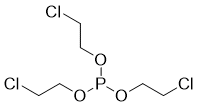 |
| Molecular Formula | C6H12Cl3O3P |
| Molecular Weight | 269.49 |
| CAS Registry Number | 140-08-9 |
| EC Number | 205-397-6 |
| SMILES | C(CCl)OP(OCCCl)OCCCl |
| Boiling point | 125-135 °C (7 mmHg) |
|---|---|
| Refraction index | 1.487 |
| Flash point | 139 °C |
| Hazard Symbols |    GHS06;GHS07;GHS08 Danger Details GHS06;GHS07;GHS08 Danger Details | ||||||||||||||||||||||||||||||||||||||||||||
|---|---|---|---|---|---|---|---|---|---|---|---|---|---|---|---|---|---|---|---|---|---|---|---|---|---|---|---|---|---|---|---|---|---|---|---|---|---|---|---|---|---|---|---|---|---|
| Risk Statements | H301+H311-H301-H311-H312-H315-H319-H300-H335-H340-H350 Details | ||||||||||||||||||||||||||||||||||||||||||||
| Safety Statements | P203-P260-P261-P262-P264-P264+P265-P270-P271-P280-P284-P301+P316-P302+P352-P304+P340-P305+P351+P338-P316-P317-P318-P319-P320-P321-P330-P332+P317-P337+P317-P361+P364-P362+P364-P403+P233-P405-P501 Details | ||||||||||||||||||||||||||||||||||||||||||||
| Hazard Classification | |||||||||||||||||||||||||||||||||||||||||||||
| |||||||||||||||||||||||||||||||||||||||||||||
| SDS | Available | ||||||||||||||||||||||||||||||||||||||||||||
 chemBlink Chemical Story
|
Tris(2-chloroethyl) phosphite is an organophosphorus compound that has garnered attention for its utility in various industrial and chemical applications. This chemical substance, with the molecular formula C6H12Cl3O3P, is primarily recognized for its role as an intermediate in the synthesis of other chemicals, particularly in the production of flame retardants and plasticizers. The discovery of tris(2-chloroethyl) phosphite dates back to the mid-20th century when the need for more effective flame-retardant chemicals became increasingly important. During this period, researchers were exploring various phosphorus-containing compounds for their potential to inhibit the combustion process. Tris(2-chloroethyl) phosphite emerged as a promising candidate due to its ability to release phosphorus-containing radicals upon decomposition, which are known to interfere with the flame propagation mechanism. One of the primary applications of tris(2-chloroethyl) phosphite is in the manufacture of flame retardants. It is used as a precursor to tris(2-chloroethyl) phosphate (TCEP), a well-known flame retardant additive used in polymers and resins. TCEP is added to materials like polyurethane foam, textiles, and plastics to enhance their resistance to ignition and slow the spread of fire. The use of tris(2-chloroethyl) phosphite in this context is critical because it provides the necessary phosphorus content that contributes to the flame-retardant properties of the final product. In addition to its role in flame retardants, tris(2-chloroethyl) phosphite is also employed in the synthesis of plasticizers. Plasticizers are additives that increase the flexibility and workability of polymers, making them more suitable for various applications. The inclusion of tris(2-chloroethyl) phosphite in the production of plasticizers allows for the creation of materials with improved mechanical properties, which are essential in industries ranging from automotive to consumer goods. The chemical also finds use as an intermediate in the synthesis of other organophosphorus compounds. Its reactivity and ability to undergo various chemical transformations make it a valuable building block in organic synthesis, particularly in the creation of compounds with specialized functions in both industrial and research settings. Despite its usefulness, the handling and use of tris(2-chloroethyl) phosphite require careful consideration due to its potential hazards. The compound is classified as a hazardous material, primarily due to its toxicity and the presence of reactive chlorine atoms. Proper safety protocols, including the use of protective equipment and appropriate storage conditions, are essential when working with this chemical to minimize the risk of exposure and ensure safe handling. In summary, tris(2-chloroethyl) phosphite is a significant organophosphorus compound with applications in the production of flame retardants, plasticizers, and other specialized chemicals. Its discovery and subsequent use in these areas underscore the importance of phosphorus-containing compounds in modern industrial processes. However, its handling necessitates strict adherence to safety guidelines to mitigate potential risks associated with its use. References 2010. Nonacarbonyl-1κ3C,2κ3C,3κ3C-μ-bis(diphenylarsino)methane-1:2κ2As:As'-[tris(2-chloroethyl) phosphite-3κP]-triangulo-triruthenium(0). Acta crystallographica. Section E, Structure reports online. DOI: 10.1107/s1600536810026267 2023. Chiral 2-Oxo-1,4,2-oxazaphosphorinanes: Synthesis, Structure, and Applications (A Review). Russian Journal of General Chemistry. DOI: 10.1134/s1070363223090074 2005. Traffic as a Source of Organophosphorus Flame Retardants and Plasticizers in Snow. Environmental Science & Technology. DOI: 10.1021/es0482177 |
| Market Analysis Reports |