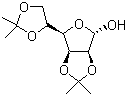
Diaceton-alpha-D-mannofuranose is a protected carbohydrate derivative obtained from D-mannose through acetonide formation. It is commonly described as 1,2:5,6-di-O-isopropylidene-α-D-mannofuranose, indicating that two isopropylidene groups protect pairs of hydroxyl functions on the sugar framework. The compound has the molecular formula C12H20O6 and is typically isolated as a crystalline solid. Its development is closely linked to the evolution of carbohydrate chemistry, particularly the need for selective protection of hydroxyl groups during structural and synthetic studies.
The chemistry of D-mannose was intensively investigated in the late 19th and early 20th centuries as part of broader efforts to elucidate the stereochemistry of sugars. Emil Fischer and contemporaries established the configurations of many aldoses and demonstrated methods for interconversion and derivatization. As synthetic carbohydrate chemistry advanced, chemists recognized that direct reactions of unprotected sugars were often complicated by the presence of multiple hydroxyl groups with similar reactivity. This led to the introduction of protecting groups, including acetonides formed by reaction with acetone under acidic conditions.
The preparation of diaceton-alpha-D-mannofuranose involves treatment of D-mannose with acetone in the presence of an acid catalyst. Under controlled conditions, two cyclic ketals are formed between acetone and pairs of vicinal hydroxyl groups, typically at the 1,2- and 5,6-positions. The reaction favors the furanose form of the sugar, resulting in a five-membered ring structure. The resulting acetonide groups stabilize the molecule and significantly alter its solubility and reactivity compared with the parent monosaccharide. Structural assignments have been confirmed through methods such as optical rotation measurement, infrared spectroscopy, and nuclear magnetic resonance spectroscopy, which demonstrate the presence of isopropylidene moieties and the retention of the alpha configuration at the anomeric center.
Diaceton-alpha-D-mannofuranose has played an important role as an intermediate in carbohydrate synthesis. By masking selected hydroxyl groups, it allows chemists to carry out regioselective transformations at unprotected positions. For example, controlled oxidation, reduction, or substitution reactions can be performed at specific sites, after which the protecting groups can be removed under acidic conditions to regenerate hydroxyl functions. This strategy has been widely applied in the preparation of complex oligosaccharides and other sugar derivatives.
The introduction of acetonide protection represented a significant methodological advance in organic chemistry. It provided a reversible and relatively stable means of controlling reactivity, facilitating systematic exploration of sugar structure and reactivity. In the case of mannose derivatives, protected intermediates such as diaceton-alpha-D-mannofuranose have been used to investigate stereochemical relationships among hexoses and to synthesize rare sugars and biologically relevant compounds.
Beyond its utility in synthesis, diaceton-alpha-D-mannofuranose has served as a model compound in studies of carbohydrate conformation. The presence of rigid cyclic ketal groups influences ring puckering and intramolecular interactions. Crystallographic analyses and spectroscopic investigations have provided information on bond lengths, angles, and preferred conformations in protected furanose systems. Such data have contributed to the broader understanding of how substitution patterns affect the three-dimensional structure of sugars.
The compound also illustrates the broader principle that temporary modification of functional groups can enable complex multistep synthesis. The reversible nature of acetonide formation allows selective protection and deprotection sequences that are fundamental to modern carbohydrate chemistry. These methodologies, refined over decades of experimental work, have been essential in the synthesis of natural products, glycosides, and pharmaceutical intermediates.
From its origins in early explorations of sugar stereochemistry to its established role as a versatile protected intermediate, diaceton-alpha-D-mannofuranose exemplifies the practical impact of protecting-group chemistry. Its preparation, structural characterization, and application in regioselective synthesis are grounded in well-documented experimental studies, and it remains a representative example of controlled functional group manipulation in carbohydrate research.
References
2010. A simple and convenient synthetic protocol for O-isopropylidenation of sugars using bromodimethylsulfonium bromide (BDMS) as a catalyst. Carbohydrate Research.
DOI: 10.1016/j.carres.2009.09.017
|




 GHS07 Warning Details
 chemBlink Chemical Story