Online Database of Chemicals from Around the World

Dexmedetomidine hydrochloride
[CAS# 145108-58-3]

List of Suppliers
Capot Chemical Co., Ltd. China Inquire
www.capotchem.com
+86 (571) 8558-6718
+86 13336195806
+86 (571) 8586-4795
capotchem@gmail.com
sales@capotchem.com
QQ Chat
Chemical manufacturer
chemBlink Standard supplier since 2006
Highpharm Medchem (Ningbo) Co., Ltd. China Inquire
www.highpharm.com
+86 (574) 5566-3958
+86 (574) 5566-3960
highpharm@highpharm.com
lisayang925@hotmail.com
QQ Chat
Chemical manufacturer
chemBlink Standard supplier since 2007
Jinan Chenghui-Shuangda Chemical Co., Ltd. China Inquire
www.jnchsd.com
+86 (531) 5889-7051
+86 15053146086
+86 (531) 5889-7093
jnchsd@qq.com
QQ Chat
Chemical manufacturer since 2002
chemBlink Standard supplier since 2007
Hefei TNJ Chemical Industry Co., Ltd. China Inquire
www.tnjchem.com
+86 (551) 6541-8684
+86 (551) 6541-8697
sales@tnjchem.com
Chemical manufacturer since 2001
chemBlink Standard supplier since 2010
Shandong Chengchuang Pharmaceutical Technology Development Co., Ltd. China Inquire
www.ccmed.cn
+86 (531) 5889-7091
+86 (531) 5889-7092
ccyychem@163.com
Chemical manufacturer since 1999
chemBlink Standard supplier since 2010
BOC Sciences USA Inquire
www.bocsci.com
+1 (631) 485-4226
+1 (631) 614-7828
info@bocsci.com
Chemical manufacturer
chemBlink Standard supplier since 2010
Shanghai Hohance Chemical Co., Ltd. China Inquire
www.hohance.com
+86 (21) 3111-5312
+86 (21) 3111-5317
info@hohance.com
Chemical manufacturer
chemBlink Standard supplier since 2011
Qingdao Xinnuo Pharmaceutical Chemical Co., Ltd. China Inquire
www.xinnuopharma.com
+86 (531) 6656-1050
+86 18615688656
+86 18653156686
+86 (531) 6656-1050
sales@xinnuopharma.com
QQ Chat
Skype Chat
Chemical manufacturer since 2013
chemBlink Standard supplier since 2014
Hangzhou Leap Chem Co., Ltd. China Inquire
www.leapchem.com
+86 (571) 8771-1850
market19@leapchem.com
QQ Chat
Chemical manufacturer since 2006
chemBlink Standard supplier since 2015
Amadis Chemical Co., Ltd. China Inquire
www.amadischem.com
+86 (571) 8992-5085
+86 (571) 8992-5065
sales@amadischem.com
Chemical manufacturer since 2010
chemBlink Standard supplier since 2015
Jinan Yufeng Bioengineering Co., Ltd. China Inquire
www.yufengpharm.com
+86 (531) 8313-0528
+86 (531) 8313-0526
sales@yufengpharm.com
Chemical manufacturer since 2012
chemBlink Standard supplier since 2015
Sichuan Benepure Pharmaceutical Co., Ltd. China Inquire
www.benepure.com
+86 (28) 8679-9990
+86 (28) 8679-9924
tony.ye@benepure.com
Chemical manufacturer since 2004
chemBlink Standard supplier since 2017
Tecoland Corporation USA Inquire
www.tecoland.com
+1 (732) 603-9577
+1 (732) 906-1522
info@tecoland.com
Chemical distributor since 2001
chemBlink Standard supplier since 2019
Zhejiang Boxiao Biopharmaceutical Co., Ltd. China Inquire
www.bx-biopharm.com
+86 (571) 6328-0982
helena_huang@bx-biopharm.com
QQ Chat
Chemical manufacturer since 2020
chemBlink Standard supplier since 2023
Shandong Chenghui Shuangda Pharmaceutical Co., Ltd. China Inquire
www.chsdpharma.com
+86-531-58897029
ericqiao@jnchsd.com
QQ Chat
WeChat: 15550412551
WhatsApp:15550412551
Chemical manufacturer since 2014
chemBlink Standard supplier since 2025
W & J PharmaChem, Inc. USA Inquire
www.wjpharmachem.com
+1 (301) 880-0624
+1 (301) 434-9366
info@wjpharmachem.com
Chemical manufacturer
Santa Cruz Biotechnology, Inc. USA Inquire
www.scbt.com
+1 (831) 457-3800
+1 (831) 457-3801
scbt@scbt.com
Chemical manufacturer
Dalton Pharma Services Canada Inquire
www.dalton.com
+1 (416) 661-2102
+1 (416) 661-2108
chemist@dalton.com
Chemical manufacturer

Identification
ClassificationBiochemical >> Inhibitor >> Neuronal signaling >> Adrenergic receptor agonist
NameDexmedetomidine hydrochloride
Synonyms4-((S)-alpha,2,3-Trimethylbenzyl)imidazole monohydrochloride; 4-[(1R)-1-(2,3-Dimethylphenyl)ethyl]-3H-imidazole hydrochloride
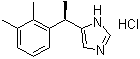
Molecular StructureCAS # 145108-58-3, Dexmedetomidine hydrochloride
Molecular FormulaC13H16N2.HCl
Molecular Weight236.74
CAS Registry Number145108-58-3
EC Number682-047-2
SMILESCC1=C(C(=CC=C1)[C@H](C)C2=CN=CN2)C.Cl
Safety Data
Hazard Symbolssymbol   GHS07 Warning  Details
Risk StatementsH302-H315-H319-H335  Details
Safety StatementsP261-P264-P264+P265-P270-P271-P280-P301+P317-P302+P352-P304+P340-P305+P351+P338-P319-P321-P330-P332+P317-P337+P317-P362+P364-P403+P233-P405-P501  Details
Hazard Classification
up    Details
HazardClassCategory CodeHazard Statement
Skin irritationSkin Irrit.2H315
Eye irritationEye Irrit.2H319
Acute toxicityAcute Tox.4H302
Specific target organ toxicity - single exposureSTOT SE3H335
Acute toxicityAcute Tox.2H330
Acute toxicityAcute Tox.2H300
Reproductive toxicityRepr.2H361
Specific target organ toxicity - single exposureSTOT SE3H336
Acute hazardous to the aquatic environmentAquatic Acute1H400
Reproductive toxicityLact.-H362
Chronic hazardous to the aquatic environmentAquatic Chronic1H410
Specific target organ toxicity - repeated exposureSTOT RE1H372
Specific target organ toxicity - single exposureSTOT SE1H370
Eye irritationEye Irrit.2AH319
Acute toxicityAcute Tox.3H311
Acute toxicityAcute Tox.3H301
SDSAvailable
up Discovery and Applications
Dexmedetomidine hydrochloride is a highly selective α2-adrenergic receptor agonist used in clinical anesthesia and intensive care medicine for its sedative, anxiolytic, and analgesic-sparing properties. It is a hydrochloride salt form of dexmedetomidine, developed as a more refined alternative to earlier α2-agonists such as clonidine. Its discovery and clinical introduction marked a significant advancement in the ability to provide conscious sedation without substantial respiratory depression.

Dexmedetomidine was initially synthesized in the 1980s as part of a pharmacological search for agents with more selective α2-adrenoceptor activity. Its development was led by Orion Pharma and Abbott Laboratories (now AbbVie), and the compound received U.S. Food and Drug Administration (FDA) approval in 1999 under the trade name Precedex for the sedation of initially intubated and mechanically ventilated patients during treatment in an intensive care setting.

Unlike other sedatives such as benzodiazepines or propofol, dexmedetomidine induces a sedative state that closely resembles natural sleep. Its action is primarily mediated through activation of α2-adrenergic receptors in the locus coeruleus of the brainstem, resulting in inhibition of norepinephrine release and reduced sympathetic activity. This produces sedation and analgesia while preserving respiratory function, which is a key advantage in various clinical scenarios.

Dexmedetomidine is used in several applications. In intensive care units (ICUs), it is administered by continuous intravenous infusion for sedation of mechanically ventilated patients. It is also approved for procedural sedation of non-intubated patients, such as during minor surgical or diagnostic procedures. Additionally, it has been employed off-label in pediatric sedation, awake fiberoptic intubation, and as an adjunct to general anesthesia due to its opioid-sparing and anesthetic-sparing effects.

The pharmacokinetics of dexmedetomidine support its use as an infusion-based agent. It has a distribution half-life of approximately 6 minutes and a terminal elimination half-life of around 2 hours. The drug is metabolized in the liver through direct glucuronidation and cytochrome P450-mediated oxidation, with metabolites excreted primarily via the kidneys.

In clinical trials and practice, dexmedetomidine has demonstrated a favorable safety profile. Common adverse effects include hypotension, bradycardia, and dry mouth. These effects are related to its sympatholytic mechanism and are dose-dependent. While generally well tolerated, careful titration and monitoring are necessary, especially in patients with underlying cardiovascular conditions.

The utility of dexmedetomidine has expanded globally, with approvals and guidelines for its use across various countries. In surgical settings, it is often employed to reduce the need for opioids, improve hemodynamic stability, and facilitate smooth recovery from anesthesia. It is also used in palliative care and for the management of agitation in critically ill patients.

Dexmedetomidine has also been studied in veterinary medicine for sedation and analgesia in dogs and cats, where it exhibits similar pharmacodynamic effects. In these contexts, it is used either alone or in combination with other anesthetic agents for premedication and procedural sedation.

In summary, dexmedetomidine hydrochloride is a selective α2-adrenergic receptor agonist widely used for sedation in intensive care and procedural settings. Its ability to provide sedation without respiratory depression, along with analgesic and anxiolytic properties, makes it a versatile agent in both human and veterinary medicine. Its development represents a significant advance in sedative pharmacology and continues to influence clinical sedation practices

References

2010. High concentrations of dexmedetomidine inhibit compound action potentials in frog sciatic nerves without α2 adrenoceptor activation. British Journal of Pharmacology, 160(7).
DOI: 10.1111/j.1476-5381.2010.00833.x

2012. CYP2A6 genetic variation and dexmedetomidine disposition. European Journal of Clinical Pharmacology, 68(6).
DOI: 10.1007/s00228-011-1208-z

2024. Dexmedetomidine Attenuated Neuron Death, Cognitive Decline, and Anxiety-Like Behavior by Inhibiting CXCL2 in CA1 Region of AD Mice. Drug Design, Development and Therapy, 18.
DOI: 10.2147/dddt.s489860
Market Analysis Reports
List of Reports Available for Dexmedetomidine hydrochloride
Related Products
Dexclamol Hydro...  Dexelvucitabine  Dexfenfluramine...  Dexibuprofen ly...  Dexindoprofen  Dexivacaine  Dexketoprofen t...  Dexlofexidine  Dexloxiglumide  Dexmedetomidine  Dexnafenodone  Dexormaplatin  Dexoxadrol  Dexoxadrol  Dexpanthenol  Dexpanthenol  Dexpemedolac  Dexpramipexole ...  Dexpropranolol ...  Dexproxibutene