
Online Database of Chemicals from Around the World
| Zhejiang Metallurgical Research Institute Co., Ltd. | China | |||
|---|---|---|---|---|
 | www.pgmcatalyst.com | |||
 | +86 (571) 8817-8133 +86 (578) 814-5985 | |||
 | +86 (578) 814-5986 | |||
 | xk@pgmcatalyst.com scm@pgmcatalyst.com ylq@pgmcatalyst.com | |||
| Chemical manufacturer since 1958 | ||||
| chemBlink Standard supplier since 2008 | ||||
| Simagchem Corporation | China | |||
|---|---|---|---|---|
| www.simagchem.com | |||
| +86 13806087780 | |||
| +86 (592) 268-0237 | |||
| sale@simagchem.com | |||
| Chemical manufacturer since 2002 | ||||
| chemBlink Standard supplier since 2008 | ||||
| Auspai Pty Lty | Australia | |||
|---|---|---|---|---|
| www.auspai.com.au | |||
| +61 (426) 886-972 | |||
| frankquy@gmail.com | |||
| Chemical distributor since 2013 | ||||
| chemBlink Standard supplier since 2013 | ||||
| Wu Han Taiyu Kaishang Technology Co., Ltd. | China | |||
|---|---|---|---|---|
| www.taiyuchem.com | |||
| +86 13657232893 | |||
| 13657232893@163.com | |||
 | WhatsApp:+86 13657232893 | |||
| Chemical manufacturer since 2018 | ||||
| chemBlink Standard supplier since 2025 | ||||
| ChemPur GmbH | Germany | |||
|---|---|---|---|---|
| www.chempur.de | |||
| +49 (721) 933-840 | |||
| +49 (721) 47-2001 | |||
| info@chempur.de | |||
| Chemical manufacturer | ||||
| Strem Chemicals, Inc. | USA | |||
|---|---|---|---|---|
| www.strem.com | |||
| +1 (978) 499-1600 | |||
| +1 (978) 465-3104 | |||
| info@strem.com | |||
| Chemical manufacturer | ||||
| Colonial Metals, Inc. | USA | |||
|---|---|---|---|---|
| www.colonialmetals.com | |||
| +1 (410) 398-7200 (800) 962-1537 | |||
| +1 (410) 398-2918 | |||
| sales@colonialmetals.com | |||
| Chemical manufacturer | ||||
| Classification | Organic raw materials >> Organometallic compound >> Organic palladium |
|---|---|
| Name | Bis(triphenylphosphinepalladium) acetate |
| Synonyms | Diacetatobis(triphenylphosphine)palladium (II); Pd(OAc)2(PPh3)2 |
| Molecular Structure | 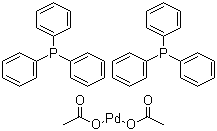 |
| Molecular Formula | C40H36O4P2Pd |
| Molecular Weight | 749.09 |
| CAS Registry Number | 14588-08-0 |
| EC Number | 238-628-4 |
| SMILES | CC(=O)O.CC(=O)O.C1=CC=C(C=C1)P(C2=CC=CC=C2)C3=CC=CC=C3.C1=CC=C(C=C1)P(C2=CC=CC=C2)C3=CC=CC=C3.[Pd] |
| Melting point | 136 °C (decomp.) (Expl.) |
|---|---|
| Hazard Symbols |  GHS07 Warning Details GHS07 Warning Details |
|---|---|
| Risk Statements | H315-H319-H335 Details |
| Safety Statements | P261-P305+P351+P338 Details |
| SDS | Available |
 chemBlink Chemical Story
|
Bis(triphenylphosphine)palladium(II) acetate, often abbreviated as Pd(PPh3)2AcO, is a widely used palladium complex in organic chemistry, particularly for its role in catalysis. It is a coordination compound consisting of a palladium(II) center bound to two triphenylphosphine (PPh3) ligands and an acetate (AcO) group. This complex is a member of the larger family of palladium(II) complexes and plays a critical role in a variety of catalytic reactions, especially those involving cross-coupling and other carbon-carbon bond-forming processes. The discovery of Pd(PPh3)2AcO was part of the broader development of palladium catalysis in the 20th century. Researchers discovered that palladium complexes with phosphine ligands could catalyze a wide range of organic reactions, including important reactions like the Heck reaction, Suzuki coupling, and Stille coupling. The use of triphenylphosphine as a ligand in these complexes provided both electronic and steric advantages, helping to stabilize the palladium center and control the reaction pathway. One of the most notable applications of Pd(PPh3)2AcO is in cross-coupling reactions, particularly the Suzuki-Miyaura and Heck reactions. In the Suzuki reaction, this palladium complex is used to catalyze the coupling of aryl or vinyl boronic acids with halides to form biaryl compounds, which are important in pharmaceuticals, agrochemicals, and materials science. In the Heck reaction, Pd(PPh3)2AcO is employed to couple an aryl halide with an alkene, forming substituted alkenes, which are valuable intermediates in the production of a variety of organic compounds. The use of bis(triphenylphosphine)palladium acetate in these reactions has several advantages. The triphenylphosphine ligands provide stability to the palladium center and allow for greater control over the reactivity of the catalyst. Additionally, the acetate group can help facilitate the activation of the palladium species, making it more effective in catalyzing the desired reactions. This has made Pd(PPh3)2AcO an essential catalyst for both academic research and industrial applications in synthetic organic chemistry. Pd(PPh3)2AcO is also valued for its ability to promote reactions under relatively mild conditions, which reduces the need for harsh reagents or extreme temperatures. This property is particularly important when working with sensitive substrates that might be prone to degradation under more aggressive reaction conditions. Furthermore, the catalyst is highly efficient, often enabling reactions to be completed with low catalyst loadings, which is beneficial for both cost-effectiveness and environmental sustainability. The palladium complex is widely used in the synthesis of complex organic molecules, particularly those containing multiple aromatic rings, which are common in pharmaceuticals and natural products. Pd(PPh3)2AcO is also used in the preparation of materials such as polymers and liquid crystals, where the formation of conjugated systems through cross-coupling reactions is required. Moreover, this catalyst has played an important role in the development of novel synthetic methodologies, contributing to the advancement of green chemistry. Its ability to catalyze reactions with high efficiency and selectivity allows for the reduction of waste and the use of more sustainable reagents, aligning with the principles of green chemistry. In summary, bis(triphenylphosphine)palladium acetate is a highly versatile and effective catalyst with important applications in organic synthesis, particularly in cross-coupling reactions such as the Suzuki and Heck reactions. Its discovery and development have had a lasting impact on synthetic chemistry, enabling the efficient and selective formation of carbon-carbon bonds, which are central to the production of pharmaceuticals, materials, and other fine chemicals. References 2014. ortho-Metallated triphenylphosphine chalcogenide complexes of platinum and palladium: synthesis and catalytic activity. Dalton Transactions, 43(31). DOI: 10.1039/C4DT01236D 2019. Base-Free Suzuki-Miyaura Coupling Reaction Using Palladium(II) Supported Catalyst in Water. Catalysis Letters, 149(5). DOI: 10.1007/s10562-019-02723-9 2021. Sesquicentennial birth anniversary of carbazole, a multifaceted wonder molecule: a revisit to its synthesis, photophysical and biological studies. Journal of the Iranian Chemical Society, 18(12). DOI: 10.1007/s13738-021-02444-0 |
| Market Analysis Reports |