
Online Database of Chemicals from Around the World
| Chizhou Dongsheng Pharmaceutical Co., Ltd. | China | |||
|---|---|---|---|---|
 | www.dspharmchem.com | |||
 | +86 (576) 8429-2571 | |||
 | +86 (576) 8429-2560 | |||
 | ksz@dspharmchem.com | |||
| Chemical manufacturer since 1995 | ||||
| chemBlink Premium supplier since 2011 | ||||
| Classification | Biochemical >> Inhibitor >> G protein coupled receptor(GPCR & G Protein) >> Endothelin receptor antagonist |
|---|---|
| Name | Bosentan |
| Synonyms | N-[6-(2-Hydroxyethoxy)-5-(2-methoxyphenoxy)-2-pyrimidin-2-yl-pyrimidin-4-yl]-4-tert-butyl-benzenesulfonamide |
| Molecular Structure | 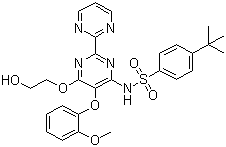 |
| Molecular Formula | C27H29N5O6S |
| Molecular Weight | 551.61 |
| CAS Registry Number | 147536-97-8 |
| EC Number | 643-099-1 |
| SMILES | CC(C)(C)C1=CC=C(C=C1)S(=O)(=O)NC2=C(C(=NC(=N2)C3=NC=CC=N3)OCCO)OC4=CC=CC=C4OC |
| Solubility | 10 mM (DMSO) |
|---|---|
| Hazard Symbols |   GHS07;GHS08 Danger Details GHS07;GHS08 Danger Details | ||||||||||||||||||||||||
|---|---|---|---|---|---|---|---|---|---|---|---|---|---|---|---|---|---|---|---|---|---|---|---|---|---|
| Risk Statements | H302-H360-H361-H412 Details | ||||||||||||||||||||||||
| Safety Statements | P203-P264-P270-P273-P280-P301+P317-P318-P330-P405-P501 Details | ||||||||||||||||||||||||
| Hazard Classification | |||||||||||||||||||||||||
| |||||||||||||||||||||||||
| SDS | Available | ||||||||||||||||||||||||
 chemBlink Chemical Story
|
Bosentan is an orally active dual endothelin receptor antagonist, widely recognized for its application in the treatment of pulmonary arterial hypertension (PAH). The discovery of bosentan emerged from research into the endothelin pathway, a critical system involved in regulating blood vessel constriction and blood pressure. Endothelin-1, a potent vasoconstrictor, was identified as a major contributor to elevated blood pressure in patients with PAH. Bosentan was developed to counteract this effect by inhibiting the endothelin-1 receptors, ETA and ETB, which play significant roles in the pathophysiology of PAH. The chemical structure of bosentan is characterized by a sulfonamide group, a bipyrimidine core, and a diaryl heterocyclic system. These structural features contribute to its selective inhibition of both ETA and ETB receptors. By blocking these receptors, bosentan effectively reduces vasoconstriction and abnormal cell proliferation in the pulmonary arteries, which are key factors in the progression of PAH. This dual receptor blockade is particularly important, as the ETA receptor primarily mediates vasoconstriction and proliferation, while the ETB receptor helps clear endothelin-1 from circulation. Bosentan was first approved for medical use in 2001, becoming the first endothelin receptor antagonist to be marketed for PAH. It is administered orally, making it convenient for patients requiring long-term therapy. The drug has demonstrated efficacy in improving exercise capacity, reducing symptoms, and slowing the progression of the disease. Its success in managing PAH has led to its inclusion in treatment guidelines and its use as a standard therapy for patients with WHO Functional Class II-IV symptoms of PAH. Beyond PAH, bosentan has also been investigated for its potential applications in other conditions involving endothelial dysfunction and vascular diseases. It has shown promise in treating systemic sclerosis, a condition characterized by fibrosis and vascular abnormalities, as well as in preventing complications related to chronic heart failure. However, these applications are still under investigation, and further clinical studies are needed to establish its effectiveness in these areas. While bosentan is an effective treatment for PAH, it is associated with certain side effects, the most notable being liver toxicity. Elevated liver enzymes have been observed in some patients, necessitating regular monitoring of liver function during treatment. Other common side effects include headaches, edema, and flushing. These risks, however, are often outweighed by the benefits, particularly in patients with advanced PAH where treatment options are limited. Bosentan has also provided valuable insights into the endothelin pathway and its broader implications for cardiovascular diseases. The development of bosentan not only represented a significant advancement in the management of PAH but also opened the door for further research into endothelin receptor antagonists as therapeutic agents for other cardiovascular and pulmonary conditions. References 2007. Treatment of patients with Eisenmenger's syndrome with Bosentan. Cardiology in the Young, 17, 2. DOI: 10.1017/s1047951107000522 2007. Management of Pulmonary Arterial Hypertension With a Focus on Combination Therapies. The Journal of heart and lung transplantation : the official publication of the International Society for Heart Transplantation, 26, 5. DOI: 10.1016/j.healun.2007.01.035 2003. Effects of the oral endothelin-receptor antagonist bosentan on echocardiographic and doppler measures in patients with pulmonary arterial hypertension. Journal of the American College of Cardiology, 41, 10. DOI: 10.1016/s0735-1097(03)00121-9 |
| Market Analysis Reports |