
Online Database of Chemicals from Around the World
| Cn Chemunion Co., Ltd. | China | |||
|---|---|---|---|---|
 | www.cnchemunion.com | |||
 | +86 17366116869 | |||
 | david@cnchemunion.com | |||
 | QQ Chat | |||
 | WeChat: +86 15250069576 | |||
 | WhatsApp:+86 17366116869 | |||
| Chemical manufacturer since 2019 | ||||
| chemBlink Standard supplier since 2024 | ||||
| Classification | Flavors and spices >> Synthetic spice >> Lactone and oxygen-containing heterocyclic compound >> Thiazole, thiophene and pyridine |
|---|---|
| Name | Bisdisulizole disodium |
| Synonyms | disodium;6-sulfo-2-[4-(6-sulfo-4-sulfonato-1H-benzimidazol-2-yl)phenyl]-1H-benzimidazole-4-sulfonate |
| Molecular Structure | 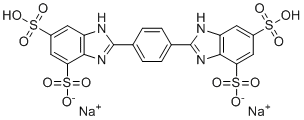 |
| Molecular Formula | C20H12N4Na2O12S4 |
| Molecular Weight | 674.57 |
| CAS Registry Number | 180898-37-7 |
| EC Number | 429-750-0 |
| SMILES | C1=CC(=CC=C1C2=NC3=C(N2)C=C(C=C3S(=O)(=O)[O-])S(=O)(=O)O)C4=NC5=C(N4)C=C(C=C5S(=O)(=O)[O-])S(=O)(=O)O.[Na+].[Na+] |
| Hazard Symbols |  GHS07 Warning Details GHS07 Warning Details |
|---|---|
| Risk Statements | H315-H319 Details |
| Safety Statements | P264-P280-P302+P352-P337+P313-P305+P351+P338-P362+P364-P332+P313 Details |
| SDS | Available |
 chemBlink Chemical Story
|
Bisdisulizole disodium, also known as disodium phenyl dibenzimidazole tetrasulfonate, is a chemical compound used primarily as an ultraviolet (UV) filter in sunscreens and other cosmetic products. Its discovery was driven by the need to develop effective, broad-spectrum UV filters to protect the skin from harmful UV radiation. Bisdisulizole disodium provides protection against both UVA and UVB rays, which are responsible for skin damage, premature aging, and increasing the risk of skin cancer. The synthesis of bisdisulizole disodium involves the reaction of benzimidazole derivatives with sulfonating agents under controlled conditions to introduce sulfonate groups, which improve the water solubility and overall functionality of the molecule in sunscreen formulations. The compound's structure includes multiple aromatic rings and sulfonate groups, which contribute to its ability to absorb and neutralize UV radiation. Bisdisulizole disodium is notable for its excellent photostability, meaning it does not degrade easily upon exposure to sunlight, maintaining its effectiveness over extended periods. This characteristic makes it a valuable ingredient in long-lasting sunscreen products, particularly those designed for outdoor activities and prolonged sun exposure. Its broad-spectrum protection is another advantage, as it helps prevent a wide range of harmful UV radiation from reaching the skin. In addition to its use in sunscreens, bisdisulizole disodium is also utilized in other cosmetic and personal care products where UV protection is important. These products include facial moisturizers, lip balms, and anti-aging creams. The compound is generally considered safe for use in cosmetics, and it is water-soluble, making it suitable for formulations that require easy rinsing or washing off after application. The growing awareness of the harmful effects of UV radiation has led to an increased demand for effective UV filters like bisdisulizole disodium. Its discovery and application in sun care products have made significant contributions to the field of dermatology and cosmetics, helping to protect skin from the damaging effects of the sun. References 2018. On the Validity of Beer-Lambert Law and its Significance for Sunscreens. Photochemistry and Photobiology. DOI: 10.1111/php.12861 2008. A reversed-phase ion-interaction chromatographic method for in-vitro estimation of the percutaneous absorption of water-soluble UV filters. Analytical and Bioanalytical Chemistry. DOI: 10.1007/s00216-008-2013-0 2006. A liquid chromatography-fluorimetric method for the in vitro estimation of the skin penetration of disodium phenyldibenzimidazole tetrasulfonate from sunscreen formulations through human skin. Analytical and Bioanalytical Chemistry. DOI: 10.1007/s00216-006-0344-2 |
| Market Analysis Reports |