
Online Database of Chemicals from Around the World
| Shanghai T&W Pharmatech Co., Ltd. | China | |||
|---|---|---|---|---|
 | www.trustwe.com | |||
 | +86 (21) 6155-1611 6155-1413 6155-1420 | |||
 | +86 (21) 5067-6805 | |||
 | contact@trustwe.com | |||
| Chemical manufacturer since 2007 | ||||
| chemBlink Standard supplier since 2008 | ||||
| Neostar United (Changzhou) Industrial Co., Ltd. | China | |||
|---|---|---|---|---|
| www.neostarunited.com | |||
| +86 (519) 8555-7386 +86 18015025600 | |||
| +86 (519) 8555-7389 | |||
| marketing1@neostarunited.com | |||
| Chemical distributor since 2014 | ||||
| chemBlink Standard supplier since 2020 | ||||
| Luminescence Technology Corp. | Taiwan | |||
|---|---|---|---|---|
| www.lumtec.com.tw | |||
| +886 (2) 2697-5600 | |||
| +886 (2) 2697-5601 | |||
| sales@lumtec.com.tw | |||
| Chemical manufacturer since 1999 | ||||
| chemBlink Standard supplier since 2024 | ||||
| Xi'an Yuri Solar Co., Ltd. | China | |||
|---|---|---|---|---|
| www.yurisolar.com | |||
| +86 (029) 8110-1199 | |||
| jiaop@yurisolar.com | |||
 | QQ Chat | |||
 | WeChat: plt18092602675 | |||
| Chemical manufacturer since 2007 | ||||
| chemBlink Standard supplier since 2025 | ||||
| Classification | Pharmaceutical intermediate >> OLED material intermediate |
|---|---|
| Name | 4,6-Bis(3,5-di-3-pyridylphenyl)-2-methylpyrimidine |
| Synonyms | B3PyMPM |
| Molecular Structure | 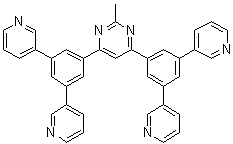 |
| Molecular Formula | C37H26N6 |
| Molecular Weight | 554.64 |
| CAS Registry Number | 925425-96-3 |
| SMILES | CC1=NC(=CC(=N1)C2=CC(=CC(=C2)C3=CN=CC=C3)C4=CN=CC=C4)C5=CC(=CC(=C5)C6=CN=CC=C6)C7=CN=CC=C7 |
| Solubility | Insoluble (2.1E-3 g/L) (25 °C), Calc.* |
|---|---|
| Density | 1.214±0.06 g/cm3 (20 °C 760 Torr), Calc.* |
| Index of Refraction | 1.653, Calc.* |
| Boiling Point | 772.1±55.0 °C (760 mmHg), Calc.* |
| Flash Point | 324.9±24.5 °C, Calc.* |
| * | Calculated using Advanced Chemistry Development (ACD/Labs) Software. |
| Hazard Symbols |  GHS07 Warning Details GHS07 Warning Details |
|---|---|
| Risk Statements | H302-H315-H319-H335 Details |
| Safety Statements | P261-P305+P351+P338 Details |
| SDS | Available |
 chemBlink Chemical Story
|
4,6-Bis(3,5-di-3-pyridylphenyl)-2-methylpyrimidine is a chemical compound that belongs to the class of pyrimidine derivatives. It features a unique structure consisting of a pyrimidine ring substituted with two 3,5-di-3-pyridylphenyl groups at positions 4 and 6, and a methyl group at position 2. This structure provides the compound with distinctive electronic properties, making it an interesting subject of research in various fields, including materials science and coordination chemistry. The discovery of 4,6-bis(3,5-di-3-pyridylphenyl)-2-methylpyrimidine occurred in the early 2000s as part of efforts to design and synthesize new organic materials for optoelectronic applications. Pyrimidine derivatives, particularly those with extended aromatic systems, are known for their ability to participate in charge transport and electronic processes, which makes them suitable candidates for use in organic electronics and optoelectronic devices. The specific arrangement of pyridine and pyrimidine groups in this compound allows for fine-tuning of its electronic properties, which can enhance its performance in various applications. In terms of applications, 4,6-bis(3,5-di-3-pyridylphenyl)-2-methylpyrimidine has been primarily studied for its role in the development of organic light-emitting diodes (OLEDs) and organic photovoltaic cells (OPVs). The compound’s ability to efficiently transport charges and its high stability under operating conditions make it a promising material for use in these devices. OLEDs, which are used in displays and lighting technologies, benefit from the compound’s electronic properties, which can help achieve higher efficiency and improved color rendering. Similarly, in OPVs, the compound’s structure facilitates charge carrier generation and transport, enhancing the overall performance of the solar cells. The pyridine groups in 4,6-bis(3,5-di-3-pyridylphenyl)-2-methylpyrimidine also enable it to act as a ligand in coordination chemistry, particularly in the formation of complexes with transition metals. These metal-ligand complexes are important in catalysis, where they can serve as catalysts for a wide range of chemical reactions, such as organic transformations and energy production processes. The ability to coordinate with metals like copper or nickel makes this compound valuable in the development of new catalysts for industrial processes. Beyond its uses in electronics and catalysis, 4,6-bis(3,5-di-3-pyridylphenyl)-2-methylpyrimidine has been investigated for its potential role in sensing applications. The pyridine groups in its structure can selectively interact with certain metal ions, which makes it useful in detecting and monitoring metal contamination in environmental samples. The compound’s high stability and ability to form strong interactions with target molecules also make it a candidate for the development of sensors for other applications, such as biomedical diagnostics. Research on the compound continues, particularly in the areas of organic electronics and catalysis. Efforts are underway to improve the synthesis and scalability of 4,6-bis(3,5-di-3-pyridylphenyl)-2-methylpyrimidine to make it more commercially viable for industrial use. Additionally, its environmental and biological impacts are being studied to assess its safety and sustainability. In conclusion, 4,6-bis(3,5-di-3-pyridylphenyl)-2-methylpyrimidine is a versatile and promising chemical compound with a wide range of applications. Its electronic properties make it a key material in the fields of organic electronics and photovoltaics, while its ability to coordinate with metals opens up opportunities in catalysis. Further research is expected to unlock additional applications and enhance the compound's practicality for commercial use. References 2024. High-performance single-component white light-emitting diodes based on donor-acceptor integrated carbon nitride. Science China Chemistry, 67(11). DOI: 10.1007/s11426-024-2339-8 2024. NHC-derived carbon-centered luminescent radicals with short-wavelength emission via suppression of Kasha’s rule. Science China Chemistry, 67(6). DOI: 10.1007/s11426-024-2003-0 2022. Heterointerface engineering of perovskite defects and energetics for light-emitting diodes. Nano Research, 15(12). DOI: 10.1007/s12274-022-5204-7 |
| Market Analysis Reports |