
Online Database of Chemicals from Around the World
| wuhan chemi Pharmacy Chemical Technology Co., Ltd. | China | |||
|---|---|---|---|---|
 | www.chemipharm.com.cn | |||
 | +86 13971619949 | |||
 | gmn424@chemipharm.com.cn | |||
 | QQ Chat | |||
 | WeChat: 13971619949 | |||
| Chemical manufacturer since 2014 | ||||
| chemBlink Standard supplier since 2026 | ||||
| Classification | Chemical reagent >> Organic reagent >> Amine salt (ammonium salt) |
|---|---|
| Name | N,N,N-Trimethyl-11-sulfanylundecan-1-aminium bromide |
| Synonyms | trimethyl(11-sulfanylundecyl)azanium bromide |
| Molecular Structure | 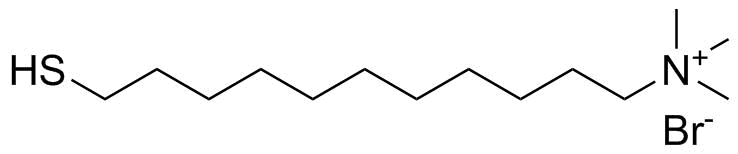 |
| Molecular Formula | C14H32BrNS |
| Molecular Weight | 326.38 |
| CAS Registry Number | 197587-43-2 |
| SMILES | C[N+](C)(C)CCCCCCCCCCCS.[Br-] |
| Melting point | 113 - 118 °C (Expl.) |
|---|---|
| Hazard Symbols |   GHS05;GHS07 Danger Details GHS05;GHS07 Danger Details |
|---|---|
| Risk Statements | H315-H318-H335 Details |
| Safety Statements | P261-P264-P271-P280-P302+P352-P304+P340+P312-P305+P351+P338-P310-P332+P313-P362-P403+P233-P405-P501 Details |
| Transport Information | UN 3335 |
 chemBlink Chemical Story
|
N,N,N-Trimethyl-11-sulfanylundecan-1-aminium bromide is a quaternary ammonium compound containing a long-chain aliphatic backbone terminated with a trimethylammonium group and a terminal thiol functionality. The compound exists as a bromide salt, in which the positively charged quaternary ammonium center is balanced by a bromide anion. Molecules of this type belong to the broader class of functionalized surfactants and organosulfur ammonium salts, which have been widely studied for their interfacial, self-assembly, and surface-modifying properties. The development of quaternary ammonium salts dates back to early studies in organic nitrogen chemistry, where the permanent positive charge on nitrogen was recognized as a key structural feature influencing solubility and surface activity. As surfactant chemistry expanded in the twentieth century, researchers began designing long-chain ammonium compounds with tailored hydrophobic and hydrophilic regions. The incorporation of additional functional groups, such as thiols, emerged later as part of efforts to create multifunctional surfactants capable of further chemical modification or surface binding. In N,N,N-trimethyl-11-sulfanylundecan-1-aminium bromide, the molecular structure consists of an eleven-carbon aliphatic chain linking two chemically distinct functional groups. At one end is the quaternary ammonium group, in which a nitrogen atom is fully substituted with three methyl groups and the alkyl chain, resulting in a permanent positive charge. At the opposite end is a sulfanyl (thiol) group, which is characterized by a sulfur–hydrogen bond and is known for its high reactivity toward oxidation and metal coordination. The presence of both a cationic head group and a terminal thiol functionality gives the compound amphiphilic character. The quaternary ammonium group is strongly hydrophilic due to its ionic nature, while the long hydrocarbon chain contributes hydrophobic character. This duality enables the compound to interact with both aqueous and nonpolar environments, a key feature of surfactant molecules. Quaternary ammonium compounds of this type are commonly used in surface chemistry and materials science. Their cationic nature allows them to adsorb onto negatively charged surfaces such as silica, metals, and certain polymeric materials. The thiol group provides an additional reactive site that can form strong bonds with metal surfaces, particularly gold, silver, and copper, through well-known thiol–metal interactions. This combination of ionic adsorption and covalent or coordinative binding makes such molecules useful in surface functionalization studies. The thiol functionality is also chemically significant because it can undergo oxidation to form disulfides or react with electrophilic species. In synthetic chemistry and materials applications, thiol-terminated molecules are often used as precursors for self-assembled monolayers (SAMs) on metal surfaces. While classical SAM systems frequently employ simple alkanethiols, functionalized variants such as ammonium-terminated thiols allow for the introduction of charged or polar surface properties. The quaternary ammonium group contributes to antimicrobial and surface-active properties commonly associated with cationic surfactants. Although specific biological applications depend on formulation and context, quaternary ammonium salts in general have been widely studied for their ability to interact with microbial membranes due to electrostatic attraction and hydrophobic insertion. However, the compound discussed here is primarily encountered in chemical research contexts rather than as a standardized commercial disinfectant. From a physicochemical standpoint, N,N,N-trimethyl-11-sulfanylundecan-1-aminium bromide is expected to exhibit strong ionic character, high polarity, and significant surface activity. The long hydrocarbon chain supports aggregation behavior such as micelle formation under appropriate conditions, while the charged headgroup ensures solubility in polar media. The thiol group introduces additional chemical reactivity that distinguishes it from simpler quaternary ammonium surfactants. Compounds combining thiol and quaternary ammonium functionalities are of interest in the design of functional interfaces, including sensor surfaces, modified electrodes, and bioactive coatings. The ability to simultaneously engage in electrostatic interactions and covalent or coordinative bonding expands their utility in surface modification strategies and materials functionalization. Overall, N,N,N-trimethyl-11-sulfanylundecan-1-aminium bromide is a multifunctional organosulfur quaternary ammonium salt characterized by a long hydrophobic chain, a permanently charged ammonium headgroup, and a reactive terminal thiol group. Its significance lies in its use as a functional surfactant and surface-modifying agent in chemical and materials research, particularly in applications involving interfacial chemistry, metal surface binding, and the design of functionalized molecular interfaces. References 2025. Principles of Nanosensor Operation. Nanosensors in Biomedical Technology. DOI: 10.1007/978-981-96-6091-9_3 2021. In Vitro Oxidative Crosslinking of Recombinant Barnacle Cyprid Cement Gland Proteins. Marine biotechnology (New York, N.Y.). URL: https://www.ncbi.nlm.nih.gov/pmc/articles/PMC8639568 2021. Comparison of Protein Interaction with Different Shaped PbS Nanoparticles and Corona Formation. Selected Progresses in Modern Physics. DOI: 10.1007/978-981-16-5141-0_6 |
| Market Analysis Reports |