
Online Database of Chemicals from Around the World
| Nanjing Finetech Chemical Co., Ltd. | China | |||
|---|---|---|---|---|
 | www.fine-chemtech.com | |||
 | +86 (25) 5207-8417 +86 17714198479 | |||
 | +86 (25) 5207-8417 | |||
 | sales@fine-chemtech.com | |||
 | QQ Chat | |||
| Chemical manufacturer since 2007 | ||||
| chemBlink Standard supplier since 2007 | ||||
| BOC Sciences | USA | |||
|---|---|---|---|---|
| www.bocsci.com | |||
| +1 (631) 485-4226 | |||
| +1 (631) 614-7828 | |||
| info@bocsci.com | |||
| Chemical manufacturer | ||||
| chemBlink Standard supplier since 2010 | ||||
| Shanghai Rochi Pharmaceutical Co., Ltd. | China | |||
|---|---|---|---|---|
| www.rochipharma.com | |||
| +86 (21) 3875-1876 +86 15000076078 | |||
| +86 (21) 5027-5764 | |||
| info@rochipharma.com | |||
| QQ Chat | |||
| Chemical manufacturer since 2009 | ||||
| chemBlink Standard supplier since 2015 | ||||
| Cangzhou Enke Pharma-tech Co., Ltd. | China | |||
|---|---|---|---|---|
| www.enkepharma.com | |||
| +86 (317) 529-6180 510-6597 +86 15533709196 | |||
| +86 (317) 510-6596 | |||
| sale@enkepharma.com enkepharma@126.com | |||
| QQ Chat | |||
 | Skype Chat | |||
 | WeChat: ymzhao | |||
| Chemical manufacturer since 2011 | ||||
| chemBlink Standard supplier since 2016 | ||||
| Lengshi Chemical (Qingzhou) Co., Ltd. | China | |||
|---|---|---|---|---|
| www.xinnuopharma.cn | |||
| +86 18615688656 | |||
| sales@xinnuopharma.com | |||
| WeChat: 18615688656 | |||
| Chemical distributor since 2024 | ||||
| chemBlink Standard supplier since 2026 | ||||
| Classification | Biochemical >> Inhibitor |
|---|---|
| Name | Baloxavir |
| Synonyms | (12aR)-12-[(11S)-7,8-difluoro-6,11-dihydrodibenzo[b,e]thiepin-11-yl]-7-hydroxy-3,4,12,12a-tetrahydro-1H-[1,4]oxazino[3,4-c]pyrido[2,1-ff][1,2,4]triazine-6,8-dione |
| Molecular Structure | 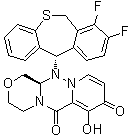 |
| Molecular Formula | C24H19F2N3O4S |
| Molecular Weight | 483.49 |
| CAS Registry Number | 1985605-59-1 |
| SMILES | C1COC[C@@H]2N1C(=O)C3=C(C(=O)C=CN3N2[C@H]4C5=C(CSC6=CC=CC=C46)C(=C(C=C5)F)F)O |
| Solubility | Insoluble (5.3E-3 g/L) (25 °C), Calc.* |
|---|---|
| Density | 1.63±0.1 g/cm3 (20 °C 760 Torr), Calc.* |
| Boiling point | 644.7±65.0 °C 760 mmHg (Calc.)* |
| Flash point | 343.7±34.3 °C (Calc.)* |
| Index of refraction | 1.757 (Calc.)* |
| * | Calculated using Advanced Chemistry Development (ACD/Labs) Software. |
| Hazard Symbols |  GHS07 Warning Details GHS07 Warning Details |
|---|---|
| Risk Statements | H302-H315-H319-H335 Details |
| Safety Statements | P261-P280-P301+P312-P302+P352-P305+P351+P338 Details |
| SDS | Available |
 chemBlink Chemical Story
|
Baloxavir is a synthetic antiviral agent belonging to the class of cap-dependent endonuclease inhibitors. It is designed to target influenza viruses by interfering with a critical step in viral RNA transcription, making it effective against both influenza A and influenza B infections. The development of baloxavir is part of modern antiviral drug discovery efforts focused on identifying non-neuraminidase mechanisms of action for influenza treatment. Traditional anti-influenza agents such as neuraminidase inhibitors block viral release from infected cells, whereas baloxavir acts earlier in the replication cycle. It was developed through structure-guided medicinal chemistry aimed at inhibiting the influenza virus polymerase complex. The molecular target of baloxavir is the cap-dependent endonuclease (CEN) activity located in the PA subunit of the influenza virus RNA polymerase complex. This enzyme is responsible for “cap-snatching,” a process in which the virus cleaves host pre-mRNA to obtain capped RNA fragments that serve as primers for viral mRNA synthesis. By inhibiting this endonuclease activity, baloxavir prevents the synthesis of viral messenger RNA, thereby blocking protein production and viral replication. Baloxavir is administered as a prodrug, baloxavir marboxil, which is rapidly converted in vivo to the active form baloxavir acid after oral administration. The prodrug design improves absorption and pharmacokinetic properties, enabling effective systemic exposure following a single oral dose in many treatment regimens. From a chemical perspective, baloxavir acid contains multiple aromatic and heteroaromatic features arranged in a rigid, polycyclic scaffold. It includes functional groups that facilitate binding to the metal-dependent active site of the viral endonuclease. The drug chelates divalent metal ions, typically magnesium or manganese, present in the enzyme’s catalytic center, thereby inhibiting enzymatic cleavage of host RNA. The discovery of baloxavir was driven by high-throughput screening and subsequent optimization of lead compounds that showed inhibition of influenza polymerase activity. Structural biology techniques, including X-ray crystallography, played a key role in elucidating the binding interactions between the inhibitor and the endonuclease active site, guiding further medicinal chemistry refinement. Clinically, baloxavir is used for the treatment of acute uncomplicated influenza in otherwise healthy individuals and in high-risk populations. One of its notable features is its single-dose oral regimen, which distinguishes it from many other antiviral therapies that require multiple doses over several days. This dosing advantage improves patient compliance and treatment convenience. Resistance to baloxavir can occur through mutations in the viral polymerase gene, particularly in residues associated with the endonuclease active site. These mutations can reduce binding affinity and decrease antiviral efficacy, highlighting the importance of surveillance in clinical use. From a pharmacological standpoint, baloxavir acid exhibits selective activity against influenza virus replication with minimal effect on host cellular enzymes. Its mechanism-based selectivity arises from its targeting of a virus-specific enzymatic function that is absent in human cells. Overall, baloxavir is a modern influenza antiviral agent that inhibits the cap-dependent endonuclease activity of the viral polymerase complex, blocking viral mRNA synthesis and replication. Its significance lies in its novel mechanism of action, oral single-dose administration, and role in expanding therapeutic options beyond traditional neuraminidase inhibitors for influenza treatment. References 2026. Development of Antiviral Drugs for Influenza. Internal medicine (Tokyo, Japan). URL: https://www.ncbi.nlm.nih.gov/pmc/articles/PMC12900603 2025. Global update on the susceptibilities of influenza viruses to neuraminidase inhibitors and the cap-dependent endonuclease inhibitor baloxavir, 2020–2023. Antiviral Research. URL: https://www.ncbi.nlm.nih.gov/pmc/articles/PMC12391581 2018. Baloxavir Marboxil for Uncomplicated Influenza in Adults and Adolescents. The New England journal of medicine. DOI: 10.1056/nejmoa1716197 |
| Market Analysis Reports |