
Online Database of Chemicals from Around the World
| Targetmol China | China | |||
|---|---|---|---|---|
 | www.targetmol.cn | |||
 | +86 (400) 820-0310 | |||
 | sales@targetmol.cn | |||
| Chemical manufacturer since 2015 | ||||
| chemBlink Standard supplier since 2025 | ||||
| Classification | Organic raw materials >> Heterocyclic compound >> Fluorenes |
|---|---|
| Name | 4-Hydroxy-9-fluorenone |
| Molecular Structure | 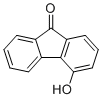 |
| Molecular Formula | C13H8O2 |
| Molecular Weight | 196.20 |
| CAS Registry Number | 1986-00-1 |
| EC Number | 631-553-1 |
| SMILES | C1=CC=C2C(=C1)C3=C(C2=O)C=CC=C3O |
| Density | 1.4±0.1 g/cm3 Calc.* |
|---|---|
| Boiling point | 386.6±11.0 °C 760 mmHg (Calc.)* |
| Flash point | 165.1±11.9 °C (Calc.)* |
| Index of refraction | 1.707 (Calc.)* |
| * | Calculated using Advanced Chemistry Development (ACD/Labs) Software. |
| Hazard Symbols |  GHS07 Warning Details GHS07 Warning Details | ||||||||||||||||
|---|---|---|---|---|---|---|---|---|---|---|---|---|---|---|---|---|---|
| Risk Statements | H315-H319-H335 Details | ||||||||||||||||
| Safety Statements | P261-P264-P264+P265-P271-P280-P302+P352-P304+P340-P305+P351+P338-P319-P321-P332+P317-P337+P317-P362+P364-P403+P233-P405-P501 Details | ||||||||||||||||
| Hazard Classification | |||||||||||||||||
| |||||||||||||||||
| SDS | Available | ||||||||||||||||
 chemBlink Chemical Story
|
4-Hydroxy-9-fluorenone is an aromatic organic compound that belongs to the fluorenone family and features a hydroxy substituent at the 4-position of the fluorenone skeleton. The core fluorenone structure consists of a tricyclic aromatic system with a ketone group at the 9-position, giving it both aromatic and carbonyl reactivity. The hydroxy substitution at the 4-position introduces additional functionality, significantly influencing the compound's electronic and hydrogen bonding properties. This dual reactivity of the carbonyl and phenolic groups has made 4-hydroxy-9-fluorenone valuable in various chemical and biochemical applications. The compound has been synthesized and studied extensively for its potential use in dye chemistry, photochemical studies, and as a synthetic intermediate. Its structure provides a framework suitable for electronic delocalization, making it an effective chromophore in systems where charge transfer and light absorption are relevant. Historically, derivatives of fluorenone, including 4-hydroxy-9-fluorenone, have been investigated for use in fluorescent dyes and as part of molecular scaffolds in materials science, particularly in organic semiconductors and nonlinear optical materials. In the context of synthetic organic chemistry, 4-hydroxy-9-fluorenone serves as a precursor or intermediate in the preparation of more complex fluorenyl compounds. The phenolic hydroxyl group is reactive toward various electrophiles, allowing for etherification, esterification, and other derivatizations. This makes it a useful building block in the synthesis of polymers, ligands, and functionalized fluorenes. Moreover, the carbonyl group at the 9-position can participate in nucleophilic addition and condensation reactions, further enhancing the compound’s versatility. In photophysical research, 4-hydroxy-9-fluorenone has been studied for its excited-state behavior, particularly in hydrogen bonding environments. The compound exhibits interesting excited-state proton transfer (ESPT) properties when dissolved in polar solvents or in the presence of proton-accepting species. These studies help in understanding fundamental aspects of photochemistry and are also relevant to the design of fluorescent probes and sensors. Its ability to engage in intramolecular hydrogen bonding also affects its fluorescence quantum yield and photostability, making it a model system in photochemical investigations. Additionally, 4-hydroxy-9-fluorenone has seen limited exploration in medicinal chemistry as a potential pharmacophore. Its structural motif appears in certain biologically active molecules, and its derivatives have been screened for antibacterial and anticancer properties. However, these applications remain largely exploratory, and more research is needed to fully characterize its pharmacological potential. The commercial availability of 4-hydroxy-9-fluorenone as a chemical reagent has supported its continued use in academic and industrial laboratories. It is typically obtained through hydroxylation of 9-fluorenone, often via electrophilic aromatic substitution under controlled oxidative conditions. Its handling requires standard precautions typical for aromatic ketones and phenols, including appropriate protective equipment and ventilation. Overall, 4-hydroxy-9-fluorenone is a structurally intriguing compound that has found utility across multiple fields of research, including synthetic chemistry, materials science, and photophysics. Its dual functionality and stable aromatic framework provide a platform for both fundamental studies and the development of advanced molecular systems. References 1997. New metabolites in the degradation of fluorene by Arthrobacter sp. strain F101. Applied and Environmental Microbiology, 63(3). DOI: 10.1128/aem.63.3.819-826.1997 2007. Dipole moments studies of fluorenone and 4-hydroxyfluorenone. Spectrochimica Acta Part A: Molecular and Biomolecular Spectroscopy, 67(1). DOI: 10.1016/j.saa.2006.07.019 2021. Molecular mechanisms and biochemical analysis of fluorene degradation by the Pseudomonas sp. SMT-1 strain. 3 Biotech, 11(9). DOI: 10.1007/s13205-021-02946-x |
| Market Analysis Reports |