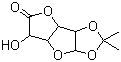
D-Glucurono-6,3-lactone acetonide is a protected derivative of D-glucurono-6,3-lactone, a naturally occurring carbohydrate lactone that is widely distributed in animals and plants. D-glucurono-6,3-lactone, commonly known as glucuronolactone, was identified in the early twentieth century during investigations of carbohydrate oxidation products and uronic acids. Studies on glucuronic acid and its lactone forms were closely connected to research on carbohydrate metabolism, particularly the role of glucuronic acid in detoxification processes in the liver, where it forms conjugates with a wide range of endogenous and exogenous compounds. The structural characterization of glucuronic acid and its lactone derivatives provided an important foundation for later developments in carbohydrate chemistry.
The acetonide derivative of D-glucurono-6,3-lactone was developed as part of the systematic exploration of protecting group strategies in carbohydrate chemistry. During the mid-twentieth century, chemists increasingly adopted isopropylidene groups to protect vicinal diols in sugars. The reaction of acetone with adjacent hydroxyl groups in carbohydrates, typically under acidic conditions, forms a cyclic acetal known as an acetonide. This transformation was widely studied because it allowed selective masking of specific hydroxyl groups while leaving others available for controlled chemical modification. In the case of D-glucurono-6,3-lactone, formation of the acetonide stabilizes two neighboring hydroxyl functions and facilitates further synthetic manipulation without disrupting the lactone ring under appropriate conditions.
The preparation of D-glucurono-6,3-lactone acetonide follows established carbohydrate protection procedures. Treatment of the parent lactone with acetone in the presence of an acid catalyst leads to the formation of the isopropylidene acetal. This strategy reflects general principles developed in carbohydrate chemistry to achieve regioselective transformations. The introduction of protecting groups such as acetonides played a crucial role in enabling the stepwise synthesis of complex sugar derivatives, which had previously been limited by the high reactivity and similar chemical behavior of multiple hydroxyl groups within the same molecule.
In practical applications, D-glucurono-6,3-lactone acetonide serves primarily as a synthetic intermediate. It has been employed in the preparation of modified glucuronic acid derivatives, including glycosides and conjugates designed for biochemical or pharmaceutical investigation. The protected lactone framework allows chemists to introduce substituents at defined positions, after which the acetonide group can be removed under controlled acidic conditions to regenerate the corresponding diol. This approach has supported the synthesis of compounds used in studies of carbohydrate metabolism, enzyme specificity, and the structure–activity relationships of glucuronic acid derivatives.
The broader significance of this compound is linked to the central role of glucuronic acid in biological systems. Glucuronic acid conjugation, known as glucuronidation, is a major pathway for the metabolism and excretion of drugs, bilirubin, steroid hormones, and other substances. By providing a protected and chemically versatile derivative of a naturally occurring uronic acid, D-glucurono-6,3-lactone acetonide has facilitated laboratory investigations into these biochemical processes. Its stability under neutral conditions and predictable behavior under acidic deprotection have made it a reliable intermediate in multistep synthetic sequences.
In addition to academic research, protected sugar lactones such as this acetonide have contributed to advances in medicinal chemistry and glycochemistry. The development of synthetic methods based on well-defined protecting group strategies has enabled the preparation of structurally precise carbohydrate derivatives for analytical standards, mechanistic studies, and the exploration of biologically active molecules. Although D-glucurono-6,3-lactone acetonide itself is not typically used as a final product in industrial applications, its role as an enabling intermediate reflects the broader historical progress of carbohydrate chemistry from structural elucidation to controlled molecular design.
References
2017. Efficient Synthesis of N-Alkyl Polyhydroxylated Pipecolamide Compounds from d-Glucurono-6,3-lactone. Synlett.
DOI: 10.1055/s-0036-1590829
|




 GHS07 Warning Details
 chemBlink Chemical Story