
Online Database of Chemicals from Around the World
| Shandong Huimeng Biotech Co., Ltd. | China | |||
|---|---|---|---|---|
 | www.huimengchem.com | |||
 | +86 (530) 884-2888 +86 18523002917 | |||
 | +86 (530) 884-2666 | |||
 | cindy@szgoldenunion.com | |||
| Chemical manufacturer since 2013 | ||||
| chemBlink Standard supplier since 2016 | ||||
| Jiangsu Agro Farm Chemical Co., Ltd. | China | |||
|---|---|---|---|---|
| www.agrofarmchemical.com | |||
| +86 15150222860 | |||
| sales@agrofarmchemical.com | |||
 | QQ Chat | |||
 | Skype Chat | |||
 | WeChat: 15150222860 | |||
 | WhatsApp:+86-15150222860 | |||
| Chemical manufacturer since 2022 | ||||
| chemBlink Standard supplier since 2023 | ||||
| Name | Glufosinate-P |
|---|---|
| Synonyms | (2S)-2-amino-4-[hydroxy(methyl)phosphoryl]butanoic acid |
| Molecular Structure | 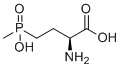 |
| Molecular Formula | C5H12NO4P |
| Molecular Weight | 181.13 |
| CAS Registry Number | 35597-44-5 |
| EC Number | 690-077-2 |
| SMILES | CP(=O)(CC[C@@H](C(=O)O)N)O |
| Solubility | 1 mg/L (25 °C water) |
|---|---|
| Density | 1.4±0.1 g/cm3, Calc.* |
| Index of Refraction | 1.501, Calc.* |
| Melting point | 272.12 °C |
| Boiling Point | 433.91 °C, 519.1±45.0 °C (760 mmHg), Calc.* |
| Flash Point | 267.7±28.7 °C, Calc.* |
| * | Calculated using Advanced Chemistry Development (ACD/Labs) Software. |
| Hazard Symbols |  GHS06 Danger Details GHS06 Danger Details | ||||||||||||
|---|---|---|---|---|---|---|---|---|---|---|---|---|---|
| Risk Statements | H302-H331 Details | ||||||||||||
| Safety Statements | P261-P264-P270-P271-P301+P317-P304+P340-P316-P321-P330-P403+P233-P405-P501 Details | ||||||||||||
| Hazard Classification | |||||||||||||
| |||||||||||||
 chemBlink Chemical Story
|
Glufosinate, also known as phosphinothricin, is a non-selective herbicide widely used in agriculture to control a wide range of weeds. Its chemical structure consists of an analog of L-glutamic acid with a phosphine methyl group. The compound is well known for its effectiveness in weed management and its role in the development of genetically modified (GM) crops. The discovery of glufosinate dates back to the 1970s, when researchers at the German company Hoechst (now part of Bayer) were investigating the potential herbicidal properties of natural products. They found that phosphinothricin is a potent inhibitor of glutamine synthetase, an enzyme that is essential for nitrogen metabolism in plants. By blocking this enzyme, glufosinate causes toxic levels of ammonia to accumulate within plant cells, leading to their death. One of the main applications of glufosinate is in the agricultural sector, where it is used as a broad-spectrum herbicide to control weeds in a variety of crops. It is particularly effective against annual and perennial grasses, broadleaf weeds, and sedges. The herbicide is applied post-emergence, meaning it is sprayed on growing weeds and works through leaf absorption. This property makes it useful for managing weeds that are already present and competing with crops for resources. The development of glufosinate-resistant GM crops has greatly increased its utility. These GM crops, such as LibertyLink soybeans, corn, and cotton, contain a gene that detoxifies glufosinate, allowing farmers to apply the herbicide without damaging the crop. This technology has revolutionized weed management, making weed control more efficient and effective, reducing the need for multiple herbicide applications, and increasing crop yields. In addition to its use on GM crops, glufosinate is also used in orchards, vineyards, and non-crop areas such as roadsides and railroads. Its ability to control a wide range of weeds makes it a versatile tool for maintaining weed-free environments in a variety of environments. In addition, its non-selective nature means that it can be used to clear vegetation in preparation for planting or other land management practices. Glufosinate also plays a role in environmental conservation efforts. It is used to manage invasive plant species that threaten local ecosystems. By effectively controlling these invasive species, glufosinate helps protect biodiversity and maintain the health of natural habitats. While glufosinate is highly effective, its use needs to be carefully managed to minimize potential environmental impacts. It is critical to follow label instructions and use proper application techniques to avoid off-target effects, such as drift to non-target plants or contamination of water supplies. Additionally, an integrated weed management approach that combines chemical, mechanical, and cultural methods is recommended to reduce reliance on herbicides and reduce the risk of weed resistance. The safety of glufosinate has been extensively studied and is considered safe when used according to label instructions. However, as with all pesticides, it is important to use personal protective equipment during handling and application to minimize the risk of exposure. References 2015. Glufosinate-P. Pharmaceutical Substances. URL: https://pharmaceutical-substances.thieme.com/ps/search-results?docUri=KD-07-0023 |
| Market Analysis Reports |