
Online Database of Chemicals from Around the World
| Luminescence Technology Corp. | Taiwan | |||
|---|---|---|---|---|
 | www.lumtec.com.tw | |||
 | +886 (2) 2697-5600 | |||
 | +886 (2) 2697-5601 | |||
 | sales@lumtec.com.tw | |||
| Chemical manufacturer since 1999 | ||||
| chemBlink Standard supplier since 2024 | ||||
| Classification | Organic raw materials >> Organic phosphine compound |
|---|---|
| Name | (2-(9H-Carbazol-9-yl)ethyl)phosphonic acid |
| Synonyms | 2PACZ; 2-carbazol-9-ylethylphosphonic acid |
| Molecular Structure | 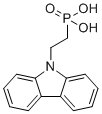 |
| Molecular Formula | C14H14NO3P |
| Molecular Weight | 275.24 |
| CAS Registry Number | 20999-38-6 |
| EC Number | 860-158-9 |
| SMILES | C1=CC=C2C(=C1)C3=CC=CC=C3N2CCP(=O)(O)O |
| Density | 1.4±0.1 g/cm3, Calc.* |
|---|---|
| Index of Refraction | 1.667, Calc.* |
| Boiling Point | 478.6±51.0 °C (760 mmHg), Calc.* |
| Flash Point | 243.2±30.4 °C, Calc.* |
| * | Calculated using Advanced Chemistry Development (ACD/Labs) Software. |
| Hazard Symbols |  GHS07 Warning Details GHS07 Warning Details | ||||||||||||||||
|---|---|---|---|---|---|---|---|---|---|---|---|---|---|---|---|---|---|
| Risk Statements | H315-H319-H335 Details | ||||||||||||||||
| Safety Statements | P261-P264-P264+P265-P271-P280-P302+P352-P304+P340-P305+P351+P338-P319-P321-P332+P317-P337+P317-P362+P364-P403+P233-P405-P501 Details | ||||||||||||||||
| Hazard Classification | |||||||||||||||||
| |||||||||||||||||
| SDS | Available | ||||||||||||||||
 chemBlink Chemical Story
|
(2-(9H-Carbazol-9-yl)ethyl)phosphonic acid is an organophosphonic acid derivative that has garnered attention for its potential applications in the fields of organic electronics and surface modification. This molecule is notable for the combination of the carbazole moiety and the phosphonic acid group, which impart both electronic and adhesive properties. The structure consists of a 9H-carbazole linked to an ethyl chain, which terminates in a phosphonic acid group, providing a versatile functional group for interactions with various substrates. The discovery of (2-(9H-carbazol-9-yl)ethyl)phosphonic acid is rooted in the need for functional materials that can be used to modify surfaces and interfaces in electronic devices. The carbazole unit is well-known for its electron-donating properties, thermal stability, and photoconductive nature. When combined with a phosphonic acid group, the resulting molecule can anchor to metal oxide surfaces, such as indium tin oxide (ITO) or titanium dioxide (TiO₂), commonly used in optoelectronic devices. The synthesis of this compound typically involves a two-step process. In the first step, 9H-carbazole is reacted with 2-bromoethyl derivatives to form an intermediate (2-(9H-carbazol-9-yl)ethyl bromide). This intermediate is then subjected to a reaction with triethyl phosphite under the Arbuzov reaction conditions to yield (2-(9H-carbazol-9-yl)ethyl)phosphonic acid. The final product is purified through recrystallization or column chromatography to ensure high purity. One of the primary applications of (2-(9H-carbazol-9-yl)ethyl)phosphonic acid is in the modification of electrode surfaces in organic light-emitting diodes (OLEDs). When applied to ITO electrodes, the phosphonic acid group forms a self-assembled monolayer (SAM), which enhances the hole-injection efficiency due to the carbazole unit’s electron-donating properties. This surface modification improves the overall performance, stability, and efficiency of OLED devices. The use of this molecule helps reduce the barrier for hole injection, leading to lower operating voltages and longer device lifetimes. In addition to OLEDs, this compound has shown promise in the field of organic photovoltaics (OPVs). The ability to modify metal oxide surfaces with carbazole-based phosphonic acids allows for better control over the interface properties, leading to improved charge transfer and energy level alignment between the active layer and the electrode. This can significantly enhance the efficiency of OPV devices by facilitating charge extraction and minimizing energy losses at the interface. Furthermore, (2-(9H-carbazol-9-yl)ethyl)phosphonic acid is useful for functionalizing semiconductor surfaces in field-effect transistors (FETs). The presence of a stable phosphonic acid group ensures strong binding to metal oxides, while the carbazole group can participate in charge transport processes. This dual functionality makes it an attractive material for tuning the electronic properties of FETs. The potential of (2-(9H-carbazol-9-yl)ethyl)phosphonic acid extends to sensor applications, where its ability to form stable monolayers on various substrates can be utilized for detecting analytes or modifying sensor interfaces. The carbazole moiety can interact with specific molecules, allowing for tailored sensor responses in chemical or biological detection systems. Research into (2-(9H-carbazol-9-yl)ethyl)phosphonic acid continues to explore ways to optimize its synthesis, functionalization, and integration into electronic devices. The combination of robust surface anchoring and favorable electronic properties positions this molecule as a valuable component in the development of next-generation electronic and optoelectronic technologies. References 2024. Self-Assembled Monolayers as Hole-Selective Contacts in Inverted Perovskite Solar Cells: A Review. Korean Journal of Chemical Engineering. DOI: 10.1007/s11814-024-00335-7 2024. Rapid advances enabling high-performance inverted perovskite solar cells. Nature Reviews Materials. DOI: 10.1038/s41578-024-00678-x 2023. Recent Progress in Interfacial Dipole Engineering for Perovskite Solar Cells. Nano-Micro Letters, 15(1). DOI: 10.1007/s40820-023-01131-4 |
| Market Analysis Reports |