
Online Database of Chemicals from Around the World
| Shanghai Worldyang Chemical Co., Ltd. | China | |||
|---|---|---|---|---|
 | www.worldyachem.com | |||
 | +86 13651600618 +86 (21) 5679-5779 | |||
 | +86 (21) 5679-5266 | |||
 | sales7777@worldyachem.com | |||
 | QQ Chat | |||
 | WeChat: 13651600618 | |||
 | WhatsApp:+86 13651600618 | |||
| Chemical manufacturer since 2012 | ||||
| Classification | Organic raw materials >> Aryl compounds |
|---|---|
| Name | 2,2-Bis(3-(3-aminobenzoylamino)-4-hydroxyphenyl)hexafluoropropane |
| Synonyms | 3-amino-N-[5-[2-[3-[(3-aminobenzoyl)amino]-4-hydroxyphenyl]-1,1,1,3,3,3-hexafluoropropan-2-yl]-2-hydroxyphenyl]benzamide |
| Molecular Structure | 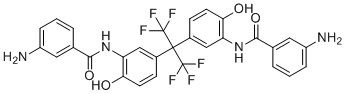 |
| Molecular Formula | C29H22F6N4O4 |
| Molecular Weight | 604.50 |
| CAS Registry Number | 220426-92-6 |
| EC Number | 889-178-6 |
| SMILES | C1=CC(=CC(=C1)N)C(=O)NC2=C(C=CC(=C2)C(C3=CC(=C(C=C3)O)NC(=O)C4=CC(=CC=C4)N)(C(F)(F)F)C(F)(F)F)O |
| Hazard Symbols |  GHS07 Warning Details GHS07 Warning Details | ||||||||||||
|---|---|---|---|---|---|---|---|---|---|---|---|---|---|
| Risk Statements | H315-H319 Details | ||||||||||||
| Safety Statements | P264-P264+P265-P280-P302+P352-P305+P351+P338-P321-P332+P317-P337+P317-P362+P364 Details | ||||||||||||
| Hazard Classification | |||||||||||||
| |||||||||||||
| SDS | Available | ||||||||||||
 chemBlink Chemical Story
|
2,2-Bis(3-(3-aminobenzoylamino)-4-hydroxyphenyl)hexafluoropropane is a synthetic organic compound belonging to the class of bisphenol derivatives. Structurally, it is derived from hexafluoropropane with two pendant phenyl rings, each bearing hydroxyl groups at the 4-position and a substituted amide at the 3-position, specifically a 3-aminobenzoylamino group. The core hexafluoroisopropylidene group provides both steric bulk and strong electron-withdrawing properties, while the presence of multiple aromatic rings, hydroxyl, and amide functionalities contributes to potential hydrogen bonding and other intermolecular interactions. This compound is part of a broader category of bisphenol analogs often designed and studied for their potential use in high-performance materials, including polymers and resins. In particular, bisphenol structures with fluoroalkyl groups and functionalized phenyl rings are of interest for their thermal stability, chemical resistance, and potential biological activity. The incorporation of hexafluoropropane increases hydrophobicity and improves resistance to oxidative degradation, while the hydroxyl and amide groups introduce possibilities for polymerization or conjugation with other molecules. The 3-aminobenzoylamino substitution provides the compound with additional reactive sites. The amino groups can participate in further derivatization, such as urea or imide formation, or in coupling reactions to form extended polymer chains or functionalized biomolecules. Moreover, the hydroxyl groups on the phenyl rings allow for possible inclusion in polycarbonate or epoxy resin formulations through standard condensation reactions, where the compound acts as a monomer or co-monomer with other reactive agents like phosgene or epichlorohydrin. Although this specific compound does not appear as a marketed drug or commercial material, its structure reflects characteristics found in materials developed for biomedical, pharmaceutical, and electronic applications. Bisphenol-based molecules with hydroxyl and amide functionalities have been evaluated for use in drug delivery systems, enzyme inhibitors, and as ligands in medicinal chemistry, owing to their ability to interact with biological macromolecules through hydrogen bonding and π-π interactions. In polymer science, similar bisphenol derivatives have been incorporated into specialty thermoplastics and thermosetting resins used in aerospace, electronics, and membrane technologies. The presence of fluorinated groups contributes to low dielectric constants and high thermal resistance, valuable properties in advanced engineering applications. Synthesis of this compound typically involves a multi-step sequence starting from hexafluoroacetone and phenolic precursors, followed by acylation and amination reactions to introduce the benzoylamino and amino substituents. Each step requires careful control of reaction conditions to preserve functional group integrity and achieve high regioselectivity. In summary, 2,2-bis(3-(3-aminobenzoylamino)-4-hydroxyphenyl)hexafluoropropane is a functionalized bisphenol compound incorporating hydroxyl, amide, and amino groups onto a fluoroalkylated aromatic backbone. While not a commercial product itself, it represents a class of compounds with utility in the development of high-performance materials and bioactive molecules, particularly where thermal stability, reactivity, and molecular recognition properties are required. |
| Market Analysis Reports |